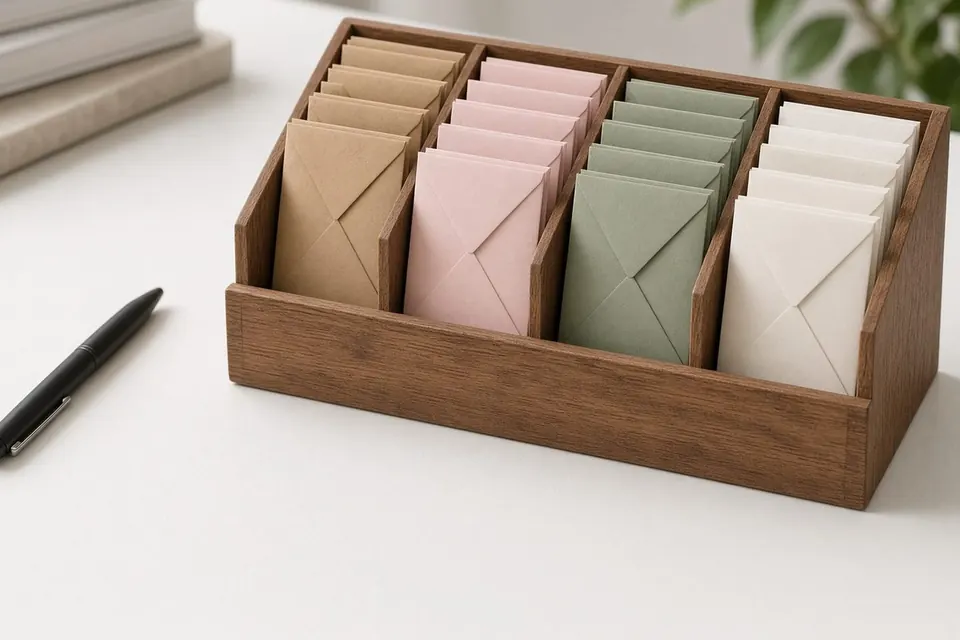
Cash stuffing for beginners comes down to one idea: after the bills that get paid online are covered, the money for everyday spending comes out of the bank as cash and goes into labeled envelopes. Groceries get an envelope. Gas gets an envelope. Eating out gets an envelope. When an envelope is empty, spending in that category stops until the next payday refill.
It's the cash envelope system with a newer name and more color-coded binders on Pinterest and TikTok. The binder is optional; the limit you can see and touch is what makes it work. Below: how to start, which categories to use in month one, how much to put in each envelope, and a sample $3,200 month worked out down to the bills you ask the teller for.
How does cash stuffing work?
Cash stuffing is a way of running the spending part of a budget, not the whole budget. Rent, utilities, insurance, loan payments, and savings transfers still leave your account electronically on their due dates. Those are hard to pay in cash anyway, and mailing cash is a bad idea. What goes into envelopes is the variable spending: the categories where the amount depends on choices you make during the month.
The cycle repeats every payday:
- Your paycheck lands and the fixed bills are scheduled.
- You withdraw one set amount of cash for the envelope categories.
- You split that cash into envelopes using the amounts from your budget.
- You pay for each purchase from its own envelope and keep the receipt or jot the amount on the envelope.
- On the day before the next payday, you count what's left and decide what to do with it.
The reason it helps people who overspend on cards is simple. A card balance is a number on a screen. An envelope with $34 left in it on the 20th is hard to ignore.
How to start cash stuffing in six steps
1. Build the budget first
Envelopes only hold the plan. They can't make one. Start from take-home pay, list the bills that are already committed, and see what's left for variable spending. The monthly budget calculator does that subtraction in your browser, and How to Create a Budget When Money Is Tight walks through the order of operations if the month is short. If you like percentage targets, the 50/30/20 calculator shows one way to split the paycheck, but the envelopes don't require any particular rule.
2. Look at the last two or three months
Pull your bank and card statements and total what you actually spent in each variable category. This is the step most beginners skip, and it's why their first envelopes run dry by the second week. The CFPB's free spending tracker is a one-page worksheet built for exactly this: sort a few weeks of spending by category and add up the totals.
3. Pick three to five envelopes
Fewer envelopes means fewer decisions at the register. Start with the categories where you most often go over, and add more later if you need them. The next section lists the usual choices.
4. Withdraw cash after payday clears
Once the deposit has posted and the scheduled bills are covered, withdraw the envelope total in one trip. Use your own bank's ATM or the teller window so you don't pay out-of-network ATM fees. Ask for smaller bills: $20s, $10s, $5s, and some $1s make it possible to fill each envelope to the dollar.
5. Stuff the envelopes and write the amount on the front
Write the category, the amount, and the pay period dates on each envelope. Plain office envelopes work fine; a zipper binder is optional.
6. Spend from the envelope and track as you go
Take only the envelope you need on each trip, so a lost wallet costs one category, not the whole month. Write each purchase on the back of the envelope or drop the receipt inside.
Cash stuffing categories for beginners
Good envelope categories have three things in common: you pay for them in person, the amount changes month to month, and you have some control over it. Here are the common ones, with a note on what belongs inside.
| Envelope | What it covers | Good first envelope? |
|---|---|---|
| Groceries | Food and drinks bought to eat at home | Yes, usually the biggest one |
| Gas | Fuel paid inside the station | Yes, if you drive to work |
| Eating out | Restaurants, takeout, coffee runs, work lunches | Yes, a common place to overspend |
| Household | Toiletries, cleaning supplies, paper goods | Yes |
| Fun money | Anything you want, no explanation needed | Yes, keeps the plan livable |
| Personal care | Haircuts, cosmetics, over-the-counter items | Later |
| Kids | School fees, activities, small clothing purchases | Later, if it applies |
| Pets | Food, litter, treats | Later, if it applies |
| Gifts | Birthdays and small occasions | Later, or as a sinking fund |
| Buffer | Small things that fit no other envelope | Yes, keep it small |
Keep out of the envelopes: rent or mortgage, utilities, insurance, debt payments, subscriptions, and anything you buy online. Those have their own lines in the budget and get paid from checking. The free bill organizer is a good place to list them with their due dates so they don't get forgotten while your attention is on the envelopes.
How much cash should go in each envelope?
Start from what you actually spent, not from what you wish you spent. Take the two or three months you pulled in step 2, average each category, and round up to a number you can fill with your bills. Then trim one or two categories a little, not all of them at once.
For a sense of scale, the Bureau of Labor Statistics found the average US household spent $6,224 on food at home in 2024, about $519 a month, plus $3,945 on food away from home. That's an average across all household sizes and incomes, so it's context, not a target. Your own statements are the better guide. For ideas on bringing the grocery envelope down without going hungry, see 25 Realistic Ways to Save Money on Groceries.
A sample cash stuffing budget for one month
Here is an illustrated month, not a real household. Take-home pay is $3,200, paid biweekly as two $1,600 checks. The fixed bills come out electronically: rent $1,250, utilities $180, phone $60, car insurance $120, and minimum debt payments of $150, plus a $100 automatic transfer to savings. That's $1,860, which leaves $1,340.
| Envelope | Monthly amount | Each payday |
|---|---|---|
| Groceries | $480 | $240 |
| Gas | $160 | $80 |
| Eating out | $80 | $40 |
| Fun money | $80 | $40 |
| Household | $70 | $35 |
| Buffer | $50 | $25 |
| Personal care | $40 | $20 |
| Total cash | $960 | $480 |
That leaves $380 of the $1,340. In this example, $200 goes to sinking funds kept in a savings account ($75 for car repairs, $75 for holidays and gifts, $50 for medical copays) and the last $180 goes toward debt or the emergency fund. Add it up: $1,860 + $960 + $200 + $180 = $3,200. Every dollar has a job, and only $960 of it ever becomes paper.
On each payday, the withdrawal is $480. Asking for 18 twenties ($360), 6 tens ($60), 10 fives ($50), and 10 ones ($10) gives exactly $480 in bills small enough to fill every envelope to the dollar.
How to start cash stuffing with no money to spare
You don't need extra money to start. Cash stuffing doesn't add spending; it moves money you'd already spend on groceries and gas from a card into an envelope. If you live paycheck to paycheck, the envelopes show a short week coming days ahead instead of at the register.
- Start with one envelope for one pay period. Groceries is the usual choice. If it holds, add gas or eating out next time.
- Don't withdraw cash that's needed for a bill that hasn't cleared yet. An overdraft fee wipes out whatever the envelope saved.
- Use the buffer envelope for the small surprises. Without one, people borrow from groceries and the plan falls apart by the 20th.
- If the math doesn't work even before the envelopes, the problem is the budget, not the method. The tight-month guide is the place to start.
What to do with leftover cash at the end of the month
Decide the rule before the first payday, so it isn't decided by whatever you feel like buying on the last day. Three options work:
- Roll it over. Leftover grocery money stays in the grocery envelope, and next payday you add less. This is the simplest rule for categories that bounce around.
- Deposit it. Count all the leftovers and put them in savings. Many cash stuffers turn this into a savings challenge; the 30-day savings challenge shows how small flat amounts add up.
- Point it at a goal. Send leftovers to a starter emergency fund or an extra debt payment. The debt avalanche vs snowball guide explains which balance to aim it at.
Cash stuffing vs sinking funds
The two get mixed up because they often live in the same binder, but they do different jobs. Cash envelopes hold money you plan to spend during this pay period. A sinking fund holds money you're saving for a known bill months away, like a $600 car insurance premium or holiday gifts in December.
A small sinking fund in an envelope is fine. Once a fund passes a couple hundred dollars, it's safer in a savings account. FDIC deposit insurance covers money in deposit accounts at insured banks, up to $250,000 per depositor, per ownership category, at each bank. Cash in a binder at home has no such protection if it's lost, stolen, or damaged.
Is cash stuffing a good idea?
For people who overspend in a few everyday categories, it can be. There's research behind the idea that paying with cash feels different. In a 2001 study published in Marketing Letters, MIT researchers Drazen Prelec and Duncan Simester found that people were willing to pay more, in some cases up to twice as much, when told to pay by credit card rather than cash. It was a small set of experiments, so it doesn't prove envelopes will cut your grocery bill by any set amount, but it fits what many people notice: a card makes spending easier to forget.
It also has real downsides:
- Cash use keeps shrinking. In the Federal Reserve Bank of Atlanta's 2025 Survey and Diary of Consumer Payment Choice, cash was 14 percent of consumer payments, and 81 percent of consumers had paid with cash in the prior 30 days, down from 83 percent in 2024. Most stores still take cash, but some don't, and online purchases never do.
- You give up card protections and rewards on those purchases, such as fraud protection and cash back.
- Lost cash is gone. Keep only the current pay period's envelopes at home.
- ATM trips and fees add friction. One withdrawal per paycheck at your own bank keeps that small.
- It doesn't fix a budget that doesn't balance. If the bills alone exceed income, envelopes just show the gap more clearly.
Can you do the cash envelope system without cash?
Yes. The envelope idea works with any tool that shows a separate balance per category. Some options:
- A spreadsheet or paper sheet with one column per envelope. Start each column at the budgeted amount and subtract each purchase. The one-page budget printable has room for this.
- Savings sub-accounts or buckets, if your bank offers them, moving each envelope's money to checking only when you're about to spend it.
- A hybrid: real cash for the one or two categories where you overspend, and a tracked card for everything else.
Common cash stuffing mistakes to avoid
- Too many envelopes. Fifteen categories in month one is how people quit in month two. Start with three to five.
- Stuffing cash for bills that get paid online. It just means a second trip to the bank to deposit it again.
- Silent borrowing between envelopes. Moving $20 from fun money to groceries is fine if you write it down. Doing it without noticing means the budget no longer matches reality.
- Keeping large sums at home. Sinking funds and emergency savings belong in an insured account.
- Never checking the results. Count the envelopes on the last day of each period and adjust next month's amounts.
Your first month, step by step
- Fill in take-home pay and fixed bills on the monthly budget checklist.
- Average two or three months of spending for each variable category.
- Pick three to five envelopes and set the amounts.
- Withdraw the cash once per paycheck, in small bills.
- Write every purchase on the envelope.
- Count, write down, and decide on leftovers before the next payday.
- Adjust the amounts once, then run a second month before judging the method.
More free worksheets are in the budget printables section. If you'd like to see how fast your leftover envelope money could reach a savings target, try the savings goal calculator.
Questions readers ask
What is cash stuffing?
Cash stuffing is a budgeting method where you withdraw the money for everyday spending as cash and divide it into envelopes labeled by category, such as groceries, gas, and eating out. You spend only what's in each envelope until the next payday.
Is cash stuffing the same as the cash envelope system?
Yes. Cash stuffing is the newer, social media name for the envelope system. The method is the same.
How many envelopes should a beginner start with?
Three to five. Groceries, gas, eating out, household, and a small buffer cover most people's everyday spending. Add more only after a month or two.
How much cash should I put in each envelope?
Average what you actually spent in that category over the last two or three months and start there. Trim one or two categories slightly once you see how the first month goes.
Should I pay bills with cash stuffing?
No. Rent, utilities, insurance, debt payments, and subscriptions are easier and safer to pay electronically from checking. Envelopes are for variable, in-person spending.
Is it safe to keep cash at home?
Keep only the current pay period's envelope cash at home. Cash isn't covered by FDIC deposit insurance, so larger amounts such as sinking funds and emergency savings belong in an insured bank or credit union account.
Sources
- Federal Reserve Bank of Atlanta, 2025 Survey and Diary of Consumer Payment Choice: Summary ResultsCash was 14 percent of consumer payments in October 2025; 81 percent of consumers paid with cash in the prior 30 days, down from 83 percent in 2024.
- US Bureau of Labor Statistics, Consumer Expenditures 2024 (news release, December 19, 2025)Average consumer unit spent $6,224 on food at home and $3,945 on food away from home in 2024.
- Drazen Prelec and Duncan Simester, Always Leave Home Without It: A Further Investigation of the Credit-Card Effect on Willingness to Pay, Marketing Letters (2001)Willingness to pay rose, by up to 100 percent in their studies, when participants were told to pay by credit card instead of cash.
- FDIC, Understanding Deposit InsuranceDeposit insurance covers deposit accounts at FDIC-insured banks, up to $250,000 per depositor, per ownership category, per bank.
- Consumer Financial Protection Bureau, Spending tracker (Your Money, Your Goals)Free worksheet for sorting a few weeks of spending into categories and totaling each one.
SaveNests Editorial Desk
The SaveNests Editorial Desk writes practical explainers for US households. Drafts are researched from public sources such as the Bureau of Labor Statistics, the Federal Reserve, the Consumer Financial Protection Bureau, the FDIC, and the IRS. The desk is not a registered investment adviser, certified financial planner, certified public accountant, or law firm, and it does not provide personal financial advice.
Free printable
Get the free Starter Budget Kit
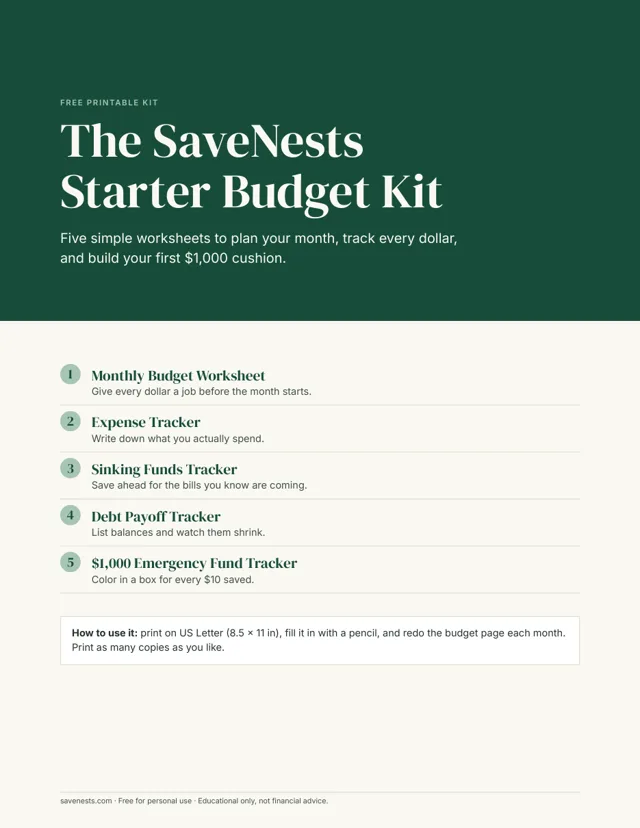
A 6-page printable PDF: monthly budget worksheet, expense tracker, sinking funds tracker, debt payoff tracker, and a $1,000 emergency fund tracker. Join the SaveNests letter to get it, plus an occasional note when a new guide is ready. Unsubscribe any time.