Budgeting
Budget Categories List: 84 Categories to Track in 2027
A complete budget categories list: 84 categories in 15 groups, what the average household spends in each (BLS 2025), forgotten categories, and how to set amounts.
Category
A budget is a plan for the money you already have coming in. It is not a personality test, and it is not a promise that a template will fix a rent bill that is larger than your paycheck.
These guides start from take-home pay, bills that are already committed, and food. They treat popular rules — including 50/30/20 — as tools you can discard when they do not fit the month you are actually living.
Nothing here is individualized financial, tax, or legal advice. Worked examples are labeled illustrations, not real households and not results you should expect.

13 guides · page 1 of 3
Budgeting
A complete budget categories list: 84 categories in 15 groups, what the average household spends in each (BLS 2025), forgotten categories, and how to set amounts.

Budgeting
Break the paycheck-to-paycheck cycle: track spending, build a bare-bones budget, start a $500–$1,000 buffer, and automate savings—with Fed and FDIC data.

Budgeting
Budget irregular income from your lowest recent months. Fund bills from that base, then assign surplus to buffer, taxes, debt, and sinking funds.
Budgeting
How to budget for 2027 in seven steps: start from take-home pay, plan for 3.7% inflation and yearly bills, and set goals with official 2027 limits.

Budgeting
Stop overspending without a strict ban: track a few weeks, fix the three categories that matter, give fun money a number, and try a 48-hour pause rule.
Budgeting
Make a Black Friday budget: set a cash cap, write a needs list with target prices, check price history, weigh card and BNPL risk, and see a $450 plan.
Free for subscribers
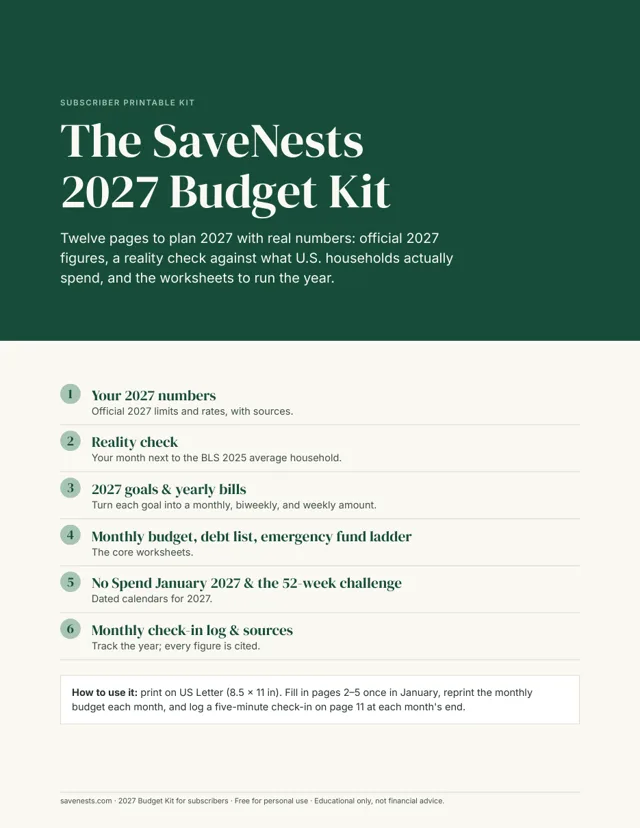
A 12-page printable PDF: official 2027 numbers (HSA limits, the 3.6% COLA), your month next to the BLS average household, goals and yearly bills, a monthly budget, a debt list, an emergency fund ladder, a No Spend January 2027 calendar, and dated 52-week challenge charts. Every figure is cited.
Free printable
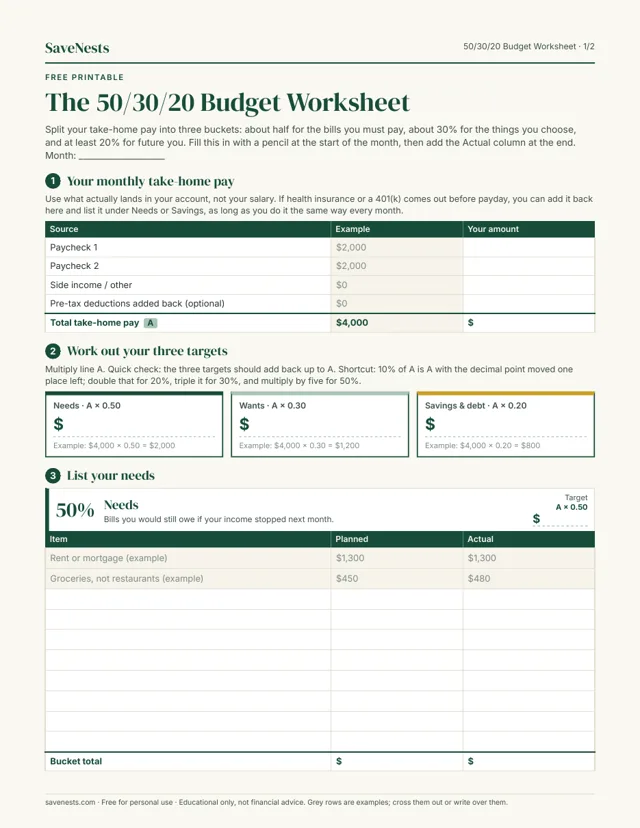
A 2-page PDF for US Letter paper: work out your take-home pay, multiply it into the three targets, list your needs, wants, and savings, and end the month with a short check-in. Worked examples are included.
You'll join the SaveNests email letter: an occasional note when a new guide or printable is ready. No spam, and you can unsubscribe in one click. See our privacy policy.
You don't need an app, a spreadsheet, or a perfect month to start. You need four numbers: the money that will arrive before your next payday, the bills already due, what you'll spend on food, and what it costs to get to work. Write those down and subtract. Whatever is left, or whatever you're short, is your starting point. How to Create a Budget When Money Is Tight walks through that order step by step, with a worked example.
If you'd rather have a framework, the 50/30/20 rule splits take-home pay into needs, wants, and savings. It works well when there's some room in the month and badly when rent takes half your pay. The 50/30/20 calculator shows your split in a few seconds so you can see which kind of month you're in.
The best budgeting method is the one you'll still be using in March. Some people like to see every dollar on a screen. Others do better when spending money is physical; cash stuffing uses labeled envelopes so you can see a category running low. If you'd rather write things down, the one-page budget printable and the monthly budget checklist take about twenty minutes on payday.
Whichever method you choose, plan for the bills that don't show up every month. Car registration, annual subscriptions, and holiday gifts are what usually break a new budget. A sinking fund spreads each one into a small monthly amount. Budgeting for a household with kids? How to Budget for a Family of Four covers two paychecks, groceries for four, and childcare.
The monthly budget calculator subtracts your bills from take-home pay, and the savings goal calculator shows how long a goal takes at a given monthly amount. Both run in your browser and don't save what you type. When you're ready to cut spending, 25 realistic ways to save on groceries is a good place to start, because food is one of the few big bills you can change this week.
Write down the take-home pay arriving before your next payday, subtract bills due in that window, then subtract food and transportation. What's left is the money you get to plan. Repeat every payday.
Take-home pay. Taxes, insurance, and payroll retirement contributions come out before you see the money, so a budget built on gross pay is short from the start.
It's a useful benchmark if your needs fit in about half your take-home pay. If they don't, a line-by-line budget built from your real bills works better.
Most people need two or three months for the plan to match reality. The first month shows which categories you underestimated; adjust them and keep going.