
Most new-year budgets fail for a boring reason: they're written from memory. You guess at groceries, forget the car registration, copy last January's gas line, and by February the numbers have nothing to do with your bank account. The fix isn't a better app. It's starting from what actually happened, then planning for what you already know is coming in 2027.
This is the process I'd use to build a 2027 budget from scratch. It takes about an hour, works on paper or in a spreadsheet, and doesn't require you to pick a budgeting philosophy first. Every number I cite comes from an official source, and the full list of 2027 figures is on our 2027 budget numbers page.
What's different about budgeting for 2027
Three things make a copy-and-paste budget riskier than usual this year. First, prices: the Consumer Price Index rose 3.7 percent over the 12 months to September 2026, and gasoline rose 34.2 percent, according to the Bureau of Labor Statistics. Second, some paycheck numbers change on January 1. The 2027 HSA limit rises to $4,500 for self-only coverage, Social Security benefits rise 3.6 percent, the 401(k) employee limit is $25,500, the IRA limit stays $7,500, and the standard deduction is $16,600 for single filers ($33,200 if you're married filing jointly). Third, savings rates: the FDIC's national average savings rate is just 0.38 percent, so where you keep your cash matters.
Step 1: Write down your 2027 take-home pay
Start with the money that actually lands in your account, after taxes, insurance, and retirement contributions. Use your most recent pay stub. If you're paid every two weeks, write each paycheck with its date. Biweekly pay gives some months three paychecks, and in 2027 those months depend on your first payday; our guide to budgeting biweekly paychecks lists them.
Your January paycheck may change slightly. Open enrollment changes your insurance deductions, and if you contribute to an HSA you may raise it to the new limit. Recheck your first January stub against what you wrote down and adjust the budget then. If your income varies, budget from your lowest normal month and treat anything above it as extra.
Step 2: Pull three months of real spending
Download your last three months of bank and card statements and total each category. Three months smooths out one odd month without going so far back that prices have changed. If you need a list of categories to sort them into, start with our budget categories list. This is the step that makes a 2027 budget honest. If gas cost you more in September than it did last spring, the statement already knows.
For a sense of scale, BLS data released on October 29, 2026 show the average U.S. household spent $81,905 in 2025, about $6,825 a month. Housing took 33.9 percent, transportation 16.5 percent, and food 13.0 percent. Your numbers will be different, and that's fine. The averages are a sanity check, not a goal.
Step 3: List fixed bills and the once-a-year ones
Write down every bill with a set amount and due date: rent or mortgage, insurance, phone, internet, loan minimums, subscriptions. Then do the part almost everyone skips: list the irregular bills you can already see on the 2027 calendar. Car registration, annual subscriptions, insurance paid every six months, school costs, birthdays, and next December's holidays all belong here.
Step 4: Choose a simple way to split what's left
Once you know take-home pay and fixed bills, you need a rule for the rest. Two beginner-friendly options:
- The 50/30/20 split: about half of take-home pay to needs, 30 percent to wants, and 20 percent to savings and extra debt payments. Plug your number into the 50/30/20 calculator to see the dollar amounts. If your needs already exceed half, that's common when housing is a third of spending; adjust the percentages instead of giving up.
- Zero-based budgeting: give every dollar a job until income minus spending equals zero. It's more hands-on but makes it obvious where money goes.
Whichever you pick, put the actual numbers in the monthly budget calculator. It subtracts each bill from take-home pay, so you can see immediately whether the plan balances.
Step 5: Set your 2027 savings goals with real limits
Pick no more than three goals, in this order for most beginners: a starter emergency fund, any employer retirement match, then one other goal such as paying down a card or saving for a car. Use official numbers when you set amounts:
| Account | Limit to plan with | Per month | Status |
|---|---|---|---|
| HSA, self-only | $4,500 (2027) | $375 | Official (Rev. Proc. 2026-24) |
| HSA, family | $9,000 (2027) | $750 | Official (Rev. Proc. 2026-24) |
| IRA | $7,500 (2027) | $625 | Official (IR-2026-136 / Notice 2026-66; unchanged) |
| 401(k) | $25,500 (2027) | $2,125 | Official (IR-2026-136 / Notice 2026-66) |
You don't need to hit any of these caps. They're ceilings, not targets. If you're 50 or older, the 2027 401(k) catch-up is $8,500, or $11,750 at ages 60 to 63, and the IRA catch-up remains $1,100. A beginner putting away $25 a week is still building the habit that matters. If you want a structured start, the 52-week savings challenge works especially well in 2027 because the year starts on a Friday, a common payday. Saving $1 in week one up to $52 in week 52 adds up to $1,378. Our 52-week savings challenge for 2027 explains it and includes a free dated chart.
Keep the savings somewhere it earns something. At the FDIC's national average savings rate of 0.38 percent, $1,378 would earn about $5 in a year. Comparing rates at other insured banks and credit unions takes ten minutes. Then set up an automatic transfer on payday so the goal doesn't depend on willpower.
Step 6: Check that it balances, then trim
Add up fixed bills, sinking funds, savings, and flexible spending (groceries, gas, fun money). If the total is more than take-home pay, cut in this order: wants you won't miss, subscriptions, then flexible lines you can realistically lower, like groceries with a meal plan. Don't cut the emergency fund to zero to make it fit; shrink it to a small weekly amount instead. If it still doesn't balance, that's information. Our guide on budgeting when money is tight covers what to do next.
Step 7: Put a 10-minute routine on the calendar
A budget is a plan you revisit, not a document you write once. Pick one recurring time, ideally the day after payday, to check spending against the plan and move money to savings. A printed sheet helps a lot of people stick with it; our free budget printables, including a printable 2027 budget planner, are made for exactly this. Mark two extra dates: your first January pay stub, and the April 15, 2027 tax deadline for 2026 IRA and HSA contributions.
What to do before January 1
Some money moves have to happen in 2026 to count: using FSA money, last 401(k) contributions for the year, charitable gifts, and open enrollment. The year-end financial checklist lists them in deadline order. Do that first, and your 2027 budget starts clean.
Your 2027 budget checklist
- Write down take-home pay per paycheck, with dates, and mark any three-paycheck months.
- Total three months of real spending by category.
- List fixed bills and every irregular 2027 bill; divide each irregular bill into a monthly amount.
- Pick 50/30/20 or zero-based and run the numbers in the calculators.
- Set up to three savings goals using official limits; automate the transfers.
- Balance the plan and trim wants first.
- Schedule a 10-minute check-in after every payday, and recheck your first January pay stub against the plan.
Questions readers ask
How do I make a budget for 2027?
Start with your take-home pay, total three months of real spending, list fixed and once-a-year bills, choose a split such as 50/30/20, set up to three savings goals, check that everything fits within take-home pay, and schedule a short check-in after every payday.
How much should I increase my budget for inflation in 2027?
Don't add a flat percentage to every line. Overall prices rose 3.7 percent in the 12 months to September 2026 (BLS), but gasoline rose 34.2 percent and food at home 1.8 percent. Rebuild each line from what you actually paid in the last two or three months.
What is the 50/30/20 rule for a 2027 budget?
About 50 percent of take-home pay goes to needs, 30 percent to wants, and 20 percent to savings and extra debt payments. On $3,600 a month that's $1,800, $1,080, and $720. Adjust if your needs are higher.
Are the 2027 401(k) and IRA limits out?
Yes. The official 2027 401(k) employee limit is $25,500, and the IRA limit is $7,500, unchanged from 2026 (IRS IR-2026-136 and Notice 2026-66, November 12, 2026). The 401(k) catch-up is $8,500 at age 50 or older, or $11,750 at ages 60 to 63. The 2027 HSA limits are $4,500 self-only and $9,000 family.
How much will the 52-week savings challenge save in 2027?
$1,378 if you save $1 in week one, $2 in week two, and so on up to $52 in week 52.
Sources
- U.S. Bureau of Labor Statistics, Consumer Price Index – September 2026 (released October 14, 2026)All items +3.7%; gasoline +34.2%; food at home +1.8% (12 months, not seasonally adjusted).
- U.S. Bureau of Labor Statistics, Consumer Expenditures – 2025 (released October 29, 2026)Average annual expenditures $81,905; housing 33.9%, transportation 16.5%, food 13.0% of spending.
- IRS, Revenue Procedure 2026-24 (2027 HSA limits)$4,500 self-only; $9,000 family.
- IRS, IR-2026-136: 401(k) limit increases to $25,500 for 2027, IRA limit remains $7,500 (November 12, 2026)2027 401(k)/403(b)/TSP $25,500; catch-up $8,500; ages 60–63 $11,750; IRA $7,500; IRA catch-up $1,100.
- IRS, Notice 2026-66 (November 12, 2026)Technical 2027 retirement plan and IRA limits.
- IRS, IR-2026-133 and Revenue Procedure 2026-35 (November 5, 2026)2027 standard deduction $16,600 single, $33,200 married filing jointly, $24,925 head of household; 2027 tax rate tables.
- Social Security Administration, 3.6 Percent Benefit Increase for 2027 (October 14, 2026)3.6% COLA for 2027.
- FDIC, National Rates and Rate Caps – October 2026National average savings rate 0.38%.
Mohamed Ouhammouche
Mohamed Ouhammouche founded and runs SaveNests, a budgeting site that helps beginners build simple budgets. This guide was reviewed by the SaveNests Editorial Desk under the editorial and fact-checking policies.
Free for subscribers
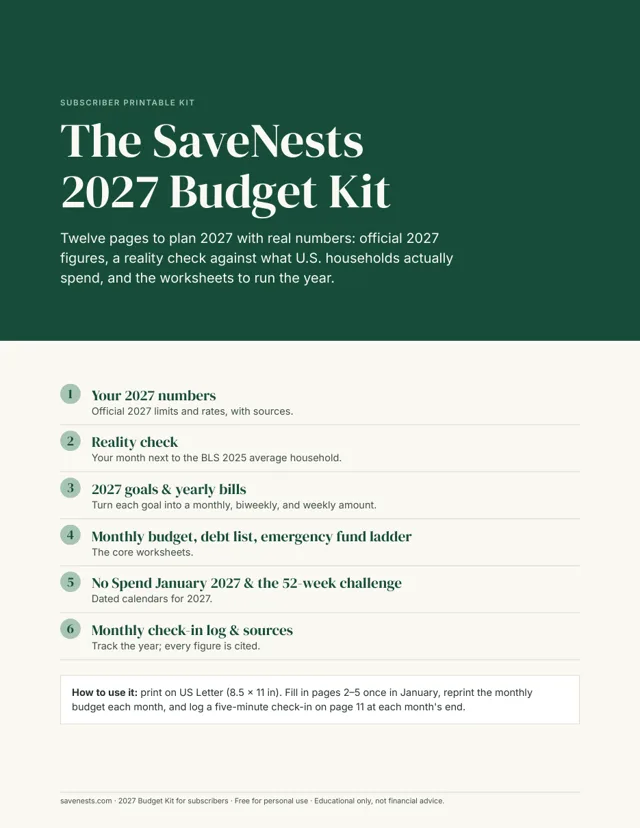
Get the 2027 Budget Kit
A 12-page printable PDF: official 2027 numbers (HSA limits, the 3.6% COLA), your month next to the BLS average household, goals and yearly bills, a monthly budget, a debt list, an emergency fund ladder, a No Spend January 2027 calendar, and dated 52-week challenge charts. Every figure is cited.