
Most budgets don't fail because the math is hard. They fail because the categories are wrong. Too few, and "Other" quietly becomes the biggest line in the month. Too many, and you spend Sunday night deciding whether a rotisserie chicken is groceries or dinner out. If you're setting up a budget for 2027, the category list is the first decision, and it's worth getting right before January.
Below is a full budget categories list: 84 categories in 15 groups, what the average U.S. household actually spends in each big group, which categories people forget, and how to pick a starting amount for every line. You won't need all 84. The point is to scan the list once, keep what applies to your life, and cross out the rest.
How many budget categories do you need?
For most people, 12 to 20 categories is the sweet spot. That's enough to see where money goes, and few enough that you can check the budget in ten minutes. Start with broad groups. Split a group into smaller categories only where you keep overspending or keep getting surprised. If dining out is always over, give takeout its own line. If utilities never change, "Utilities" can stay one line.
What the average household spends by category
Before you pick numbers, it helps to see a real baseline. The Bureau of Labor Statistics' Consumer Expenditure Survey for 2025, released October 29, 2026, found that the average household (BLS calls it a consumer unit) spent $81,905 for the year, about $6,825 a month, on income before taxes averaging $110,847. Here's how that spending broke down:
| Category | Per year | Per month | Share of spending |
|---|---|---|---|
| Housing (shelter, utilities, supplies, furniture) | $27,790 | $2,316 | 33.9% |
| Transportation | $13,492 | $1,124 | 16.5% |
| Food | $10,633 | $886 | 13.0% |
| Personal insurance and pensions | $10,175 | $848 | 12.4% |
| Healthcare | $6,470 | $539 | 7.9% |
| Entertainment | $4,084 | $340 | 5.0% |
| Cash contributions (giving) | $2,237 | $186 | 2.7% |
| Apparel and services | $2,010 | $168 | 2.5% |
| Education | $1,583 | $132 | 1.9% |
| Miscellaneous | $1,335 | $111 | 1.6% |
| Personal care | $986 | $82 | 1.2% |
A few things jump out. Housing, transportation, and food together were 63.4 percent of all spending, so those three groups deserve the most careful categories. Within housing, shelter alone was $17,626 a year (about $1,469 a month) and utilities, fuels, and public services were $4,931 (about $411 a month). Within food, eating at home cost $6,491 and food away from home $4,142, which is why so many budgets need separate grocery and dining-out lines.
"Personal insurance and pensions" is mostly Social Security taxes and retirement contributions, plus life insurance. Much of it comes out of a paycheck before you see it, which is one reason to budget from take-home pay. Treat these averages as context, not targets. Average incomes ranged from $18,125 in the lowest fifth of households to $286,188 in the highest, and spending ranged from $37,935 to $159,512, so your numbers can look very different and still be right for you. For what the average looks like for a family, see how to budget for a family of four.
The full budget categories list (84 categories)
Copy the groups that apply, then cross out the lines you don't have. Where a category is often paid through payroll or escrow, I've noted it, so you don't count it twice.
1. Housing (7)
- Rent or mortgage
- Property taxes (skip if your lender escrows them)
- Homeowners or renters insurance (skip if escrowed)
- HOA or condo fees
- Home repairs and maintenance
- Furniture and household items
- Household supplies: cleaning products, paper goods, light bulbs
2. Utilities (6)
- Electricity
- Natural gas, propane, or heating oil
- Water and sewer
- Trash and recycling
- Internet
- Cell phone
3. Food (5)
- Groceries
- Dining out
- Takeout and delivery
- Coffee and snacks on the go
- Work and school lunches
4. Transportation (8)
- Car payment or lease
- Gas or EV charging
- Auto insurance
- Maintenance and repairs: oil changes, tires, brakes
- Registration, inspection, and license fees
- Parking and tolls
- Public transit
- Rideshare and taxis
5. Health (6)
- Health insurance premiums (if not taken out of your paycheck)
- Doctor visits and copays
- Prescriptions
- Dental
- Vision and glasses or contacts
- HSA or FSA contributions (if not payroll-deducted)
6. Other insurance (3)
- Life insurance
- Disability insurance
- Umbrella or other policies
7. Debt payments (5)
- Credit card payments
- Student loans
- Personal loans
- Medical bills on a payment plan
- Buy now, pay later installments
8. Savings (5)
- Emergency fund
- Retirement (if not taken out of your paycheck)
- Sinking funds (see group 14)
- Big goal: down payment, next car, wedding
- Kids' education savings
9. Kids and family (7)
- Childcare or daycare
- School fees, field trips, and supplies
- Activities, sports, and lessons
- Allowance
- Diapers, formula, and baby supplies
- Kids' clothing and shoes
- Child support or alimony
10. Personal (6)
- Clothing and shoes (adults)
- Haircuts and personal services
- Toiletries and cosmetics
- Gym or fitness
- Hobbies
- Classes and courses for you
11. Entertainment and subscriptions (6)
- Streaming services
- Cable or satellite TV
- Music, apps, and games
- Movies, concerts, and events
- Books and magazines
- Fun money for each adult
12. Pets (4)
- Food and litter
- Vet visits and vaccines
- Grooming and boarding
- Pet insurance
13. Giving and gifts (4)
- Charity or place of worship
- Birthday gifts
- Holiday gifts
- Weddings, showers, and other celebrations
14. Annual and irregular costs (8)
- Vacation and travel
- Holiday extras: food, decorations, cards, travel
- Annual subscriptions and memberships
- Insurance premiums billed every 6 or 12 months
- Tax preparation and any taxes owed
- Back-to-school
- Car replacement fund
- Appliance and electronics replacement
15. Miscellaneous (4)
- Bank and ATM fees
- Postage and shipping
- Work expenses that aren't reimbursed
- A small buffer line for the true surprises
A simpler starter list (12 categories)
If 84 lines makes you want to close the tab, start here and add categories later:
- Housing (rent or mortgage, plus insurance and fees)
- Utilities (including phone and internet)
- Groceries
- Dining out and takeout
- Transportation (car payment, gas, insurance, upkeep)
- Health (premiums, copays, prescriptions)
- Debt payments
- Savings and emergency fund
- Personal and household
- Kids or pets (if you have them)
- Giving and gifts
- Fun money
This is also a good set for cash stuffing: the lines you pay by card or autopay stay digital, and only groceries, dining out, personal, and fun money go into envelopes. If you'd like to see the categories on paper, the one-page budget printable has room for about this many.
Sorting categories into needs, wants, and savings
If you use the 50/30/20 rule, each category still needs a home. A rough guide:
- Needs: housing, utilities, groceries, transportation to work, health, insurance, childcare, and minimum debt payments.
- Wants: dining out, takeout, streaming, hobbies, most clothing beyond the basics, travel, and fun money.
- Savings and debt payoff: emergency fund, retirement, sinking funds, and anything you pay on debt above the minimum.
Some lines are split. A basic phone plan is a need; the premium unlimited plan is partly a want. Groceries are a need; the $12 cheese board is a want. Put the line where most of the money goes and move on. If you'd rather give every dollar a specific job instead of three buckets, zero-based budgeting uses exactly this kind of list.
The categories people forget
The lines that break budgets are rarely rent or groceries. They're the bills that show up once or twice a year and feel like emergencies even though you knew they were coming. Look back over the last 12 months of bank and card statements for these:
- Car registration, inspection, and the six-month auto insurance bill
- Annual memberships: warehouse clubs, shipping, software, roadside assistance
- Holiday spending, which starts earlier than you think. In the National Retail Federation's October 2026 survey, 43 percent of holiday shoppers planned to start before November, and half of those early shoppers did it to spread out their holiday budgets.
- Birthdays and other gifts, which add up across a year even when each one is small
- Medical deductibles and dental work
- Back-to-school clothes and supplies
- Vet visits
- Home and car repairs that aren't a surprise, only a when
Each of these is a sinking fund: divide the yearly cost by 12 and set that amount aside every month. If Christmas is your biggest irregular line, how to budget for Christmas walks through building that one.
How to set an amount for each category
- Start from take-home pay, the amount that lands in your account. If your pay changes from month to month, use a cautious base month.
- Pull your last three months of bank and card statements and add up what you actually spent in each category. Divide by three.
- For annual and irregular lines, look back 12 months, add them up, and divide by 12.
- Fill fixed bills first (housing, utilities, insurance, minimum debt payments), then savings, then everything flexible.
- If the total is more than your income, cut from the flexible lines first: dining out, subscriptions, fun money. Don't cut groceries to an amount you can't actually hit.
- Leave a small buffer line. Some months are just weird.
Prices are still moving, so check the lines that shifted recently. In the October 2026 Consumer Price Index, released November 10, food rose 0.5 percent in a single month (groceries 0.4 percent, food away from home 0.5 percent), electricity rose 0.9 percent, and motor vehicle insurance rose 0.7 percent. Gasoline was up 37.4 percent from a year earlier. Your 2025 average for those categories may already be too low for 2027. Used cars went the other way, down 1.2 percent in October.
Two categories deserve a closer look before January. Debt payments: credit card accounts that paid interest averaged a 22.36 percent rate in the third quarter of 2026, according to the Federal Reserve's G.19 release, so any extra you can fit in that line saves real money. The credit card payoff guide shows how to order it. And savings: the Fed's survey of 2025 found 63 percent of adults would cover a $400 emergency with cash or its equivalent, and 55 percent had three months of expenses set aside. If you're not there yet, the $1,000 emergency fund plan is a good first savings category. Shop around for where you keep it, since the FDIC's national average was just 0.39 percent for savings accounts and 0.64 percent for money market accounts as of November 16, 2026.
Setting up your 2027 categories
The end of the year is the easiest time to set categories because the information is fresh. Your December statements show what the holidays really cost, and January's bills haven't landed yet. A simple plan for the next five weeks:
- This weekend: pick your categories from the list above and cross out what you don't need.
- Early December: pull three months of statements and set a starting amount for every line.
- Mid-December: list your 2027 annual bills by month so the sinking-fund lines start on January 1.
- After New Year's: run January with the new categories, then adjust in February.
The 2027 budget planner walks through the whole year month by month, how to budget for 2027 covers the bigger decisions, and the 2027 budget numbers post collects the official limits and figures that change on January 1. If you're paid every two weeks, how to budget biweekly paychecks shows how to assign each category to a paycheck.
Common budget category mistakes
- Using one "Miscellaneous" line for everything you didn't plan. If it's more than a small buffer, split it until you can see what's in it.
- Counting payroll deductions twice. If health insurance or retirement comes out before payday, don't add it as a spending line too.
- Forgetting annual bills, then calling them emergencies.
- Never revisiting categories. After three months, merge lines that never move and split the ones that always go over.
Budget categories checklist
- Pick 12 to 20 categories from the list.
- Mark which ones come out of your paycheck so you don't count them twice.
- Add up three months of statements for each category.
- List annual and irregular bills and divide each by 12.
- Fill fixed bills, then savings, then flexible spending.
- Leave a small buffer line.
- Update grocery, electricity, gas, and insurance lines for current prices.
- Review and adjust after the first month.
To run the numbers on screen, the monthly budget calculator works in your browser, and our budgeting guides cover the next steps.
Questions readers ask
What are the main budget categories?
The main budget categories are housing, utilities, food, transportation, health, insurance, debt payments, savings, personal spending, and entertainment, plus kids, pets, and giving if they apply to you. In the BLS Consumer Expenditure Survey for 2025, housing (33.9 percent), transportation (16.5 percent), and food (13.0 percent) made up 63.4 percent of average household spending.
How many categories should a budget have?
Most people do well with 12 to 20. Start with broad groups and split a category only where you keep overspending or getting surprised. A beginner can start with about 12 lines and add more later.
What are the 4 basic budget categories?
One common way to group a budget is four buckets: fixed expenses (rent, insurance, loan payments), variable needs (groceries, gas, utilities), wants (dining out, entertainment), and savings or debt payoff. The 50/30/20 rule uses three buckets: needs, wants, and savings.
How much should I spend in each budget category?
Start with what you actually spent: add up three months of statements for each category and divide by three, and divide annual bills by 12. Then fit the total to your take-home pay. National averages, like the BLS figure of about $541 a month on groceries and $345 on food away from home in 2025, are context, not targets.
What budget categories do people forget?
The ones that come once or twice a year: car registration and six-month insurance bills, annual memberships, holidays, birthdays, medical deductibles, back-to-school costs, vet visits, and home or car repairs. Give each a sinking fund by dividing the yearly cost by 12.
Is debt a budget category?
Yes. Give minimum payments their own line with your fixed bills, and add any extra payoff as a separate line under savings and debt. Credit card accounts that paid interest averaged a 22.36 percent rate in the third quarter of 2026, according to the Federal Reserve, so extra payments on cards usually go furthest.
Sources
- U.S. Bureau of Labor Statistics, Consumer Expenditures in 2025 (released October 29, 2026), Tables 1, 2 and 3Average annual expenditures $81,905; income before taxes $110,847; housing $27,790 (33.9%), shelter $17,626, utilities $4,931; transportation $13,492 (16.5%); food $10,633 (13.0%), food at home $6,491, food away $4,142; personal insurance and pensions $10,175 (12.4%); healthcare $6,470; entertainment $4,084; cash contributions $2,237; apparel $2,010; education $1,583; miscellaneous $1,335; personal care $986; quintile income $18,125 to $286,188 and spending $37,935 to $159,512.
- U.S. Bureau of Labor Statistics, Consumer Price Index, October 2026 (released November 10, 2026)Seasonally adjusted October changes: food +0.5%, food at home +0.4%, food away from home +0.5%, electricity +0.9%, motor vehicle insurance +0.7%, used cars and trucks -1.2%; gasoline +37.4% over 12 months (not seasonally adjusted).
- Federal Reserve, G.19 Consumer Credit (November 6, 2026)Commercial bank interest rate on credit card accounts assessed interest: 22.36% (2026 Q3).
- Board of Governors of the Federal Reserve System, Economic Well-Being of U.S. Households in 2025 (SHED report, May 2026)63% would cover a $400 emergency expense with cash or its equivalent; 55% had three months of expenses in emergency savings.
- FDIC, National Rates and Rate Caps (November 16, 2026)National average rates: savings 0.39%, money market 0.64%.
- National Retail Federation, Affordability Shapes Winter Holiday Shopping (October 20, 2026)43% of holiday shoppers planned to start before November; 50% of early shoppers did so to spread out their holiday budgets. Survey of 8,094 adults, Oct. 1-7, 2026.
Mohamed Ouhammouche
Mohamed Ouhammouche founded and runs SaveNests, a budgeting site that helps beginners build simple budgets. This guide was reviewed by the SaveNests Editorial Desk under the editorial and fact-checking policies.
Free for subscribers
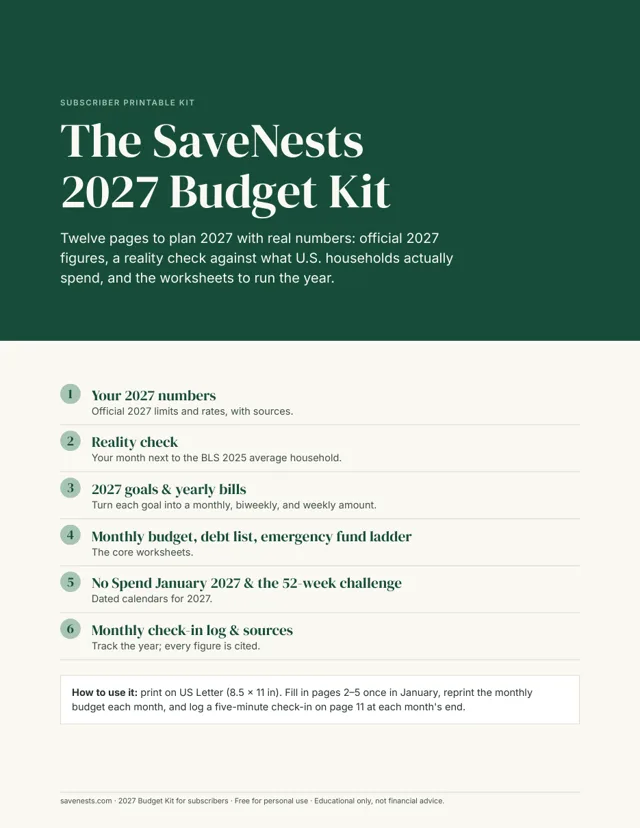
Get the 2027 Budget Kit
A 12-page printable PDF: official 2027 numbers (HSA limits, the 3.6% COLA), your month next to the BLS average household, goals and yearly bills, a monthly budget, a debt list, an emergency fund ladder, a No Spend January 2027 calendar, and dated 52-week challenge charts. Every figure is cited.