
Secret Santa is supposed to be the cheap option. Instead of buying for eight cousins or a whole office, you buy one gift for one person. It only stays cheap if the group agrees on a number first. Leave it vague, and one person spends $15 while another spends $60, and someone goes home feeling bad about their gift.
This guide covers the money side of a gift exchange: how to pick a Secret Santa budget everyone can afford, how to word the rules so the cap actually holds, and what you can buy at common price points. It works for family draws, friend groups, and the office party. If you're still setting your overall holiday number, start with How to Budget for Christmas and come back here once you know what the exchange can take.
The short answer
Pick one fixed cap before you draw names, and set it at a level the person with the least money can pay without stress. For many offices and casual friend groups, that lands somewhere in the $10 to $25 range. Family draws are often a bit higher because each person buys only one adult gift. Say whether tax and shipping count toward the cap (they should), ban cash-equivalent loopholes or allow them on purpose, and set a gift-giving date. Then count the cap against your own gift budget, the same as any other name on your list.
- Agree on the cap before the draw, not after.
- Size it for the tightest budget in the group, not the average.
- State that the cap includes tax and shipping.
- Decide whether gift cards are allowed.
- Set a draw date, a buy-by date, and an exchange date.
- Give people a quiet way to opt out.
Why the cap matters more this year
Gift budgets are holding steady while prices aren't. In Gallup's October 2026 poll, Americans expected to spend an average of $1,011 on holiday gifts, about the same as the last two years. Gallup's own bottom line was that steady gift budgets may not stretch quite as far, because prices are higher. Twenty-four percent of people said they'd spend less than last year and 18 percent said they'd spend more. Twenty-seven percent planned to spend less than $500 on gifts in total.
The Bureau of Labor Statistics price data shows where that pinch lands. Over the 12 months ending September 2026, overall consumer prices rose 3.7 percent. Several classic Secret Santa categories rose faster: toys were up 6.6 percent, candy and chewing gum 7.7 percent, coffee 7.1 percent, and jewelry 11.8 percent. Postage was up 12.7 percent, which matters if your exchange is long-distance. Some categories were calmer: recreational books were down 0.7 percent and cosmetics, perfume, and bath products were up 1.4 percent.
- Postage+12.7%
- Jewelry+11.8%
- Candy and chewing gum+7.7%
- Coffee+7.1%
- Toys+6.6%
- All items+3.7%
- Stationery and gift wrap+3.7%
- Cosmetics, perfume, bath+1.4%
U.S. Bureau of Labor Statistics, Consumer Price Index, September 2026, Table 2.
The practical takeaway: a $20 cap buys a little less than it did last December, especially if your go-to gift is a candy tin or a bag of good coffee. That's an argument for choosing the cap thoughtfully and picking gift categories that haven't jumped, not for quietly raising the number.
How to pick a Secret Santa budget
The right number is the one that nobody in the group has to stretch for. That sounds obvious, but groups usually set the cap by asking who has the biggest ideas, not who has the smallest budget.
Size it for the tightest budget, not the average
In an office, the group includes interns and managers. In a family, it might include a college student, a retired grandparent, and a cousin between jobs. The Federal Reserve's survey of household finances for 2025 found that 37 percent of adults would not cover a $400 emergency expense with cash or its equivalent. You won't know who in your group is in that 37 percent, and you shouldn't have to. A modest cap protects them without anyone having to explain themselves.
A simple test: if the cap would make you think twice in a tight month, it's probably too high for someone else in the group.
Common price points, and who they suit
These are typical ranges groups choose, not survey figures. Use them as a starting point for the conversation.
| Cap | Usually suits | What it buys well |
|---|---|---|
| $5–$10 | Large offices, classrooms, teen groups, a second "joke gift" round | Snacks, a mug, socks, a paperback, stickers, a small plant |
| $15–$20 | Most workplaces, friend groups, roommates | A book plus a treat, a nice candle, a board game card deck, a quality kitchen tool |
| $25–$30 | Close friends, adult siblings | A good hardcover, a puzzle, a specialty food item, a cozy throw |
| $40–$50 | Small family draws where each adult buys only one gift | One considered gift: a cast-iron pan, a hobby kit, an experience for one |
For a family that's switching from "everyone buys for everyone" to a name draw, a higher cap can still save money overall. If eight adults used to spend $25 on each of the other seven, that's $175 per person. A single $50 gift cuts that to $50. If you're working out per-person amounts for the rest of your list, How Much to Spend on Christmas Gifts has a framework by circle of closeness.
Set it as a cap, not a target
Word it as "up to $20," not "about $20." "About" invites people to round up. "Up to" tells the person who finds a perfect $12 gift that they're done. It's also worth saying out loud that coming in under the cap is fine.
Secret Santa rules you can copy
Most Secret Santa trouble isn't about the gift itself. It's about rules nobody wrote down. Paste something like this into the group chat or the office email, and change the details to fit:
- Budget: gifts are up to $20, including tax and any shipping. Under is fine.
- Draw: names are drawn by [date] using [a hat / a free online picker]. If you draw yourself, draw again.
- Gift cards: allowed / not allowed. (Pick one.)
- Wish list: everyone adds two or three ideas within the cap, plus any allergies or "please no" items, by [date].
- Buy by: [date], so online orders arrive in time.
- Exchange: [date, time, place], or ship directly to your person by [date] if we're remote.
- Opting out: tell [organizer] privately by [date]. No reason needed.
- Keep it kind: no gag gifts that single someone out, and nothing you wouldn't want opened in front of the group.
Why the cap should include tax and shipping
If shipping isn't inside the cap, remote players quietly pay more than people who hand gifts over in person. With postage prices up 12.7 percent over the past year, that gap isn't trivial on a $20 gift. Including tax and shipping keeps the real cost the same for everyone. If your group is spread out, order straight to your recipient from a store with free shipping on small orders, or let remote people send a digital gift.
The gift card question
Gift cards are the easy answer, and plenty of people genuinely want them. NRF's 2026 holiday survey found gift cards were again the most-wanted item, chosen by 47 percent of people, ahead of clothing at 44 percent. The downside in a Secret Santa is that a $20 card next to a thoughtful $20 gift can feel like a mismatch. Groups usually decide either "gift cards welcome" or "gift cards only if it's on the wish list." Either is fine; deciding up front is what matters.
Two practical notes on cards. Under federal rules summarized by the Consumer Financial Protection Bureau, gift card money must be good for at least five years from the date it was loaded, and inactivity fees can't start in the first 12 months. And if your employer, not the employees, is paying for the gifts, the IRS treats gift cards differently from small physical gifts. IRS Publication 15-B says cash and cash equivalents such as gift cards are never excludable as a de minimis benefit, no matter how small, while low-value holiday gifts other than cash can be. That's mainly the company's problem, but it's why some HR teams prefer physical gifts.
Secret Santa gift ideas by budget
Low-cost gifts land best when they're specific to the person. Use the wish list if your group has one. If not, a little detective work in the group chat beats a generic candle.
Under $10
- A paperback from a used bookstore or a library sale. Book prices were roughly flat over the last year in the BLS data.
- A favorite snack or hot sauce they mention often, with a handwritten note.
- Fun socks, a good pen, or a pocket notebook.
- A small houseplant or a cutting from one of yours in a thrifted pot.
- A homemade treat: cookies, spiced nuts, or a jar of cocoa mix.
Under $20
- A book they've mentioned plus a bar of chocolate.
- A mug filled with their favorite tea or coffee. Coffee prices are up, so a smaller bag of something good beats a big bag of something average.
- A card game or a pocket-size puzzle.
- A quality kitchen tool: a bench scraper, a microplane, a good peeler.
- A phone stand, a long charging cable, or a cable organizer for the desk.
Under $25
- A 1,000-piece puzzle or a small board game.
- A cozy item: a soft scarf, slippers, or a fleece throw on sale.
- A specialty food kit: pasta and sauce, a baking mix, or a local coffee roaster's sampler.
- A hobby starter: watercolor postcards and a travel brush, a crochet kit, or seed packets and gloves.
- An experience if it fits: a movie ticket, a bowling game, or a museum entry.
Office Secret Santa: a few extra rules
Workplace exchanges need a bit more care, because people don't choose their coworkers and can't easily skip the party.
- Make it opt-in, not opt-out, and let people join quietly.
- Keep the cap modest. A cap somewhere in the $10 to $25 range keeps it easy for most teams, and lower is kinder when pay ranges are wide.
- Avoid gifts that are too personal: no clothing sizes, perfume, or anything about appearance.
- Don't make managers buy for their direct reports in the same draw if your workplace discourages gifts up the chain. Check your company's gift policy.
- For remote teams, send a digital gift or ship directly, and keep shipping inside the cap.
- Offer a no-cost way to join: a white elephant round with regifted items, or a card exchange.
White elephant versus Secret Santa
In a white elephant exchange, everyone brings one wrapped gift and people pick or "steal" in turns, so nobody knows in advance what they'll end up with. In Secret Santa, each person buys for one specific person. The budget logic is the same: one cap, agreed in advance, tax included. White elephant tends to suit lower caps and funny or general gifts; Secret Santa suits personal ones.
Family Secret Santa
A family name draw is one of the most effective ways to cut a holiday gift budget without cutting the holiday. A few things help it go smoothly:
- Draw early. Late November works for most families, before anyone has started buying.
- Keep spouses and partners from drawing each other. Most free online pickers let you set exclusions.
- Decide whether kids are in the draw or kept separate. Many families do adults-only Secret Santa and keep separate caps for the children.
- Add a wish list so the one gift each person gets is something they actually want.
- Write down who had whom this year so you can avoid repeats next year.
If someone in the family can't take part this year, a draw makes it easy to sit out without being noticed. That's one of its best features.
Paying for it without new debt
A $20 Secret Santa gift is a small line, but holiday spending is dozens of small lines. Treat the exchange like any other name on your gift list: put the cap in your holiday budget, and pay for it from cash you already have. If you use cash stuffing, a single "gifts" envelope covers it.
If it goes on a credit card, pay the full statement balance. The Federal Reserve's latest consumer credit release shows an average 22.36 percent rate in August 2026 on credit card accounts that were charged interest. A $20 gift carried for months at that rate stops being a $20 gift. If you're already carrying a balance, How to Pay Off Credit Card Debt has a step-by-step plan, and it's a good reason to suggest a lower cap or to sit this one out.
For next year, it's worth adding the exchange to a holiday sinking fund. Gifts, food, travel, and party contributions are known costs on a slow schedule. Saving a little each month means December doesn't have to pay for all of it at once.
Secret Santa budget checklist
- Pick a cap the tightest budget in the group can afford.
- Word it as "up to," including tax and shipping.
- Decide on gift cards before the draw.
- Collect short wish lists and any allergies or no-go items.
- Set draw, buy-by, and exchange dates.
- Offer a private, no-questions opt-out.
- Add the cap to your own holiday gift budget.
- Pay in cash or pay the card in full.
A good Secret Santa isn't measured by price. It's measured by whether everyone could relax and enjoy opening their gift. A clear cap, agreed early, does most of that work.
Questions readers ask
How much should you spend on Secret Santa?
Spend up to the cap your group agrees on before the draw, and set that cap at a level the person with the tightest budget can pay comfortably. Many offices and friend groups choose something in the $10 to $25 range; family draws are often higher because each person buys only one adult gift.
What is a good Secret Santa budget for work?
For most workplaces, a cap in the $10 to $25 range keeps things easy, and a lower cap is kinder in a team with a wide pay range. Make the exchange opt-in, include tax and shipping in the cap, and check your company's gift policy.
Does the Secret Santa budget include tax and shipping?
It should. Including tax and shipping keeps the real cost the same for people who hand gifts over in person and people who have to mail them. Say this clearly in the rules.
Is a gift card OK for Secret Santa?
Yes, if your group allows it. NRF's 2026 survey found gift cards were the most-wanted holiday gift, chosen by 47 percent of people. Decide before the draw whether gift cards are welcome or only allowed when they're on the person's wish list.
What are the basic Secret Santa rules?
Agree on a price cap, draw names by a set date, collect short wish lists, set a buy-by date and an exchange date, decide on gift cards, and give people a private way to opt out. Write the rules down and share them with the group.
What is the difference between Secret Santa and white elephant?
In Secret Santa each person buys a gift for one specific person whose name they drew. In white elephant everyone brings one general gift and people pick or steal in turns. Both work best with one agreed price cap.
How do I suggest a lower Secret Santa budget?
Bring it up before the draw and frame it around the whole group: suggest a cap of up to a lower amount so everyone can join comfortably. You don't need to mention your own finances, and saying that coming in under the cap is fine helps.
Sources
- Gallup, Holiday Shopping Plans Point to Average Retail Year (November 6, 2026)October 1–19, 2026 poll: average expected gift spending $1,011; 24% plan to spend less and 18% more than last year; 27% expect to spend under $500.
- National Retail Federation, Affordability Shapes Winter Holiday Shopping, According to NRF Holiday Survey (October 20, 2026)Gift cards most wanted (47%), then clothing (44%), books and other media (25%), personal care or beauty (24%); 56% say the economy will affect holiday spending.
- U.S. Bureau of Labor Statistics, CPI Table 2, detailed expenditure categories (September 2026)12-month changes: all items +3.7%; toys +6.6%; candy and chewing gum +7.7%; coffee +7.1%; jewelry +11.8%; postage +12.7%; recreational books -0.7%; cosmetics, perfume, bath +1.4%; stationery and gift wrap +3.7%.
- Board of Governors of the Federal Reserve System, Economic Well-Being of U.S. Households in 2025 (SHED, May 2026)63% would cover a $400 emergency expense with cash or its equivalent, so 37% would not.
- Federal Reserve, Consumer Credit G.19 (release of November 6, 2026)Average interest rate on credit card accounts assessed interest: 22.36% (August 2026, latest quarterly reading).
- Consumer Financial Protection Bureau, If my prepaid card expires, do I lose my money?Gift card funds must be good for at least five years under federal law; inactivity fees only after 12 months of non-use.
- Internal Revenue Service, Publication 15-B (2026), Employer's Tax Guide to Fringe BenefitsCash and cash equivalents such as gift cards are never excludable as de minimis benefits; low-value holiday gifts other than cash can be.
Mohamed Ouhammouche
Mohamed Ouhammouche founded and runs SaveNests, a budgeting site that helps beginners build simple budgets. This guide was reviewed by the SaveNests Editorial Desk under the editorial and fact-checking policies.
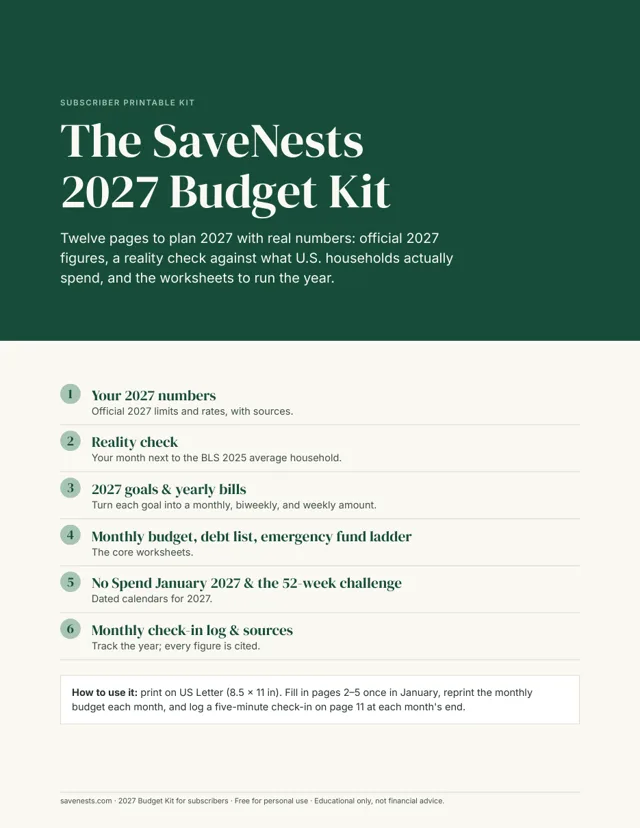
Free for subscribers
Get the 2027 Budget Kit
A 12-page printable PDF: official 2027 numbers (HSA limits, the 3.6% COLA), your month next to the BLS average household, goals and yearly bills, a monthly budget, a debt list, an emergency fund ladder, a No Spend January 2027 calendar, and dated 52-week challenge charts. Every figure is cited.