Christmas with kids gets expensive in a particular way. It isn't usually one big present that does the damage. It's the third "little" gift added because the pile looked small, the stocking that turned into a second Christmas, the batteries, the class party, and the gift for the cousin you forgot until December 20. Kids remember a handful of things from the morning. The card statement remembers all of it.
This guide is for parents who want the morning to feel generous without paying for it until spring. It covers a number per child, a gift structure that keeps the pile honest, what toys cost now, and where to look if money is really short. If you haven't set a total for the whole season yet, How to Budget for Christmas builds that number first, and this page handles the kids' line inside it.
The short answer
Decide the kids' total from money you'll actually have by December 24, split it into an equal cap per child, and use the four-gift rule (something they want, something they need, something to wear, something to read) so the count is set before you shop. Put stockings, wrapping, and batteries inside the cap, buy from a written list, and keep it off a credit card.
- Set the total for all the kids from cash you'll have, not from what you hope to spend.
- Give each child the same cap, or have a simple reason ready when caps differ.
- Use the four-gift rule to fix the count before you shop.
- Put stockings, wrapping, batteries, and gifts from Santa inside each child's cap.
- Shop from a list with a price next to every item.
- Pay in cash or debit, and stop when the line is spent.
How much should you spend on kids for Christmas?
There's no official number, and any figure you see online is somebody else's income talking. A good kids' budget is the amount you can pay for in full by the time the bills arrive, without touching rent, groceries, minimum payments, or the emergency fund. For a broader per-person method that covers the adults too, How Much to Spend on Christmas Gifts has the full breakdown.
What has changed is what that money buys. Because October 2025 prices weren't collected, the most recent full-year comparison in the Bureau of Labor Statistics' Consumer Price Index runs from September 2025 to September 2026. Over those 12 months, the index for toys rose 6.6 percent while overall prices rose 3.7 percent. Boys' apparel was up 7.8 percent and girls' apparel 3.6 percent, while books and baby clothes got slightly cheaper.
- Boys' apparel+7.8%
- Toys+6.6%
- Bicycles and sports vehicles+6.2%
- All items+3.7%
- Girls' apparel+3.6%
- Recreational books-0.7%
- Infants' and toddlers' apparel-1.3%
U.S. Bureau of Labor Statistics, CPI-U index levels, U.S. city average, September 2025 and September 2026.
In practical terms, if you spent $100 a child last year and keep the same number, you'll get a little less in the toy aisle and about the same on the bookshelf. That's one quiet argument for the four-gift rule: two of its four slots, the book and often the clothes, are in categories where prices barely moved.
You're not the only one feeling it. In the National Retail Federation's October 2026 holiday survey of 8,094 adults, 56 percent said the economy would affect their holiday spending. Among them, 43 percent planned to shop sales more often.
Step 1: Set the total, then split it by child
Start with one number for all the kids, not a number per gift. Count the paychecks left before Christmas, decide what you can set aside from each without shorting a bill, and add any cash you've already saved. That total is the kids' line. Then divide it.
Kids notice fairness between siblings more than the total, so equal caps are easiest to defend. If caps differ, have a plain reason ready, such as an older child's one bigger gift. Some families keep the count equal instead of the dollars, so each child opens the same number of boxes. Either works if you decide it before the first purchase.
| Cap per child | Want | Need | Wear | Read | Stocking and extras |
|---|---|---|---|---|---|
| $50 | $20 | $10 | $10 | $5 | $5 |
| $100 | $40 | $20 | $20 | $10 | $10 |
| $150 | $60 | $30 | $25 | $15 | $20 |
Notice that the extras get their own column. Stockings, wrapping paper, tape, gift bags, and batteries are where kids' budgets quietly grow by 20 or 30 percent. If they live inside the cap, they can't.
Step 2: Use the four-gift rule
The four-gift rule is simple: each child gets something they want, something they need, something to wear, and something to read. It works because it decides the count for you and builds in two practical gifts without making the morning feel like a back-to-school run.
- Want: the one thing on the list they'd be upset not to see. Give it the biggest share of the cap, and buy it first so it doesn't get squeezed.
- Need: something they'd get anyway, like new sneakers, a lunch box, a winter hat, sports gear, or a backpack. You were going to spend this money in January, so it's not extra.
- Wear: pajamas, a hoodie, a team shirt. Matching Christmas pajamas can be the wear gift and the Christmas Eve tradition at once.
- Read: a book, a comic, a magazine subscription, or a book they pick themselves at the bookstore as an outing.
Some families add a fifth slot, "something to do," for an experience. The point isn't the exact rule. It's that the count is fixed before you're in a store looking at a pile that seems small.
Ideas that fit a small cap, by age
- Babies and toddlers: they often enjoy the box more than the gift. One sturdy toy, board books, and clothes in the next size up go a long way. Keep balls and toys with small parts away from children under 3, as the Consumer Product Safety Commission advises.
- Ages 4 to 8: art supplies, a building set, a dress-up costume, a puzzle, a library-style stack of chapter books, or a coupon for a day out with one parent.
- Ages 9 to 12: a craft or science kit, a board game the whole family will play, a bike or scooter with the helmet budgeted in, or the cash to buy something themselves.
- Teens: they usually want fewer, specific things. Ask for a ranked list, and consider a gift card. In NRF's October 2026 survey, gift cards were the most-wanted gift, named by 47 percent of people, ahead of clothing at 44 percent.
Step 3: Put Santa and the stockings inside the cap
Two lines break kids' budgets more than any toy: gifts "from Santa" that get bought on top of the parents' gifts, and stockings that grow into a second round of presents. Count both in each child's cap.
- Pick one gift per child that's from Santa, and make it come out of the want or need slot rather than adding to the pile.
- Give the stocking a firm number. Candy, a small toy, socks, a toothbrush, and an orange is a classic stocking, and it doesn't need to cost much.
- Buy wrapping, tape, bags, and batteries once, early, and charge them to the extras column. Plenty of toys don't include batteries.
Step 4: Shop from a list, with timing on your side
Write every child's four gifts on one page with a target price and space for what you actually paid. If something comes in under the target, the savings go back to the total instead of into a fifth gift. If something comes in over, something else on that child's list gets cheaper.
Prices on toys have tended to soften as December arrives. In the BLS index for toys, which isn't seasonally adjusted, the December 2024 level was 3.8 percent below September 2024, and December 2025 was 3.2 percent below September 2025. That's an average across all toys, not a promise about the one your child wants, and popular items sell out. Buy the main want gift at a fair price, and leave books, clothes, and stocking stuffers for later sales. Black Friday Budget has rules for using sales without blowing the total.
Shop where you trust the seller. CPSC tells parents to buy toys from stores and online retailers they know, and to be wary of online deals that sound too good to be true, since those toys may be hazardous or counterfeit.
Step 5: Cheaper gifts that still land
The goal isn't the cheapest Christmas possible. It's to put the money where the kids will notice it and save it where they won't.
- Secondhand: barely used bikes, building sets, and sports gear cost a fraction of new. CPSC says to check CPSC.gov/recalls before buying secondhand products online, and it's a good habit for yard sales and resale shops too.
- Bundles: one big set (a building kit, a dollhouse, a train set) shared by siblings, with each child getting a small personal add-on.
- Experiences: a coupon for a movie night, a trip to the skating rink, or a day out with one parent. Put the real date on the coupon so it actually happens.
- Homemade: a cookie-baking kit with a promise to bake together, or a photo book.
- Their own money: older kids often love a little cash and a trip to choose something themselves.
Safety gear belongs in the price of the gift. If a scooter or bike is the want gift, CPSC recommends a helmet and other safety gear for riding toys, with kids using them every time. Budget the helmet in the same line so it isn't an extra purchase in January.
Step 6: Don't forget the other kids
Parents' December lists include a lot of children who aren't theirs: classroom gift exchanges, teacher gifts, cousins, a babysitter's kids, and the friend whose party is on December 21. Give these one line with a per-gift limit, and buy a few simple gifts at once so you aren't running to the store every week. For family gift draws, Secret Santa Budget has wording you can copy for setting a cap everyone can afford.
Step 7: Keep the kids' gifts off a credit card
Toys bought on a card get more expensive every month the balance sits. The Federal Reserve's G.19 report, released November 6, 2026, put the average interest rate on credit card accounts assessed interest at 22.36 percent in the third quarter of 2026. At that rate, $500 of gifts paid off at $50 a month takes 12 payments and costs about $59 in interest.
Buy Now, Pay Later can feel safer because many plans charge no interest. But the Consumer Financial Protection Bureau notes that most BNPL loans charge late fees for missed payments, and several small plans due in January add up fast. If you're already carrying a balance, How to Pay Off Credit Card Debt lays out a plan, and it's worth reading before adding to it.
If money is really short this year
If the kids' line is close to zero, you still have options, and none of them are a failure. Many communities run toy drives in December. Toys for Tots, for example, takes toy requests through the local campaign that serves your area, so you apply there rather than nationally. You can also dial 211, the national number for referrals to local help. United Way's 211 network says its local specialists are available 24/7, calls are confidential and can be anonymous, and it made more than 19 million connections to help in 2025.
Apply early, because local programs set their own deadlines. And it's fine to keep the morning small: one wanted gift, a stocking, and a big breakfast is a real Christmas. If you're hosting the family meal, Christmas Dinner on a Budget shows how to feed 10 people for about $75.
A sample plan for three kids on $300
Here's how a $300 kids' line could look for three children aged 4, 8, and 13. The amounts are invented to show the method, so adjust them to your own prices and kids.
| Age 4 | Age 8 | Age 13 | |
|---|---|---|---|
| Want (from Santa) | $35 | $40 | $45 |
| Need | $20 | $20 | $15 |
| Wear | $15 | $15 | $15 |
| Read | $10 | $8 | $7 |
| Stocking | $10 | $10 | $10 |
| Wrapping and batteries | $5 | $5 | $5 |
| Total | $95 | $98 | $97 |
| Left for teacher and class gifts | $10 |
All three caps are within a few dollars of each other, the 13-year-old's want gift is bigger and the book smaller, and the extras are already counted. If the 8-year-old's want gift goes on sale for $30, that $10 goes back into the total, not into another box.
Start next year's kids' fund in January
The easiest Christmas to pay for is the one you save for all year. Take this year's kids' total, divide by 12 or by the number of paychecks you'll get, and set up an automatic transfer in January into a separate account. A $300 Christmas is $25 a month. That's a sinking fund, and it turns December into a month where the money is already sitting there.
Christmas on a budget for kids checklist
- Kids' total set from cash you'll have by December 24.
- Equal cap per child, or a reason ready if caps differ.
- Four-gift list written for each child: want, need, wear, read.
- Santa gift, stocking, wrapping, and batteries counted inside each cap.
- Target price next to every item, with space for what you paid.
- Secondhand items checked at CPSC.gov/recalls; helmets budgeted with riding toys.
- One line for teacher, class, cousin, and party gifts.
- Paid in cash or debit, with savings from sales returned to the total.
- Toy drive or 211 contacted early if money is short.
- January transfer set up for next year's kids' fund.
Questions readers ask
How much should I spend on my child for Christmas?
There's no official amount. Start from the cash you'll have by December 24 without touching bills or savings, split it into an equal cap per child, and include stockings, wrapping, and batteries in that cap. Prices have risen: the BLS toy index was up 6.6 percent in the 12 months to September 2026.
What is the four-gift rule for Christmas?
Each child gets four gifts: something they want, something they need, something to wear, and something to read. It fixes the number of gifts before you shop and builds in practical items, so the pile feels full without the total running away.
How do I do Christmas on a tight budget with kids?
Pick one wanted gift per child, keep the stocking small, buy secondhand where it's safe, add an experience coupon, and pay in cash. If money is very short, apply to a local toy drive such as your area's Toys for Tots campaign or dial 211 for local help.
Should siblings get the same amount spent on them?
Equal caps are easiest to explain, but you can also keep the number of gifts equal instead of the dollars. If one child gets a bigger gift, have a simple reason ready. Decide the rule before you start buying.
Are toys cheaper closer to Christmas?
On average they have been. The BLS toy price index was 3.8 percent lower in December 2024 than in September 2024, and 3.2 percent lower in December 2025 than in September 2025. Popular items can still sell out, so buy the main gift when you see a fair price.
Is it safe to buy secondhand toys?
Often, yes. The Consumer Product Safety Commission says to check CPSC.gov/recalls before buying secondhand products, follow the age guidance, and keep toys with small parts away from children under 3.
Sources
- U.S. Bureau of Labor Statistics, Consumer Price Index, October 2026, Table 2 (November 10, 2026)12-month changes not published for October 2026 because October 2025 data were not collected; toys +1.0% unadjusted September to October 2026.
- U.S. Bureau of Labor Statistics, CPI-U index levels, U.S. city average (Public Data API)September 2025 to September 2026: toys (SERE01) 28.212 to 30.084, +6.6%; all items (SA0) 324.800 to 336.940, +3.7%; boys' apparel (SEAB) +7.8%; girls' apparel (SEAD) +3.6%; sports vehicles including bicycles (SERC01) +6.2%; recreational books (SERG02) -0.7%; infants' and toddlers' apparel (SEAF) -1.3%. Toys September to December: 28.150 to 27.092 in 2024 (-3.8%), 28.212 to 27.317 in 2025 (-3.2%).
- National Retail Federation, Affordability Shapes Winter Holiday Shopping (October 20, 2026)56% say the economy will affect holiday spending; of those, 43% will shop sales more often, 31% comparison shop online, 29% use coupons; gift cards most wanted (47%), clothing 44%. 8,094 adults surveyed Oct. 1-7.
- U.S. Consumer Product Safety Commission, Don't Be Left Out in the Cold This Holiday Season with Unsafe Presents (December 9, 2025)Buy from trusted sellers; be wary of deals that sound too good to be true; check CPSC.gov/recalls before buying secondhand; helmets for riding toys; small parts away from children under 3.
- Federal Reserve, G.19 Consumer Credit (November 6, 2026)Commercial bank interest rate on credit card accounts assessed interest: 22.36% (2026 Q3).
- Consumer Financial Protection Bureau, What is a Buy Now, Pay Later (BNPL) loan?Many BNPL loans don't charge interest, but most charge late fees for missed payments.
- Marine Toys for Tots Foundation, Request a ToyToy requests are submitted to the local campaign that supports your area.
- United Way 211, About 211Free, confidential referrals to local help, 24/7; more than 19 million connections in 2025.
Mohamed Ouhammouche
Mohamed Ouhammouche founded and runs SaveNests, a budgeting site that helps beginners build simple budgets. This guide was reviewed by the SaveNests Editorial Desk under the editorial and fact-checking policies.
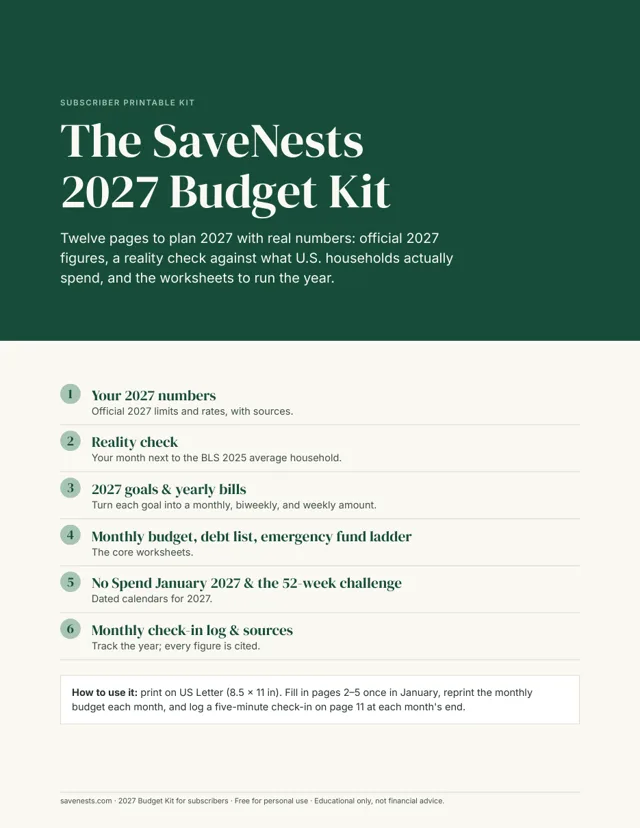
Free for subscribers
Get the 2027 Budget Kit
A 12-page printable PDF: official 2027 numbers (HSA limits, the 3.6% COLA), your month next to the BLS average household, goals and yearly bills, a monthly budget, a debt list, an emergency fund ladder, a No Spend January 2027 calendar, and dated 52-week challenge charts. Every figure is cited.