
Black Friday 2026 falls on November 27, the day after Thanksgiving, and Cyber Monday follows on November 30. The deals usually start well before that. Retailers have spent years stretching the event into a weeks-long run of early sales, app-only discounts, and countdown timers, so the real question isn't whether you'll see a good price. It's whether you'll still have a plan for the rest of the holidays when the weekend is over.
Plenty of people shop it. The National Retail Federation counted a record 202.9 million shoppers over the five days from Thanksgiving through Cyber Monday in 2025, up from 197 million in 2024. Those shoppers spent $337.86 each on average on holiday items over that weekend, the highest figure since 2019, and about two-thirds of it ($225.74) went to gifts. Adobe Analytics, which tracks online checkouts at major US retailers, measured $11.8 billion in online spending on Black Friday 2025 alone, up 9.1 percent from the year before.
This year looks even more concentrated. In the NRF's October 2026 holiday survey, 64 percent of consumers said they're likely to wait until Thanksgiving weekend to do most of their holiday shopping, up from 51 percent five years ago. More than half (56 percent) said the economy will affect their plans, and of those, 43 percent plan to shop sales more often. Adobe forecasts $12.9 billion in online spending on Black Friday 2026 (up 9.2 percent) and $15.1 billion on Cyber Monday, part of $47.5 billion over the five days of Cyber Week.
None of that means you need to spend $337. It means the weekend is built to move money, and a budget is the thing that decides how much of yours moves. This guide walks through a simple Black Friday budget: set a cap before you shop, write a needs list, compare prices and check price history, pick how you'll pay (and understand the card and buy now, pay later risks), and use a sample budget as a template. If you haven't set an overall holiday number yet, start with How to Budget for Christmas Without Going Into Debt; this post assumes Black Friday is one slice of that bigger plan.
What a Black Friday budget is (and isn't)
A Black Friday budget is a fixed dollar amount, decided ahead of time, for what you'll buy between the first early deals and Cyber Monday, plus a written list of what that money is for. It's not a separate pot of money that appears in November. It comes out of the same paychecks that pay rent, groceries, and the rest of the holidays.
That's why the order matters. The NRF's Thanksgiving weekend survey found that, as of that weekend in 2025, shoppers still had about 53 percent of their holiday shopping left to do. If you spend your whole gift budget on Friday, you'll still have stockings, a holiday meal, travel, and the gifts you forgot to cover in December. A Black Friday budget is the part of your holiday budget you choose to spend during the sale window, and no more.
Step 1: Set a cap before you shop
Set the number while you're calm, not while a timer is counting down. Work from cash you'll actually have, not what a card limit allows.
- Start with your total holiday budget: gifts, food, travel, decorations, and extras, funded from the paychecks you have left before late December. The Christmas budget guide walks through that math.
- Subtract the costs that aren't on sale anyway: the holiday meal (Thanksgiving on a budget covers the November one), travel, a cushion for December surprises.
- From what's left for gifts and household purchases, decide what share you'll buy during the sale window. Many people pick the big-ticket or wish-list items and leave stocking stuffers and small gifts for December.
- Write that number down. That's your Black Friday cap.
Then check where the money will come from. If you've been running a holiday sinking fund, the cap shouldn't be more than what's in it plus what the next paycheck can spare after bills. If you're doing No Spend November, decide now whether Black Friday is an exception with a dollar limit or whether you're skipping the sales entirely. Both are reasonable. Deciding on Thursday night is the part that doesn't work.
Step 2: Make a needs list with target prices
A list is the cheapest tool you have. It turns "look at all these deals" into "is the thing I came for on sale?" Build it in three columns: the item, who it's for (or which household need it fills), and the most you'll pay.
- Gifts you've already decided on, by person, with a cap next to each name.
- Household things you'd buy in the next two or three months anyway: a winter coat for a growing kid, a vacuum that's dying, replacement sheets.
- Items you've been waiting on and already know the regular price for.
Leave off anything that only became a want after you saw an ad. If you're tempted, put it on a separate "maybe next time" list with the price and the date. Most of those items will either be on sale again or stop seeming important.
Write a model number or a specific product, not a category. "Headphones" invites you to compare five pairs and buy the one with the biggest discount badge. "Sony WH-series, under $X" lets you check one price and move on.
Step 3: Compare prices and check price history
Discounts are real but uneven. In its 2026 holiday forecast, Adobe expects discounts to peak at about 30 percent off list price for electronics and 29 percent for toys, 23 percent for TVs, computers, and apparel, 19 percent for sporting goods, and 18 percent for appliances and furniture. Those are peak averages across many retailers, roughly in line with 2025, so an individual "60% off" badge may be measured from a list price few people ever paid.
Three checks take a couple of minutes per item:
- Check the price history. Price trackers and browser extensions show what an item has actually sold for over the past months. If the Black Friday price matches a price from September, it's a normal sale, not a once-a-year deal. A sale price is only a deal if it's lower than what you'd otherwise pay.
- Compare at least two other stores for the exact same model. Some retailers sell special versions of TVs and appliances for the holidays with slightly different model numbers, which makes direct comparison harder. If you can't match the model, compare the specs that matter to you.
- Add the real total: shipping, tax, a required membership, and the cost of returning it if it's wrong. A slightly higher price with free returns can beat a lower one with a restocking fee.
Then read the return window. Many stores extend holiday return windows, but not all do, and some categories (opened electronics, final-sale items) have stricter rules. If a gift might need to go back, buy it where returns are easy, and keep receipts in one folder or email label.
Timing matters less than it used to. Adobe found Black Friday online spending growth outpaced Cyber Monday for the second year in a row in 2025, and it expects the same in 2026, driven partly by earlier discounts. Its forecast puts discounts at up to 14 percent in early November, up to 21 percent just before Thanksgiving, and up to 30 percent during Cyber Week. By category, Adobe expects the deepest discounts on electronics and computers on Cyber Monday, on TVs, toys, apparel, appliances, and furniture on Black Friday, and on sporting goods on Thanksgiving Day. NRF's weekend survey showed the Sunday after Thanksgiving drew a record 32.6 million in-store shoppers in 2025. In practice, the same item is often discounted at similar prices across the whole stretch, so you don't need to stay up for a doorbuster to get a fair price. If your target price shows up early, buy it and take it off the list.
Step 4: Cash vs credit, and how you'll pay
How you pay decides whether a deal stays a deal. The simplest rule: pay with money that already exists in your account, either cash, debit, or a credit card you'll pay in full when the statement arrives.
Credit cards: fine if paid in full, expensive if not
Credit cards offer fraud protection and sometimes rewards, which makes them reasonable for online shopping when you pay the full statement balance. Carrying the balance is where the savings disappear. The Federal Reserve's consumer credit report put the average interest rate on credit card accounts that were assessed interest at 22.36 percent in August 2026.
Holiday balances also tend to linger. In LendingTree's December 2025 survey, 37 percent of consumers said they took on holiday debt, averaging $1,223, and 63 percent of them expected it to take three months or longer to pay off. If you already carry a balance, a sale isn't a good reason to add to it. Our guide on how to pay off credit card debt walks through a payoff plan, including why a fixed payment beats the minimum.
Buy now, pay later: the risks are in the small print
Buy now, pay later (BNPL) splits a purchase into installments, often four payments over six weeks with no interest. It's heavily used during the sales: Adobe recorded $1.03 billion in BNPL online spending on Cyber Monday 2025, the first single day above $1 billion, and LendingTree found 45 percent of gift-givers used BNPL at least once last season. For 2026, Adobe expects BNPL to drive $21.3 billion in online spending in November and December, including $1.09 billion on Cyber Monday and $807 million on Black Friday, with 82 percent of it coming through phones.
The Consumer Financial Protection Bureau points out a few risks worth knowing before you click:
- Most BNPL loans charge late fees, even when they charge no interest.
- Payments are often set to autopay from a bank account. If the account is short when a payment hits, your bank may charge an overdraft or NSF fee on top of the BNPL late fee.
- Some longer BNPL plans do charge interest, so read whether it's a pay-in-four plan or a monthly loan with an APR.
- Returns can be messy. If you return an item, keep watching the plan until the refund is applied; payments may still be due while the refund is processed.
The bigger risk is stacking. Four BNPL plans from one weekend can mean a dozen small payments landing in December and January, alongside rent and holiday bills. If you use BNPL, write every installment date into your budget in the month it's due, and count the full purchase price against your Black Friday cap on the day you buy it.
Cash, debit, and envelopes
Paying with cash or debit makes the cap physical. Some people pull their Black Friday budget out as cash for in-store shopping, or move it into a separate checking or savings bucket and shop only from that. When the bucket is empty, the weekend is done. Cash Stuffing for Beginners shows an envelope setup that works for holiday categories.
Sample Black Friday budget
Here's the $450 cap from the example above, turned into a working list. The numbers are an illustration of the method, not a recommendation of what to spend.
| Item | For | Target price | Notes |
|---|---|---|---|
| Wireless headphones (specific model) | Teen | $80 | Price history shows $79–$99 since summer; buy at $80 or less |
| Board game | Family gift | $30 | Compare two stores plus shipping |
| Winter boots | Younger child | $45 | A need, would buy in December anyway |
| Kitchen appliance on wish list | Partner | $90 | Check return window; skip if not under $90 |
| Gifts for parents (shared) | Parents | $60 | One gift, split with a sibling |
| Sheets and towels | Household | $55 | Replacing worn sets; would buy by January |
| Small gifts and exchange | Office swap, teacher | $40 | Can wait for December if needed |
| Shipping, tax, cushion | — | $50 | Tax alone can add several percent |
| Total | $450 | Funded from holiday savings and one paycheck |
The cushion line is deliberate. Sales tax and shipping are easy to forget when you compare sticker prices. If you finish under budget, move the leftover back to the holiday fund for December rather than looking for something else to buy.
Rules for the weekend itself
- Shop from the list only. If something new tempts you, add it to the maybe list and look again in a week.
- Track each purchase against the cap the same day, on paper or in a note. Totals drift fast across several stores and apps.
- Unsubscribe from store emails or mute app notifications for the week if they tend to pull you in.
- Remove saved cards from shopping apps, or at least the ones you don't intend to use, so every purchase takes an extra step.
- Sleep on anything over a set amount, such as $100, unless it's already on the list at your target price.
- Watch for "bundle" and "spend $X, get $Y" offers. They're only savings if the extra item was on your list.
If you're with family over Thanksgiving, agree on plans ahead of time. Shopping can be a fun tradition, and the cap is what lets you enjoy it without regret.
When it makes sense to skip Black Friday
Skipping is a legitimate budget choice. It makes sense if you don't have the cash yet, if you're carrying a card balance you're trying to pay down, or if your list doesn't include anything that's usually discounted. Groceries, holiday food, and many small gifts aren't cheaper on Black Friday than at other times. If you're running No Spend November, sitting the weekend out is often the cleanest way to keep the streak, and the money you don't spend can go into your holiday sinking fund for December.
The sales also come back. Holiday promotions continue into December, and many retailers run sales again after Christmas. If you miss a deal, it's rarely the last chance it's sold as.
After the weekend: close the loop
- Add up what you spent, including tax and shipping, and compare it to the cap.
- Subtract it from your holiday budget so you know what's left for December.
- List every BNPL installment and card statement date in your calendar.
- Check prices on big items for a couple of weeks; some stores adjust if the price drops again within their policy window.
- Return anything you bought on impulse while you're still inside the return window.
Then use what's left to plan the rest of the season: How Much to Spend on Christmas Gifts helps you split the gift money by person, and the Christmas budget guide covers food, travel, and the extras.
Black Friday budget checklist
- Set your total holiday budget from the paychecks you have left.
- Subtract food, travel, and December costs, then pick a Black Friday cap.
- Write a needs list with a specific product and a target price for each item.
- Check price history and two other stores for every item over $50.
- Read the return window before you buy.
- Decide how you'll pay: cash, debit, or a card you'll pay in full.
- If you use BNPL, count the full price against the cap and calendar every payment.
- Track spending against the cap the same day.
- Move anything left back into the holiday fund.
Questions readers ask
How much should I budget for Black Friday?
Use a number you can pay in cash or pay off in full from the paychecks you have before the statement is due, after rent, food, bills, and the rest of your holiday costs. NRF found Thanksgiving weekend shoppers spent $337.86 on average on holiday items in 2025, but that's an average, not a target.
When is Black Friday 2026?
Black Friday 2026 is Friday, November 27, the day after Thanksgiving on November 26. Cyber Monday is November 30. Many retailers start early deals in the weeks before.
Are Black Friday deals really the lowest prices of the year?
Sometimes, but not always. Adobe expects 2026 holiday discounts to peak around 30 percent for electronics and 29 percent for toys, about the same as 2025. Check an item's price history: if it sold for the same price earlier in the year, it's a normal sale.
Should I use a credit card on Black Friday?
Only if you'll pay the full statement balance. The Federal Reserve reported an average 22.36 percent rate in August 2026 on card accounts charged interest, so carrying a balance can erase much of a sale discount.
Is buy now, pay later a good idea for Black Friday?
It can spread out a planned purchase, but the CFPB notes most BNPL loans charge late fees and autopay can trigger overdraft fees. Count the full price against your budget on the day you buy and avoid stacking several plans.
How do I avoid impulse buying on Black Friday?
Shop only from a written list with target prices, track spending against your cap the same day, mute store notifications, remove saved cards from apps, and wait a week before buying anything that isn't on the list.
Can I do No Spend November and still shop Black Friday?
Yes, if you set it as a planned exception with a dollar limit and a specific list before November starts. Or skip the sales and move the money to a holiday sinking fund for December.
What day has the best Black Friday 2026 deals?
It depends on the category. Adobe's 2026 forecast expects the deepest online discounts for electronics and computers on Cyber Monday (November 30), for TVs, toys, apparel, appliances, and furniture on Black Friday (November 27), and for sporting goods on Thanksgiving Day. Discounts are expected to peak at about 30 percent off list price during Cyber Week.
Should I shop Black Friday if I have credit card debt?
Only with cash you already have, and only for things on your list. A discount of 20 or 30 percent can be wiped out by months of interest at the 22.36 percent average rate on cards charged interest. If you're paying down a balance, it's often better to skip the sales and put the money toward the debt.
Sources
- National Retail Federation, Thanksgiving Holiday Weekend Draws a Record 203 Million Shoppers (December 2, 2025)202.9 million shoppers Thanksgiving Day–Cyber Monday 2025 (197 million in 2024); $337.86 average holiday spending, $225.74 on gifts; 53 percent of holiday shopping still left; record 32.6 million in-store shoppers on Sunday. Survey of 3,099 adults, Nov. 26–30, 2025.
- Adobe, Cyber Monday Hits Record $14.25 Billion in Online Spending with Over $1 Billion Driven by Buy Now Pay Later (December 2, 2025)Black Friday 2025 online spending $11.8 billion, up 9.1 percent; Cyber Week $44.2 billion; BNPL $1.03 billion on Cyber Monday; Black Friday growth outpaced Cyber Monday for the second year.
- Adobe, U.S. Holiday Shopping Season to Hit Record $275.1 Billion Online, Rising 6.7% YoY (September 28, 2026)2026 forecast: Black Friday $12.9 billion (up 9.2%), Cyber Monday $15.1 billion, Cyber Week $47.5 billion; discounts up to 14% early November, 21% before Thanksgiving, 30% Cyber Week; category peaks electronics 30%, toys 29%, TVs, computers and apparel 23%, sporting goods 19%, appliances and furniture 18%; BNPL $21.3 billion Nov–Dec, $1.09 billion Cyber Monday, $807 million Black Friday.
- National Retail Federation, Affordability Shapes Winter Holiday Shopping, According to NRF Holiday Survey (October 20, 2026)56% say the economy will affect holiday spending, and 43% of those plan to shop for sales more often; 64% likely to do most shopping over Thanksgiving weekend (63% last year). Survey of 8,094 adults, Oct. 1–7, 2026.
- National Retail Federation, 2026 holiday shopping trends: What consumers are planning64% likely to wait until Thanksgiving weekend to do most holiday shopping, vs 51% five years ago.
- Federal Reserve, Consumer Credit G.19 (release of October 7, 2026)Average interest rate on credit card accounts assessed interest: 22.36 percent (August 2026).
- LendingTree, Holiday Debt Hits $1,223 as Tariffs Push 45% of Americans to Cut Back on Gifts (December 22, 2025)37 percent took on holiday debt averaging $1,223; 63 percent expect three months or longer to repay; 45 percent of gift-givers used BNPL.
- Consumer Financial Protection Bureau, Do Buy Now, Pay Later (BNPL) loans have fees?Most BNPL loans charge late fees; autopay can trigger bank overdraft or NSF fees.
Mohamed Ouhammouche
Mohamed Ouhammouche founded and runs SaveNests, a budgeting site that helps beginners build simple budgets. This guide was reviewed by the SaveNests Editorial Desk under the editorial and fact-checking policies.
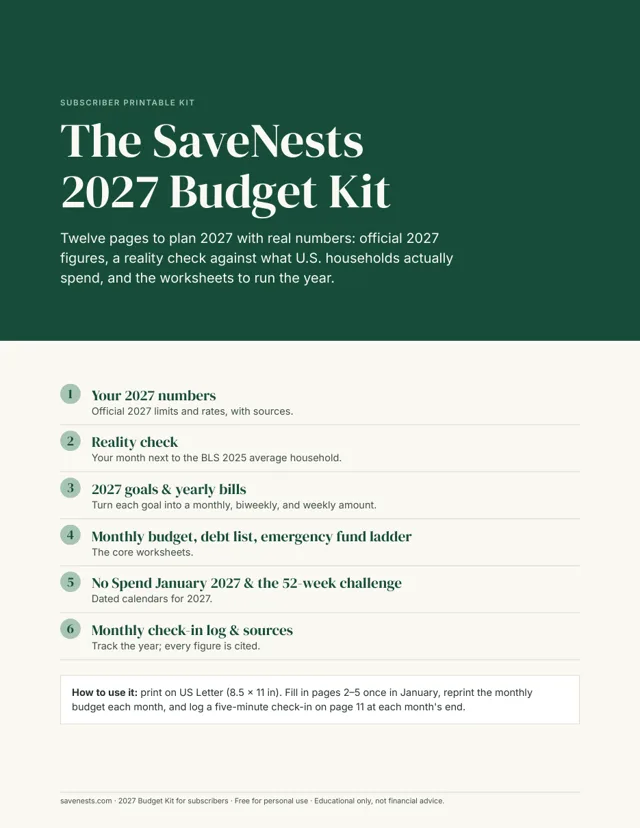
Free for subscribers
Get the 2027 Budget Kit
A 12-page printable PDF: official 2027 numbers (HSA limits, the 3.6% COLA), your month next to the BLS average household, goals and yearly bills, a monthly budget, a debt list, an emergency fund ladder, a No Spend January 2027 calendar, and dated 52-week challenge charts. Every figure is cited.