
Most Christmas budgets don't fail at the mall. They fail in October, when nobody writes a number down, and again in the second week of December, when the gifts are mostly bought but the food, the wrapping, the teacher cards, the gas for the drive to Grandma's, and the office gift exchange are still coming. By January the season has turned into a card balance that hangs around until spring.
That pattern is common, not a personal failing. In LendingTree's survey of more than 2,000 US consumers taken in mid-December 2025, 37 percent said they took on holiday debt, and the average among them was $1,223. Sixty-three percent of those borrowers expected it to take three months or longer to pay off. Nearly half (49 percent) said they had planned to go into debt all along.
This guide is the opposite of planning to borrow: find your real number from the paychecks you have left, list every holiday cost, cap each person, fund it on a schedule, and set shopping rules that survive Black Friday. If you've never built a regular monthly budget, the Budgeting for beginners hub is a good place to start alongside this one.
What is a good Christmas budget?
A good Christmas budget is the amount you can pay for in cash by the time the bills arrive, without skipping rent, groceries, minimum payments, or your regular savings. That's it. It isn't a percentage of your salary, and it isn't whatever your sister spent last year.
National averages are useful context, as long as you don't treat them as targets. The National Retail Federation's 2025 holiday survey of 8,247 adults found people planned to spend $890.49 each on average: $627.93 on gifts for family and friends and $262.56 on food, candy, decorations, greeting cards, and other seasonal items. Gallup's October 2025 poll put average expected gift spending at $1,007. When Gallup asked again in November, the estimate had dropped to $778, the largest mid-season drop it has recorded since it began comparing the two readings in 2006.
Income matters a lot, too. In that November Gallup reading, adults in households earning under $50,000 expected to spend $384 on gifts, middle-income households (Gallup's $50,000 to $99,999 group) expected $842, and households earning $100,000 or more expected $1,230. If your number is far below the national average, you're in a lot of company. And remember these are plans, not proof anyone could afford them.
The early 2026 surveys point the same way: steady plans, more caution. Circana's 2026 holiday study of 3,534 consumers, released October 8, found expected spending averaging $779, down from $796 last year, and 74 percent said they expect to save money by buying more promotional items, store brands, or simply less. In NRF's October 2026 survey of 8,094 adults, 56 percent said the economy will affect their holiday spending. Among them, 43 percent plan to shop sales more often, 31 percent will comparison shop online more, and 29 percent will use more coupons.
What's costing more this Christmas
Prices haven't moved evenly. Overall consumer prices were up 3.7 percent from September 2025 to September 2026, but some holiday lines rose much faster, and a few got cheaper. Budget with this year's prices, not last year's receipts:
| Holiday cost | Price change |
|---|---|
| Gasoline (all types) | +34.2% |
| Airline fares | +22.4% |
| Postage | +12.7% |
| Jewelry | +11.8% |
| Turkey and other uncooked poultry | +8.4% |
| Candy and chewing gum | +7.7% |
| Toys | +6.6% |
| Ham | +4.0% |
| Stationery and gift wrap | +3.7% |
| Televisions | −1.9% |
| Smartphones | −9.9% |
If you're driving to family, the travel line needs the biggest bump: gas was up about a third over the year. Toys up 6.6 percent means a $120 kid's line buys roughly what $113 bought last year. Shipping gifts costs more too, so mail early and compare that with buying online for delivery to the recipient.
Step 1: Find your Christmas number from the paychecks you have left
Count paydays, not weeks. Mid-October to Christmas 2026 is a little over nine weeks. If you're paid every Friday, that's about nine paychecks. Every other Friday, it's four or five, depending on your schedule. Paid on the 15th and the last day of the month, about four. Paid once a month, probably two.
Then ask one question for each paycheck: after rent, utilities, food, transportation, minimum debt payments, and the savings transfer you already make, how much can go to Christmas? Be honest and a little cautious. Write the number down.
If you don't know what's left after bills, do a quick monthly plan first with the monthly budget calculator, or work through How to Create a Budget When Money Is Tight if the honest answer is "not much." A $200 Christmas paid in cash beats a $900 Christmas that becomes a $1,000 balance.
Step 2: List every holiday cost, not just gifts
NRF's 2025 numbers show why this step matters: roughly 30 percent of planned holiday spending ($262.56 of $890.49) wasn't gifts at all. Budgets that only list presents run out in mid-December, right when the groceries and the extras show up. Go down this list and put a dollar amount next to each line that applies to you, even if it's small:
- Gifts for family and close friends
- Kids' stocking stuffers
- Teachers, coaches, bus drivers, babysitters, and other thank-you gifts or tips
- Office or friend gift exchanges and Secret Santa
- Holiday meals, baking, and hosting (extra groceries, drinks, paper goods)
- Travel: gas, flights, a pet sitter, or a night in a hotel
- Decorations, a tree, lights, and replacement ornaments
- Wrapping paper, tape, gift bags, and shipping
- Cards and postage
- Holiday outfits, parties, school events, and potlucks
- Charitable giving or a church or community donation
Total the non-gift lines first; whatever is left is your gift budget. Food and travel happen whether or not the presents are bought, so they get funded first. For the food line, plan the holiday weeks like any other week, with a dollar number and a few leftover nights; Meal Planning on a Budget shows how, using USDA's September 2026 food cost figures.
Step 3: Give every person a cap
Now split the gift money by name. A total like "$450 for gifts" is easy to blow because each purchase feels small. A list with a cap next to every name is much harder to drift past, since you can see exactly whose money you're spending. Here's how Jordan's $750 plays out:
| Line | Budget | Notes |
|---|---|---|
| Holiday food and hosting | $140 | Christmas dinner and baking, on top of normal groceries |
| Travel | $60 | Gas for a two-hour round trip, twice |
| Decor, wrapping, cards, postage | $40 | Reuse last year's decorations; buy tape and one roll of paper |
| Thank-you gifts and exchanges | $50 | Two teachers at $15, one $20 office swap |
| Partner | $100 | One gift |
| Two kids | $240 | $120 each, stockings included |
| Parents | $60 | One shared gift |
| Siblings and nieces/nephews | $40 | Family name draw: one $40 gift instead of five small ones |
| Cushion | $20 | For the thing you forgot |
| Total | $750 | Matches cash available by December 18 |
The $20 cushion is on purpose, for the party invitation or neighbor you forgot.
How much to spend on Christmas per child
There's no official per-child number, and anyone who gives you one is guessing about your income. What helps more is deciding two things in advance: a dollar cap per child and a gift count. Many families use the "something you want, something you need, something to wear, something to read" approach because it limits the count without making anyone feel shortchanged. Kids notice fairness between siblings more than they notice totals, so keep caps equal or explain the difference.
Families with kids feel the most pressure. NRF found that families with children planned to raise their gift budgets by more than $30 on average in 2025, and in LendingTree's survey, 48 percent of parents with kids under 18 took on holiday debt, averaging $1,324. If that sounds familiar, fund the kids' line first and trim the adults' gifts. Christmas on a Budget for Kids walks through a four-gift plan that keeps each child's cap equal. Most adults would honestly rather have a smaller gift than know you went into debt for it.
Step 4: Fund it on a schedule
Move the per-paycheck amount on payday, before it blends into everyday spending. Three ways that work:
- A separate savings account or bucket labeled "Christmas." This is a sinking fund: money set aside a little at a time for a cost you know is coming. Schedule an automatic transfer for the day after payday.
- Cash envelopes for the categories that tend to run over, usually gifts and food. When the envelope is empty, that line is done. Cash Stuffing for Beginners shows the setup.
- A spending freeze to free up cash. In the sample month in our No Spend November guide, pausing eating out, shopping, and one subscription freed about $335. Point whatever you free up at the Christmas fund before the big shopping weeks.
Whatever you choose, keep the Christmas money separate from your emergency fund. If you don't have a starter cushion yet, keep a small transfer going to a $1,000 emergency fund even in December. A car repair the week before Christmas is exactly how holiday plans end up on a card.
Step 5: Shopping rules that survive Black Friday
In NRF's October 2026 survey, 43 percent of shoppers planned to start before November, and half of those early shoppers said it was to spread out their budget, which is sensible. But 64 percent said they're likely to do most of their shopping over Thanksgiving weekend, when deal pressure peaks. A few rules keep the plan intact:
For a step-by-step plan for the sales weekend itself, see our Black Friday budget guide, and use How Much to Spend on Christmas Gifts to turn your gift total into a cap for each person.
- Shop from the written list only. If it isn't on the list, it waits until December 26 or doesn't get bought.
- Write a target price next to each gift before the sales start. A deal is only a deal if it comes in at or under that price.
- Track every purchase against the person's cap the same day. A notes app works fine; so does the back of the list.
- Keep receipts and gift receipts in one envelope. Returns are part of the budget.
- Unsubscribe from store emails for the season, or filter them to a folder you open once a week.
- When one person's line runs over, take it from someone else's line or from the cushion. Never from rent or groceries.
Credit cards and buy now, pay later
Paying with a card you clear in full on the next statement is fine and can earn rewards. The trouble starts when the balance carries over. The Federal Reserve's consumer credit report released October 7, 2026, put the average rate on credit card accounts that were charged interest at 22.36 percent for August.
Here's what that means for the average holiday balance from LendingTree's survey. Carrying $1,223 at 22.36 percent costs about $23 in interest the first month. If you pay $100 a month, it takes 15 payments to clear, and you pay roughly $178 in interest along the way. That's a gift's worth of money spent on nothing. If you already have holiday debt from last year, Debt Avalanche vs Snowball helps you pick a payoff order.
Buy now, pay later (BNPL) plans feel safer because many charge no interest. LendingTree found 45 percent of gift-givers used BNPL for at least one purchase last season. The Consumer Financial Protection Bureau notes that most BNPL loans do charge late fees, and an autopay that hits an empty checking account can trigger an overdraft fee from your bank too. If you use BNPL, count every installment as part of the Christmas budget in the month it's due. Several small plans can still add up to a January you can't pay.
If your number is smaller than you'd like
A small Christmas budget is still a real budget. Ways to stretch it:
- Suggest a name draw for adults or cousins. One thoughtful gift each costs less than ten token ones.
- Set a family price cap, like $25 per adult, and say it early, ideally before Thanksgiving.
- Give time or skills: a homemade meal, a babysitting night, a framed photo, a repair you can do.
- Shop your own house for wrapping, ribbons, and decorations before buying new ones.
- Drop one tradition that costs more than it's worth to you and keep the ones you love.
You don't owe anyone a full explanation. As LendingTree's Matt Schulz put it, if times are tough, it's OK to give friends and family a heads up that gifts may be a little light this year.
Start next year's Christmas fund in January
The cheapest Christmas is one you've been saving for since winter. In early January, while the season is still fresh, add up what this year actually cost. Your receipts and statements will tell you. Divide that total by 11 or 12 and set up a monthly transfer. A $900 Christmas is $75 a month starting in January. Start in March and it's $100 a month. Start in October and it's $300 a month. The savings goal calculator does that math for any date and amount.
Give the Christmas fund a line in every month's plan, next to car registration and insurance. If you use zero-based budgeting, it's one more job you give your dollars each month. Next October, you'll open the account and see your number already there. The other December deadlines (FSA money, your last paycheck for 401(k) changes, open enrollment) are in the year-end financial checklist.
A one-evening Christmas budget checklist
- Count the paydays between today and December 25.
- Decide what each paycheck can give after bills and regular savings, and multiply.
- Add any holiday savings you already have. That total is your Christmas budget.
- List the non-gift costs (food, travel, decor, wrapping, cards, events) and price them.
- Subtract them. Split what remains by person, with a cap and a gift count for each.
- Open or label a Christmas savings bucket and automate the per-paycheck transfer.
- Write target prices next to each gift before Black Friday.
- Track every purchase against the person's cap the same day.
- Pay any card in full when the statement comes, or don't use it for gifts.
- In January, total the real cost and start next year's monthly transfer.
Prefer paper? The one-page budget on Budget printables works as a holiday plan: paycheck math at the top, names down the side.
Questions readers ask
Are Christmas gifts and travel more expensive in 2026?
Many are. BLS data show prices from September 2025 to September 2026 up 6.6 percent for toys, 12.7 percent for postage, 22.4 percent for airline fares, and 34.2 percent for gasoline, against 3.7 percent for all items. Televisions (down 1.9 percent) and smartphones (down 9.9 percent) got cheaper.
How do I keep Christmas food costs down?
Give holiday food its own line before you budget gifts, plan the holiday weeks around a weekly dollar number, and schedule leftover nights after the big meal. Turkey and other uncooked poultry were up 8.4 percent over the year to September 2026, so price your main dish early.
What is a good Christmas budget?
One you can pay for in cash by the time the bills arrive, without cutting rent, groceries, minimum debt payments, or regular savings. Count your paydays before December 25, decide what each can spare, and add any holiday savings you already have.
How much does the average American spend on Christmas?
The National Retail Federation's 2025 survey found people planned to spend $890.49 each on gifts, food, decorations, and other seasonal items, including $627.93 on gifts. Gallup's November 2025 poll put expected gift spending at $778, down from $1,007 in October. Those are averages, not targets.
How much should I spend on Christmas per child?
There is no official number. Set a dollar cap and a gift count per child before you shop, keep siblings' caps equal or explain any difference, and fund the kids' line before adult gifts if money is tight.
How do I make a Christmas budget?
Find your total from the paychecks left before Christmas, list non-gift costs like food, travel, and wrapping first, then split what remains by person with a cap. Move the money to a separate savings bucket each payday.
Should I use a credit card for Christmas shopping?
Only if you will pay the full statement balance. The Federal Reserve reported an average rate of 22.36 percent in August 2026 on card accounts charged interest, so a $1,223 balance paid at $100 a month costs about $178 in interest over 15 payments.
Is buy now, pay later a good way to pay for Christmas?
It can spread a payment, but the CFPB notes most BNPL loans charge late fees, and autopay from an empty account can trigger overdraft fees. Count every installment in your Christmas budget and avoid stacking plans.
How do I save money for Christmas next year?
In January, total what this Christmas actually cost, divide by 11 or 12, and set up an automatic monthly transfer to a separate Christmas sinking fund. A $900 holiday is $75 a month if you start in January.
Sources
- National Retail Federation, Affordability Shapes Winter Holiday Shopping, According to NRF Holiday Survey (October 20, 2026)56 percent say the economy will affect holiday spending; of those, 43 percent will shop sales more often, 31 percent comparison shop online, 29 percent use coupons; 43 percent start before November, 50 percent of them to spread out budgets; 64 percent likely to do most shopping Thanksgiving weekend. Survey of 8,094 adults, Oct. 1–7, 2026.
- Circana, Circana's 2026 Holiday Study Finds Consumers Spending Selectively, Not Stepping Away (October 8, 2026)Expected holiday spending averages $779, versus $796 last year; 74 percent expect to adopt money-saving behaviors. Survey of 3,534 US consumers.
- U.S. Bureau of Labor Statistics, CPI Table 2, September 202612-month changes to September 2026: all items 3.7%, gasoline 34.2%, airline fares 22.4%, postage 12.7%, jewelry 11.8%, other uncooked poultry including turkey 8.4%, candy 7.7%, toys 6.6%, ham 4.0%, stationery and gift wrap 3.7%, televisions −1.9%, smartphones −9.9%.
- National Retail Federation, Consumers to Spend Second-Highest Amount on Record, According to NRF Holiday Survey (October 16, 2025)$890.49 per person planned ($627.93 gifts, $262.56 seasonal items); 42 percent planned to start before November, 54 percent of early shoppers to spread out the budget; 63 percent planned most shopping over Thanksgiving weekend; families with children planned to raise gift budgets by more than $30. Survey of 8,247 adults, Oct. 1–7, 2025.
- National Retail Federation, NRF Forecasts 2026 Holiday Sales Growth as Consumers Remain Resilient (October 15, 2026)November–December 2026 retail sales forecast to grow 4.2 percent to $1.013 trillion.
- Gallup, U.S. Holiday Shoppers Plan to Spend Briskly (October 28, 2025)Average expected holiday gift spending of $1,007 in the Oct. 1–16, 2025 poll.
- Gallup, Economic Confidence Slips; Holiday Spending Plans Plummet (December 4, 2025)November 2025 estimate of $778, down $229 from October; $384 for households under $50,000, $842 middle income, $1,230 for $100,000 or more.
- LendingTree, Holiday Debt Hits $1,223 as Tariffs Push 45% of Americans to Cut Back on Gifts (December 22, 2025)37 percent took on holiday debt averaging $1,223; parents of kids under 18: 48 percent, $1,324; 63 percent expect three months or longer to repay; 45 percent of gift-givers used BNPL. Online survey of 2,032 consumers, Dec. 10–15, 2025.
- Federal Reserve, Consumer Credit G.19 (release of October 7, 2026)Average interest rate on credit card accounts assessed interest: 22.36 percent (August 2026).
- Consumer Financial Protection Bureau, Do Buy Now, Pay Later (BNPL) loans have fees?Many BNPL loans charge no interest, but most charge late fees; autopay can trigger bank overdraft or NSF fees.
Mohamed Ouhammouche
Mohamed Ouhammouche founded and runs SaveNests, a budgeting site that helps beginners build simple budgets. This guide was reviewed by the SaveNests Editorial Desk under the editorial and fact-checking policies.
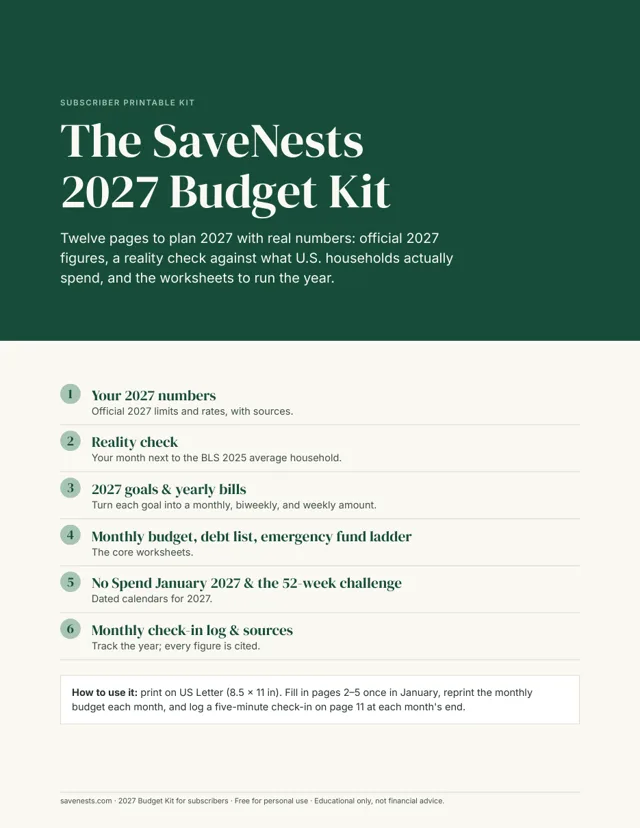
Free for subscribers
Get the 2027 Budget Kit
A 12-page printable PDF: official 2027 numbers (HSA limits, the 3.6% COLA), your month next to the BLS average household, goals and yearly bills, a monthly budget, a debt list, an emergency fund ladder, a No Spend January 2027 calendar, and dated 52-week challenge charts. Every figure is cited.