The last two months of the year are when money gets loud. Holiday sales, travel, gifts, and a pile of small deadlines land in the same few weeks, and the deadlines are easy to miss because nobody sends a reminder. Your flexible spending account won't email you before the money expires.
This year-end financial checklist is the list I'd rather work through in November than discover in February. It's written for US households, uses numbers from the IRS, the Federal Reserve, and the Bureau of Labor Statistics, and is sorted by what actually has a deadline. Skim the table, mark what applies to you, and give yourself a couple of evenings.
Year-end money deadlines at a glance
| What | Deadline | Source |
|---|---|---|
| Health FSA money (use it or lose it) | End of your plan year, often December 31, unless your plan has a grace period or carryover | IRS |
| 401(k), 403(b), 457, TSP payroll contributions for 2026 | Your last 2026 paycheck | IRS |
| Cash gifts for the new non-itemizer charitable deduction | December 31, 2026 | IRS |
| Marketplace plan for coverage starting January 1 | December 15, 2026 | HealthCare.gov |
| Marketplace Open Enrollment ends | January 15, 2027 | HealthCare.gov |
| W-2 forms from employers | By February 1, 2027 | IRS |
| IRA and HSA contributions for 2026 | Your tax filing deadline, April 15, 2027 (not including extensions) | IRS |
1. Look back at what 2026 actually cost
Pull up your bank and card statements for the year. You're looking for three things: categories that ran far over what you expected, bills that showed up only once or twice (car registration, an insurance premium, a school fee), and subscriptions you forgot you had.
The Consumer Financial Protection Bureau's free spending tracker is built for this: sort spending into categories, total each one, and separate what you had to pay from what you chose. If a full year feels like too much, do the last three months plus last December. The once-a-year bills go into step 12.
2. Spend down your FSA before it expires
A health flexible spending account is the one item on this list where waiting can cost you money you already set aside. FSAs are generally use-it-or-lose-it. For 2026, the most you could put into a health FSA through payroll was $3,400. Employers can choose to soften the rule in one of two ways: a carryover, which for plan years starting in 2026 can be up to $680 into the next year, or a short grace period after the plan year ends. Some plans offer neither.
Log in or ask HR: how much is left, when does the plan year end, and is there a carryover or grace period? Then book the eye exam or refill the prescriptions you'd need anyway. Don't buy things you won't use just to drain the account.
3. Check your workplace retirement contributions
Contributions to a 401(k), 403(b), most 457 plans, and the federal Thrift Savings Plan come out of your paycheck, so the real deadline for 2026 is your last paycheck of the year, and payroll usually needs some notice to change the percentage. For 2026, the IRS limit on employee contributions to these plans is $24,500. If you're 50 or older, you can generally add an $8,000 catch-up, and if you're 60 to 63, the higher catch-up limit is $11,250.
Most people aren't close to those limits, and that's fine. The more useful check: are you contributing enough to get any employer match your plan offers? Your plan summary will say.
4. Note the IRA and HSA deadlines (they're later)
You can make 2026 contributions to a traditional or Roth IRA until your tax filing deadline, which is April 15, 2027, not including extensions. The 2026 IRA limit is $7,500, plus a $1,100 catch-up if you're 50 or older. Health savings accounts work the same way on timing: if you had an eligible high-deductible health plan, you can contribute for 2026 up to the filing deadline. The 2026 HSA limits are $4,400 for self-only coverage and $8,750 for family coverage.
They're on a December list because a bonus or tax refund often funds them, and it helps to decide where that money goes before it arrives. If you're still building a cushion, see step 11 first.
5. Make and record charitable gifts by December 31
This one is new for 2026. Starting with the 2026 tax year, people who take the standard deduction can deduct up to $1,000 in cash contributions to eligible charities, or $2,000 for married couples filing jointly. Before this year, if you didn't itemize, your donations didn't reduce your federal income tax at all. Since the 2026 standard deduction is $16,100 for single filers, $24,150 for heads of household, and $32,200 for married couples filing jointly, most households don't itemize, so this change reaches a lot of people.
A few rules from the IRS matter here:
- It has to be cash (including checks, cards, and bank transfers) given during 2026. Donated clothing, furniture, or stock doesn't count for this deduction.
- Gifts to donor-advised funds generally don't qualify.
- The charity has to be an eligible organization. The IRS Tax-Exempt Organization Search tool lets you check.
- Keep a record of every cash gift: a bank record or a written receipt from the charity with its name, the date, and the amount. For any single gift of $250 or more, you need a written acknowledgment from the charity.
Giving should fit your budget, not the other way around. If you planned to give, put the amount in your December plan and keep the receipts in one folder.
6. Run a quick tax withholding check
A surprise tax bill in April is a budget problem, and so is a giant refund you could have used during the year. The IRS Tax Withholding Estimator takes about 25 minutes, needs your most recent pay stubs, and can produce a filled-in Form W-4 for your employer.
The IRS suggests checking every January and after big life changes. It also notes that if you changed your withholding partway through the year, you may need to update it again in late December so next year's withholding is right.
7. Don't sleep through open enrollment
If you buy health insurance through the Marketplace, Open Enrollment for 2027 coverage runs from November 1, 2026 through January 15, 2027. Pick a plan by December 15 and coverage starts January 1. Enroll between December 16 and January 15 and coverage starts February 1. If you already have a Marketplace plan, you may be automatically re-enrolled, but premiums, networks, and financial help change from year to year, so it's worth updating your expected 2027 income and comparing plans before December 15.
Employer plans have their own window. It's also when you set next year's FSA amount, so use step 2: if money was left over this year, elect a little less; if you ran out early, elect a little more.
8. Put a cap on holiday spending before the sales start
The National Retail Federation expects November and December retail sales to grow 4.2 percent over 2025, to about $1.013 trillion. In its October survey, 56 percent of holiday shoppers said the state of the economy will affect their spending plans this year, and among them, 43 percent plan to shop for sales more often. And 64 percent said they're likely to wait until Thanksgiving weekend to do most of their shopping.
Sales help only if the total is decided first. Write one holiday number covering gifts, food, travel, and decorations, and divide it by the paychecks left before you shop. How to Budget for Christmas walks through that math and sets per-person caps, and the Black Friday budget keeps deal weekend inside the plan.
9. Check your credit reports for free
AnnualCreditReport.com lets you check your reports from Equifax, Experian, and TransUnion for free every week, and checking your own report doesn't affect your credit scores.
Look for accounts you don't recognize, wrong balances, and late payments you don't think you made. Disputing an error is free.
10. Write down every balance and its interest rate
Make one list: every credit card, loan, Buy Now, Pay Later plan, and store card, with the balance, the interest rate, and the minimum payment. Credit card accounts that were charged interest averaged a 22.36 percent rate in August 2026, according to the Federal Reserve, so a balance that rides through the holidays costs real money.
Note any promotional rate that ends soon and read its terms. Once the list is done, Debt Avalanche vs Snowball helps you pick which balance gets extra money first in 2027.
11. Check where your emergency fund stands
In the Federal Reserve's survey of household finances in 2025, 63 percent of adults said they would cover a surprise $400 expense entirely with cash or its equivalent. That leaves 37 percent who wouldn't. And 55 percent said they had set aside enough to cover three months of expenses if they lost their main source of income.
Write down what's in your emergency savings and set one goal for the first quarter of 2027. If you don't have a cushion yet, How to Build a $1,000 Emergency Fund breaks the first goal into weekly amounts.
12. Build the 2027 budget on this year's real prices
A budget written in January 2026 is probably out of date. Prices for all items rose 3.7 percent in the 12 months to September 2026, according to the Bureau of Labor Statistics, but some of the lines people budget for moved much more than that. For a step-by-step plan, see how to budget for 2027, and print the free 2027 budget planner.
| Category | 12-month change |
|---|---|
| All items | +3.7% |
| Gasoline (all types) | +34.2% |
| Electricity | +4.4% |
| Utility (piped) gas service | +5.0% |
| Shelter | +3.2% |
| Food away from home | +3.5% |
| Food at home | +1.8% |
These are national averages, not a forecast of your bills. But if your gas line is the same number it was a year ago, it's probably too low. Replace each line with what you actually paid in the last two or three months. Zero-Based Budgeting Without the Spreadsheet Maze is a simple way to give every dollar of the new year's take-home a job.
Then take the once-a-year bills you found in step 1 and turn each one into a monthly set-aside. That's a sinking fund: the bill divided by the months until it's due. Next December's holiday fund belongs on that list too.
Last, start a tax folder (paper or digital) for the 2026 return. Employers have until February 1, 2027 to send W-2 forms. Add your charity receipts from step 5, any 1099 forms as they arrive, and records for IRA or HSA contributions you make before April 15.
The year-end financial checklist
- Pull this year's statements; total your categories and list once-a-year bills and forgotten subscriptions.
- Check your FSA balance, plan-year end date, and carryover or grace period rules. Spend on eligible things you need.
- Review your 401(k) or 403(b) percentage before the last paycheck. Make sure you're getting any employer match.
- Note the April 15, 2027 deadline for 2026 IRA and HSA contributions and decide where a bonus or refund will go.
- Make planned charitable cash gifts by December 31 and save every receipt.
- Run the IRS Tax Withholding Estimator with your latest pay stub.
- Compare Marketplace plans and enroll by December 15 for January 1 coverage; review employer benefits and next year's FSA election.
- Set one holiday total and divide it by your remaining paychecks before the sales start.
- Pull your free credit reports at AnnualCreditReport.com and dispute errors.
- List every debt with its balance, rate, minimum, and any promotional end date.
- Write down your emergency fund balance and a first-quarter 2027 goal.
- Build your 2027 budget from recent real bills, add sinking funds, and start the tax folder.
If twelve feels like a lot, start with the real deadlines: the FSA, your last paycheck, and December 15 if you buy your own insurance. The rest can wait for a quiet evening before New Year's.
Questions readers ask
What should be on a year-end financial checklist?
Start with anything that has a deadline: unused health FSA money, workplace retirement contributions (your last paycheck is the cutoff), charitable cash gifts by December 31, and Marketplace enrollment by December 15 for January 1 coverage. Then review your year's spending, check your withholding and credit reports, list your debts, check your emergency fund, and build next year's budget on real recent bills.
What money moves should I make before December 31?
Use or plan for remaining FSA money, adjust your 401(k) or 403(b) contribution before your final 2026 paycheck if you want to save more, and make any charitable cash gifts you planned so they count for 2026. IRA and HSA contributions for 2026 can wait until April 15, 2027.
Can I still contribute to an IRA for 2026 after December 31?
Yes. The IRS lets you make IRA contributions for a tax year until that year's tax filing deadline, not including extensions. For 2026, that's April 15, 2027. The 2026 limit is $7,500, plus $1,100 if you're 50 or older.
Can I deduct charitable donations if I don't itemize?
Starting with tax year 2026, yes, within limits. Non-itemizers can deduct up to $1,000 of cash gifts to eligible charities ($2,000 for married couples filing jointly). Noncash gifts and donations to donor-advised funds don't qualify, and you need a bank record or receipt for each gift.
What happens to FSA money I don't use by the end of the year?
Health FSAs are generally use-it-or-lose-it. Your employer may offer either a carryover (up to $680 for plan years starting in 2026) or a short grace period after the plan year ends, or neither. Check your plan's rules and remaining balance before December.
When is the deadline to sign up for Marketplace health insurance for 2027?
Open Enrollment runs November 1, 2026 to January 15, 2027. Enroll by December 15, 2026 for coverage that starts January 1, 2027. Plans chosen December 16 through January 15 start February 1.
Sources
- Internal Revenue Service, 401(k) limit increases to $24,500 for 2026, IRA limit increases to $7,500 (IR-2025-111, November 13, 2025)2026 elective deferral limit $24,500; catch-up $8,000 (age 50+), $11,250 for ages 60–63; IRA limit $7,500; IRA catch-up $1,100.
- Internal Revenue Service, IRS releases tax inflation adjustments for tax year 2026 (IR-2025-103, October 9, 2025) and Rev. Proc. 2025-322026 standard deduction $16,100 single, $24,150 head of household, $32,200 married filing jointly; health FSA limit $3,400; maximum carryover $680.
- Internal Revenue Service, Publication 15-B (2026), Employer's Tax Guide to Fringe BenefitsHealth FSA "use-or-lose" rule; plans may allow a grace period or, instead, a carryover of unused amounts.
- Internal Revenue Service, Rev. Proc. 2025-19 (HSA limits for 2026) and Publication 9692026 HSA contribution limits $4,400 self-only, $8,750 family; contributions for a year can be made through the tax filing deadline (Pub. 969).
- Internal Revenue Service, Traditional and Roth IRAsDeadline to make IRA contributions is the tax return filing deadline, not including extensions.
- Internal Revenue Service, Publication 6196 (10-2026), Charitable Contribution Deduction Tips for Non-Itemizers, and Topic no. 506Non-itemizers may deduct up to $1,000 ($2,000 married filing jointly) of 2026 cash gifts to eligible charities; donor-advised funds and noncash gifts don't qualify; keep bank records or receipts; written acknowledgment needed for gifts of $250 or more (Topic 506).
- Internal Revenue Service, Tax Withholding EstimatorAbout 25 minutes; needs recent pay stubs; check every January and after life changes; may need to update again in late December after a mid-year change.
- Internal Revenue Service, General Instructions for Forms W-2 and W-3 (2026)Employers must furnish 2026 Forms W-2 to employees by February 1, 2027.
- HealthCare.gov, When can you get health insurance? (dates and deadlines)Open Enrollment November 1 to January 15; enroll by December 15 for January 1 coverage; December 16 to January 15 for February 1 coverage.
- National Retail Federation, NRF Forecasts 2026 Holiday Sales Growth as Consumers Remain Resilient (October 15, 2026)November–December 2026 retail sales forecast to grow 4.2% over 2025 to $1.013 trillion.
- National Retail Federation, Affordability Shapes Winter Holiday Shopping, According to NRF Holiday Survey (October 20, 2026)56% say the economy will affect holiday spending; of those, 43% will shop sales more often; 64% likely to wait until Thanksgiving weekend for most shopping. Survey of 8,094 adults, October 1–7.
- AnnualCreditReport.comFree weekly credit reports from Equifax, Experian, and TransUnion; checking doesn't affect credit scores; disputes are free.
- Federal Reserve, G.19 Consumer Credit (October 2026 release)Average interest rate on credit card accounts assessed interest: 22.36% (August 2026).
- Board of Governors of the Federal Reserve System, Economic Well-Being of U.S. Households in 2025 (SHED report, May 2026)63% would cover a $400 emergency expense with cash or its equivalent (37% would not); 55% had three months of expenses set aside.
- U.S. Bureau of Labor Statistics, Consumer Price Index, September 2026 (released October 14, 2026)12 months to September 2026: all items +3.7%, gasoline +34.2%, electricity +4.4%, utility gas service +5.0%, shelter +3.2%, food away from home +3.5%, food at home +1.8% (Table A).
- Consumer Financial Protection Bureau, Your Money, Your Goals: Spending trackerSort spending into categories, total each one, and separate obligations from choices.
Mohamed Ouhammouche
Mohamed Ouhammouche founded and runs SaveNests, a budgeting site that helps beginners build simple budgets. This guide was reviewed by the SaveNests Editorial Desk under the editorial and fact-checking policies.
Free for subscribers
Get the 2027 Budget Kit
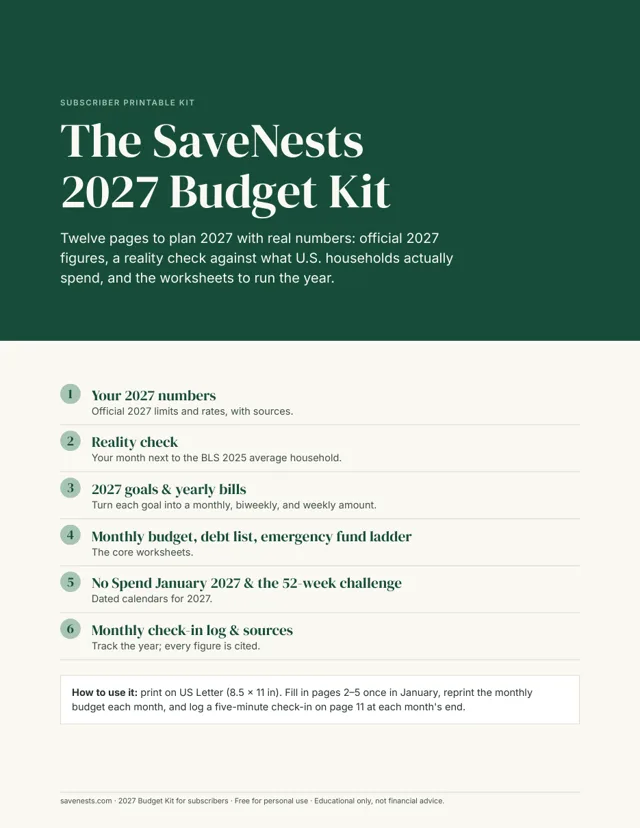
A 12-page printable PDF: official 2027 numbers (HSA limits, the 3.6% COLA), your month next to the BLS average household, goals and yearly bills, a monthly budget, a debt list, an emergency fund ladder, a No Spend January 2027 calendar, and dated 52-week challenge charts. Every figure is cited.