
Most New Year's money resolutions are written on January 1 and forgotten by the first credit card statement of February. "Save more," "get out of debt," "finally budget." They sound right, but none of them tells you what to do on a Tuesday in March.
A financial goal that lasts has four parts: a dollar amount, a deadline, a monthly (or per-paycheck) number, and a place for the money to sit. This guide gives you 15 examples of financial goals for 2027 with the math already done, an order to tackle them in, and a one-page way to track them. You don't need all 15. Two or three that fit your situation will do more than a list of ten you never look at again.
Late November is a good time to write them: you can see what December will cost, and you have five weeks to set up accounts and transfers before January 1.
Where most households are starting from
It helps to know what "normal" looks like before you set targets. The Federal Reserve's survey of household finances for 2025, published in May 2026, found:
- 63 percent of adults would cover a surprise $400 expense with cash or its equivalent. The other 37 percent would borrow, sell something, or couldn't cover it.
- 55 percent had emergency savings that would cover three months of expenses.
- 59 percent had at least one major unexpected expense in the prior 12 months. The most common was a major car repair or replacement (30 percent), followed by a house or appliance repair (22 percent) and a big medical bill (21 percent).
- Only 35 percent of adults who aren't retired thought their retirement savings were on track.
Debt is the other side. The New York Fed counted $1.285 trillion in US credit card balances at the end of September 2026, up $22 billion in the quarter and $52 billion from a year earlier. And the Federal Reserve's G.19 report puts the average rate on credit card accounts that were charged interest at 22.36 percent in the third quarter of 2026. At that rate, a $1,000 balance costs about $19 a month in interest.
How to write a financial goal you'll actually keep
SMART goals (specific, measurable, achievable, relevant, time-bound) boil down to one sentence for money:
Compare "build an emergency fund" with "I will save $1,000 by December 31, 2027, by moving $42 every other Friday into my 'Car & Surprises' savings account." The second one has a number you can check, a date you can count down to, and an action small enough to automate.
The math is just division. Take the target, divide by the number of months (or paychecks) you have, and round up a little:
| Target | Per month | Per biweekly paycheck | Per week |
|---|---|---|---|
| $500 | $41.67 | $19.23 | $9.62 |
| $1,000 | $83.33 | $38.46 | $19.23 |
| $2,500 | $208.33 | $96.15 | $48.08 |
| $5,000 | $416.67 | $192.31 | $96.15 |
| $7,500 (2027 IRA limit) | $625.00 | $288.46 | $144.23 |
| $10,000 | $833.33 | $384.62 | $192.31 |
If the monthly number makes you wince, change the deadline or the target, not the habit. $2,500 by next December that you actually reach beats $5,000 you abandon in April. The savings goal calculator runs these numbers for any amount and date.
Which goals come first
Order matters more than ambition. Investing $300 a month while a card charges 22 percent is a slow leak. This order works for most US households:
- Stay current. Every bill and every minimum payment on time. Late fees and penalty rates undo progress faster than anything else.
- A small cash cushion, $400 to $1,000, so the next car repair doesn't go on a card.
- Any employer retirement match. If your employer matches contributions, that match is part of your pay. Not taking it means leaving it on the table.
- High-interest debt, usually credit cards and payday or buy now, pay later balances that have slipped.
- A fuller emergency fund, working toward three months of essential expenses.
- Sinking funds for bills you know are coming: car registration, holidays, annual subscriptions.
- Bigger long-term goals: more for retirement, a house down payment, paying off lower-rate loans early.
You can work on two at once, like a small automatic transfer to savings plus every spare dollar to the card. Just make sure the most expensive problem gets the most money.
15 financial goals for 2027 (with the math)
These are examples, not a checklist. Each one has a sample target. Swap in your own numbers.
Quick wins to finish by spring
- Save a $400 cushion by March 31. There are 13 Fridays from January 1 to March 26, 2027, so $31 a week gets you there. That's the exact amount the Fed survey uses as its test.
- Set up autopay for every minimum payment by January 15. It isn't a savings goal, but it protects every other goal. Pay the minimum automatically, then pay extra by hand.
- Check all three credit reports by February 1. The CFPB notes you can get a free report from Equifax, Experian, and TransUnion once a week at AnnualCreditReport.com. Dispute anything you don't recognize.
- Do one no-spend month. January is the natural pick after the holidays. Our No Spend January 2027 guide has the rules and a dated calendar, and whatever you don't spend can jump-start goal 4 or goal 6.
- Cancel or downgrade one recurring bill by February 28. Write down the monthly savings and send that exact amount to your top goal so it doesn't just disappear into everyday spending.
Bigger goals for the middle of the year
- Build a $1,000 starter emergency fund by December 31. That's $83.33 a month or $38.46 per biweekly paycheck. How to Build a $1,000 Emergency Fund breaks it into stages.
- Pay off one credit card in 12 months. A $3,000 balance at 22.36 percent takes a payment of about $281 a month to clear in a year, with about $376 in total interest. Paying just $100 a month would take 45 months and cost about $1,435 in interest. See How to Pay Off Credit Card Debt for the full plan.
- Pick a payoff order for all your debts and write it down: avalanche (highest rate first) or snowball (smallest balance first). Debt Avalanche vs Snowball compares them, and the debt payoff calculator shows your dates.
- Fund a car repair sinking fund. Since a car repair was the most common big surprise expense in the Fed survey, $50 a month gives you $600 by December. Set it up alongside your other sinking funds.
- Start a Christmas 2027 fund in January. There are 48 Fridays from January 1 to November 26, 2027. $1,000 over 48 weeks is $20.83 a week. Use this year's real total from your Christmas budget as next year's target.
Goals that take the whole year (or longer)
- Save $5,000 in 2027. That's $416.67 a month or $96.15 a week, which is a stretch for most budgets. How to Save $5,000 shows a few ways to split it, and the 52-week money challenge covers $1,378 of it with an increasing weekly amount.
- Work toward three months of essential expenses. If rent, utilities, food, insurance, transportation, and minimum payments come to $3,000 a month, the goal is $9,000. Over two years that's $375 a month. Count only essentials.
- Get the full employer match. Check your plan documents or ask HR what percentage they match, then set your contribution to at least that. It's usually a one-time change in your benefits portal.
- Raise your retirement contribution by 1 percentage point. On a $50,000 salary, that's $500 more a year, and in a traditional 401(k) it comes out before income tax, so your take-home pay drops by less than that. For 2027 the IRS raised the 401(k) employee limit to $25,500. The IRA limit stays at $7,500, or $625 a month if you want to max it out.
- Hold a monthly money date. Thirty minutes on the same day each month to check balances, look at last month's spending, and move money toward goals. It's the habit that keeps the other 14 alive. The 2027 budget planner has a page for it.
Financial goals by situation
The same list doesn't fit everyone. A few adjustments by stage:
- Families with kids: sinking funds do the most work here. Back-to-school, holidays, birthdays, and the car all come back every year. The budget categories list helps you catch the ones you'd otherwise miss.
- Irregular income: set goals as a percentage of each deposit instead of a fixed monthly amount, and build the cushion bigger before anything else. See how to budget an irregular paycheck.
- 50 and older: the IRS allows catch-up contributions. For 2027, most 401(k) savers 50 and older can add $8,500 on top of the $25,500 limit, people aged 60 to 63 can add up to $11,750 instead, and the IRA catch-up stays at $1,100. Even if you can't max these out, it's a reason to revisit your percentage.
Turn the goals into a one-page plan
Goals that live in your head get renegotiated every payday. Goals on paper don't. Here's the setup:
- Pick no more than three goals from the list. One short-term, one mid-year, one long-term is a good mix.
- Write each one as a goal sentence with the amount, date, and per-paycheck number.
- Give each goal its own account or a named "bucket" inside one savings account, so the money is never mixed up with spending money.
- Schedule the automatic transfers for the day after payday, starting with your first 2027 paycheck.
- Put four check-in dates on the calendar: March 31, June 30, September 30, and December 31. At each one, compare where you are with where the math says you should be.
- Write the goals into your 2027 budget as line items, like rent or groceries. A goal that isn't in the budget is competing with everything that is.
Where to keep goal money
Savings goals should sit somewhere safe, separate, and easy to reach in an emergency, but not so easy that you spend it by accident. A savings or money market account at an FDIC-insured bank (or NCUA-insured credit union) checks all three boxes. Deposits are insured up to at least $250,000 per depositor at each insured bank.
Shop the rate. The FDIC's national averages as of November 2026 were 0.39 percent for savings, 0.64 percent for money market accounts, and 1.81 percent for a 12-month CD, and plenty of banks pay well above the average. A CD can work for a goal with a fixed date, like next December's holiday fund, as long as you won't need the money before it matures.
What to do when you fall behind
You will, at some point. A month with three birthdays, a vet bill, a slow stretch of shifts. A few rules:
- Shrink the transfer, don't stop it. $25 instead of $100 for a month keeps the habit alive.
- Move the deadline before you abandon the goal. Pushing $1,000 from December to next March is still a win.
- If you had to use the cushion, that's what it was for. Refill it before going back to the other goals.
- Watch prices, not just your plan. Consumer prices rose 0.4 percent in October 2026 alone, according to the BLS, with food up 0.5 percent. If a budget line keeps running short, raise it at your next check-in instead of pulling from savings every month.
Start before January 1
You don't have to wait for the new year. With Black Friday and Cyber Monday deals everywhere this weekend, test each purchase against your Black Friday budget and your 2027 goals. If it fits neither, skip it.
Then use December to finish the year-end financial checklist, write your two or three goal sentences, open or rename the accounts, and set up the first transfers. When January 1 arrives, the plan is already running. If you'd like a fun way to fund one of your goals, our list of money saving challenges has 15 options with yearly totals.
Questions readers ask
What are good financial goals for 2027?
Good 2027 financial goals have a dollar amount and a deadline. Common examples: save a $400 to $1,000 cushion, pay off one credit card, get your full employer retirement match, build toward three months of essential expenses, start a Christmas 2027 fund in January, and check your credit reports. Pick two or three that fit where you are now.
What are examples of short-term financial goals?
Short-term goals take a few weeks to a year: saving $400 by March 31 ($31 a week), setting up autopay for every bill, checking your three credit reports, canceling one unused subscription, doing a no-spend month, or saving $1,000 by the end of the year ($83.33 a month).
Should I save or pay off debt first in 2027?
Do both, in order. Build a small cushion of $400 to $1,000 first so surprises don't go on a card, take any employer match, then put most extra money toward high-interest debt. The Fed's G.19 report put the average rate on credit card accounts charged interest at 22.36 percent in Q3 2026, far above the 0.39 percent national average savings rate from the FDIC.
How many financial goals should I set for the year?
Two or three at a time. One short-term, one mid-year, and one long-term goal is a good mix. When one is finished, move its monthly amount to the next goal instead of letting it slip back into spending.
What are the 401(k) and IRA limits for 2027?
The IRS set the 2027 401(k), 403(b), and most 457 employee contribution limit at $25,500, up from $24,500 in 2026. The IRA limit stays at $7,500. Catch-up contributions for people 50 and older are $8,500 in most workplace plans ($11,750 for ages 60 to 63) and $1,100 for IRAs.
How do I stay on track with my money goals?
Automate the transfer for the day after payday, keep goal money in a separate savings account, and check your progress four times a year: March 31, June 30, September 30, and December 31. If you fall behind, shrink the transfer or move the deadline rather than quitting.
Sources
- Board of Governors of the Federal Reserve System, Economic Well-Being of U.S. Households in 2025 (SHED report, May 2026)63% would cover a $400 emergency expense with cash or its equivalent; 55% had three months of expenses in emergency savings; 59% had a major unexpected expense (car repair 30%, house or appliance 22%, medical 21%); 35% of non-retirees said retirement savings were on track.
- Federal Reserve Bank of New York, Quarterly Report on Household Debt and Credit, Q3 2026 (November 10, 2026)Credit card balances $1.285 trillion at the end of September 2026, up $22 billion in the quarter and $52 billion from a year earlier.
- Federal Reserve, G.19 Consumer Credit (November 6, 2026)Commercial bank interest rate on credit card accounts assessed interest: 22.36% (2026 Q3).
- Internal Revenue Service, 401(k) limit increases to $25,500 for 2027, IRA limit remains $7,500 (IR-2026-136, November 12, 2026)2027 limits: 401(k) $25,500; IRA $7,500; catch-up $8,500 (ages 60 to 63: $11,750); IRA catch-up $1,100.
- FDIC, National Rates and Rate Caps (November 2026)National average rates: savings 0.39%, money market 0.64%, 12-month CD 1.81%.
- FDIC, Deposit InsuranceDeposits are insured to at least $250,000 per depositor at each FDIC-insured bank.
- Consumer Financial Protection Bureau, How do I get a free copy of my credit reports?Free reports from Equifax, Experian, and TransUnion once a week at AnnualCreditReport.com.
- U.S. Bureau of Labor Statistics, Consumer Price Index, October 2026 (November 10, 2026)All items +0.4% and food +0.5% in October 2026 (seasonally adjusted).
Mohamed Ouhammouche
Mohamed Ouhammouche founded and runs SaveNests, a budgeting site that helps beginners build simple budgets. This guide was reviewed by the SaveNests Editorial Desk under the editorial and fact-checking policies.
Free for subscribers
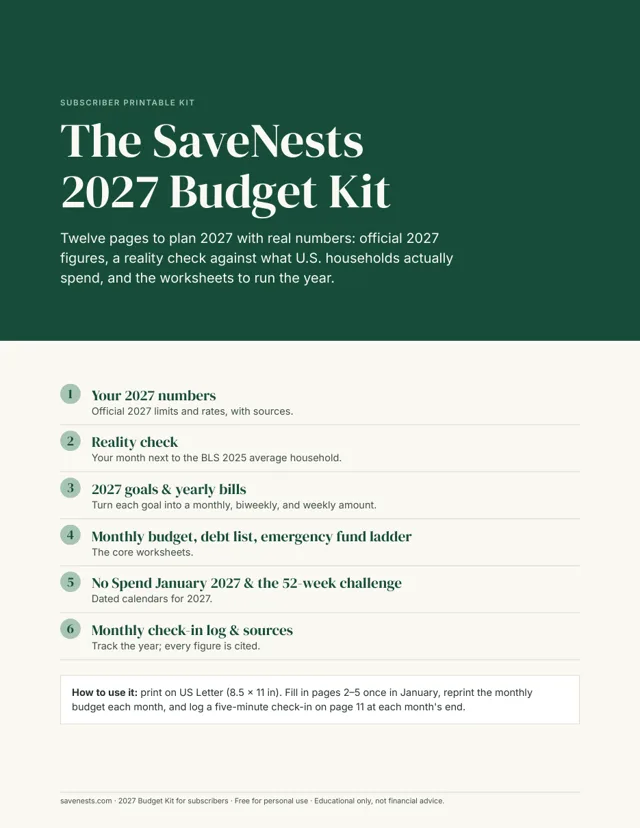
Get the 2027 Budget Kit
A 12-page printable PDF: official 2027 numbers (HSA limits, the 3.6% COLA), your month next to the BLS average household, goals and yearly bills, a monthly budget, a debt list, an emergency fund ladder, a No Spend January 2027 calendar, and dated 52-week challenge charts. Every figure is cited.