Five thousand dollars comes up a lot. It's a used-car down payment, a deposit plus moving costs, or the point where a surprise bill stops being a crisis. It's also big enough that "I'll save what's left at the end of the month" almost never gets you there.
This guide turns $5,000 into a weekly, per-paycheck, and monthly number for three timelines, shows where that money usually comes from, and explains where to keep it so it's still there when you need it. No made-up success stories, just the arithmetic and the official numbers behind it. If you haven't decided on a goal yet, How Much Should I Save Each Month? helps you choose one first.
The short answer
To save $5,000 you need about $1,667 a month for 3 months, $834 a month for 6 months, or $417 a month for 12 months. Pick the timeline your take-home pay can actually carry, move the money automatically on payday into a separate FDIC-insured savings account, and add any one-time money (a tax refund, a bonus, things you sell) straight to the pile instead of the checking account.
- Choose the timeline: 3, 6, or 12 months.
- Convert it to a per-paycheck amount using the table below.
- Find that amount: cut, earn, and redirect windfalls.
- Automate the transfer on payday.
- Keep the money somewhere insured and slightly out of reach.
- Check progress every two weeks and adjust.
How much to save per week, paycheck, and month
Here's the math, rounded up to the next dollar so you finish at or just above $5,000. A 3-month window has about 13 weeks and 6 biweekly paychecks; 6 months has 26 weeks and 13 paychecks; a year has 52 weeks and 26 paychecks.
| Timeline | Per month | Per biweekly paycheck | Per week | Per day |
|---|---|---|---|---|
| 3 months | $1,667 | $834 (6 checks) | $385 (13 weeks) | $55 |
| 6 months | $834 | $385 (13 checks) | $193 (26 weeks) | $28 |
| 12 months | $417 | $193 (26 checks) | $97 (52 weeks) | $14 |
Notice the pattern: every time you double the timeline, the monthly number is cut in half. That's the most useful lever you have. A goal that looks impossible at $1,667 a month can look ordinary at $417.
If your paychecks change from week to week, use your lowest recent month as the base and send anything above it to savings. How to Budget an Irregular Paycheck walks through that method. Paid every two weeks? How to Budget Biweekly Paychecks covers the two three-paycheck months, an easy boost here.
Which timeline fits you
Save $5,000 in 3 months
This is the hard version. At $1,667 a month, most households need more than trimming: usually a windfall, extra income, and a short stretch of very lean spending. It can work with a clear end date and a reason worth the squeeze, like a lease deposit. If it means skipping bills or putting groceries on a credit card, the timeline is too short.
Save $5,000 in 6 months
The middle option is $834 a month, or $385 per biweekly check. For many people that's still a stretch from cuts alone, but it becomes realistic once a tax refund or a few months of side income are part of the plan. A spring refund lands inside a January-to-June window, which is one reason this timeline is popular for New Year goals.
Save $5,000 in a year
At $417 a month, or $97 a week, this is the version most budgets can carry without a dramatic change. It pairs well with a structured challenge if you like checking boxes: the 52-week money challenge builds to $1,378 on its own, so you'd need more than the classic version to hit $5,000, but the weekly habit is the same.
Where the money actually comes from
There are only four sources: spending less, earning more, redirecting one-time money, and temporarily lowering another saving goal. Most $5,000 plans use at least two.
1. Spend less where the averages are big
Start with flexible categories, because rent and insurance don't change on short notice. The Bureau of Labor Statistics' Consumer Expenditure Survey for 2025, published October 29, 2026, gives a sense of scale. The average household spent $4,142 on food away from home last year, about $345 a month, and $4,084 on entertainment, about $340 a month. Those are averages across all households, not your numbers, but they show why these two lines are where most people find their first few hundred dollars.
Prices matter too. Over the 12 months ending September 2026, overall consumer prices rose 3.7 percent, food away from home rose 3.5 percent, and gasoline was up 34.2 percent. The same habits cost more than last year, so each meal out you skip saves more.
- Pull your last two months of card and bank statements and total food away from home, entertainment, shopping, and subscriptions.
- Set a new monthly cap for each, then subtract. The difference is your cut-based savings.
- Cancel or pause subscriptions you haven't opened in a month. How to Stop Overspending Without Feeling Restricted has a gentler way to decide what stays.
- Plan meals around what's on sale. 25 Realistic Ways to Save on Groceries and Meal Planning on a Budget cover the details.
A short no-spend stretch can jump-start the plan. A 30-day savings challenge or a No Spend January gives you one month of extra savings and a clear picture of which purchases you didn't miss.
2. Earn more for a set period
Extra income works best with an end date and a destination. Overtime, a seasonal job, freelance work, or selling things you no longer use all count. The rule: every extra dollar goes to the $5,000 account the day it arrives, before it blends into everyday spending.
With gig or freelance work, set aside part of each payment for taxes first. Income tax usually isn't withheld from side income, and an April tax bill can undo months of progress.
3. Redirect windfalls
One-time money is the fastest way to shorten the timeline. In the 2026 filing season, the IRS reported an average federal refund of $3,276 through early May, which by itself is about two-thirds of $5,000. Your refund may be much smaller or larger, and some people owe instead. But if you usually get a refund, decide now that it goes to this goal, so the decision is already made when the deposit shows up.
The same goes for a bonus, a cash gift, a rebate, or a third-paycheck month.
4. Pause a lower-priority goal, carefully
If you're saving for a vacation or a big purchase, you can pause that for a few months and redirect the money. What you shouldn't do is stop an employer retirement match to fund a short-term goal; the match is part of your pay, and you don't get it back later.
An example 6-month plan
Here's how the pieces could fit together for a 6-month goal. These are example amounts to show the method, not a real person's budget. Swap in your own numbers.
| Source | Per month | Over 6 months |
|---|---|---|
| Automatic transfer from regular pay | $400 | $2,400 |
| Lower eating-out and entertainment caps | $150 | $900 |
| Tax refund, deposited once | — | $1,200 |
| Selling unused items or extra shifts | $85 | $510 |
| Total | $5,010 |
Without the refund, the same plan would need about $1,200 more from cuts or extra work, roughly $200 a month. Building a table like this before you start shows you whether your timeline is realistic, and gives you a clear number to adjust if it isn't. The savings goal calculator does the monthly math for any goal and deadline.
Make it automatic
The single most effective thing you can do is schedule the transfer for the day your paycheck lands. Money you never see in checking is money you're less likely to spend. Most banks let you set a recurring transfer, and many employers let you split direct deposit so part of each check goes straight to savings.
Name the account after the goal, like "$5K car fund." A labeled account is harder to raid. If you budget with envelopes, the cash stuffing guide shows how to track a savings envelope, though a balance this size is safer in an insured account than in cash at home.
Where to keep $5,000
Keep it somewhere boring, insured, and separate from checking. Deposits at FDIC-insured banks are covered up to $250,000 per depositor, per bank, per ownership category, so a $5,000 savings goal is fully protected at an insured bank. Credit unions have similar coverage through the NCUA.
Shop the rate, because the gap is wide. The FDIC's national average savings rate was 0.38 percent as of October 2026. At that rate, a full $5,000 sitting for a year earns about $19. Many online banks and credit unions pay several times the national average on savings or money market accounts, so it's worth comparing a few before you open one. Check that the rate is listed as an APY and that the institution is federally insured.
A CD can help if you're sure of the date. The FDIC national average was 1.39 percent for a 6-month CD and 1.76 percent for a 12-month CD in the same release, and individual banks often pay more. The catch is an early withdrawal penalty, so only lock up money you're certain you won't need before the term ends. For a goal you're still building, a savings account is usually simpler.
Should you save $5,000 or pay off debt first?
If you carry credit card debt, compare the rates. The Federal Reserve's latest consumer credit release shows an average 22.36 percent interest rate on credit card accounts that were charged interest (August 2026, the latest quarterly reading). No savings account comes close to that, so every dollar of high-rate balance you pay off is worth more than a dollar sitting in savings.
A practical middle path is to build a small buffer first, so a surprise bill doesn't go straight back on the card, then send most extra money to the debt. How to Build a $1,000 Emergency Fund covers the first step and How to Pay Off Credit Card Debt covers the second. Once the card is paid off, the payment you were making becomes your $5,000 savings transfer.
Why $5,000 is a meaningful number
$5,000 isn't magic, but it's a level many households don't have available. In the Federal Reserve's survey of household finances for 2025, published May 2026, 38 percent of adults said the largest emergency expense they could cover right now using only their savings was $5,000 or more. Fifty-five percent said they had set aside enough to cover three months of expenses in an emergency or rainy day fund.
The same survey found a strong link between regular saving and having that cushion: 86 percent of adults who always had money left over at the end of the month had three months of expenses set aside, compared with 13 percent of those who never had money left over. Nationally, the Bureau of Economic Analysis put the personal saving rate at 3.8 percent of disposable income in September 2026. A $5,000 goal is a concrete way to push your own rate above that.
If money is very tight right now, a smaller first goal is not a failure. How to Save Money on a Low Income starts from where the budget really is, and every dollar saved toward $5,000 still counts if the timeline needs to stretch.
How to stay on track
- Track the balance, not the cuts. Write the total down every payday; seeing $1,155 become $1,540 is what keeps people going.
- Use a visual tracker. A printed grid with 50 squares of $100 each makes the goal feel finite.
- Plan for known expenses. Car registration, gifts, and annual subscriptions are the usual reasons people dip into savings. Set up sinking funds for them so the $5,000 account stays untouched.
- If you miss a month, don't restart. Extend the timeline by a month or add a little to each remaining transfer.
- At the halfway point, if you're behind, pick a longer timeline instead of quitting.
$5,000 savings checklist
- Choose 3, 6, or 12 months and write down the per-paycheck amount.
- Open or label a separate, federally insured savings account for the goal.
- Set an automatic transfer on payday.
- Set new caps for eating out, entertainment, and shopping.
- Decide in advance where your tax refund, bonuses, and extra income go.
- Build a $1,000 buffer first if you carry high-rate card debt.
- Set up sinking funds for irregular bills.
- Check the balance every payday and adjust the timeline if needed.
Saving $5,000 is mostly a math problem, broken into weekly pieces and handled by an automatic transfer. Once you finish, keep the transfer running. The habit is worth more than the first $5,000.
Questions readers ask
How much do I need to save each month to have $5,000 in 6 months?
About $834 a month, which is $385 per biweekly paycheck over 13 paychecks or $193 a week over 26 weeks. Those amounts are rounded up so you finish at or just above $5,000.
Is it possible to save $5,000 in 3 months?
It's possible, but it takes about $1,667 a month, so most people combine spending cuts with a windfall like a tax refund or bonus and some extra income. If it would mean missing bills or using a credit card for groceries, a 6- or 12-month timeline is safer.
How much should I save per paycheck to reach $5,000 in a year?
If you're paid every two weeks, save $193 per paycheck for 26 paychecks. If you're paid weekly, save $97 a week. If you're paid monthly, save $417 a month.
Where should I keep my $5,000 savings?
Keep it in a separate savings or money market account at an FDIC-insured bank or NCUA-insured credit union. Deposits are insured up to $250,000 per depositor, per institution, per ownership category. Compare rates, because many accounts pay far more than the national average of 0.38 percent reported by the FDIC in October 2026.
Should I save $5,000 or pay off credit card debt first?
If you carry a credit card balance, build a small emergency buffer first, then put most extra money toward the card. Credit card accounts charged interest averaged a 22.36 percent rate in the Federal Reserve's latest data, which is far more than a savings account earns.
Is there a $5,000 savings challenge?
Yes, there are many versions, usually a printable chart where you color in a box each time you save a set amount. A simple one is 50 boxes of $100 each. Any chart works as long as the amounts add up to $5,000 and fit your timeline.
Can a tax refund help me save $5,000?
It can be the biggest single piece. The IRS reported an average refund of $3,276 in the 2026 filing season through early May. Deciding ahead of time that your refund goes straight to the goal can shorten the timeline by months.
Sources
- U.S. Bureau of Labor Statistics, Consumer Expenditures 2025 (news release, October 29, 2026)Average 2025 spending per consumer unit: food away from home $4,142; entertainment $4,084; total expenditures $81,905.
- U.S. Bureau of Labor Statistics, Consumer Price Index, September 2026 (October 14, 2026)12-month change: all items +3.7%; food away from home +3.5%; gasoline +34.2%.
- Internal Revenue Service, Filing season statistics for week ending May 8, 2026Average refund amount $3,276 (2026) versus $2,939 (2025).
- Federal Deposit Insurance Corporation, National Rates and Rate Caps (as of October 19, 2026)National average rates: savings 0.38%; money market 0.63%; 6-month CD 1.39%; 12-month CD 1.76%.
- Federal Deposit Insurance Corporation, Deposit InsuranceStandard coverage is $250,000 per depositor, per insured bank, for each ownership category.
- Federal Reserve, Consumer Credit G.19 (release of November 6, 2026)Average interest rate on credit card accounts assessed interest: 22.36% (latest quarterly reading).
- Board of Governors of the Federal Reserve System, Economic Well-Being of U.S. Households in 2025 (SHED, May 2026)38% said the largest emergency expense they could cover now from savings was $5,000 or more (table 26); 55% had three months of expenses in a rainy day fund; 86% of those who always had money left over vs 13% of those who never did.
- U.S. Bureau of Economic Analysis, Personal Saving RatePersonal saving rate 3.8% of disposable personal income, September 2026.
Mohamed Ouhammouche
Mohamed Ouhammouche founded and runs SaveNests, a budgeting site that helps beginners build simple budgets. This guide was reviewed by the SaveNests Editorial Desk under the editorial and fact-checking policies.
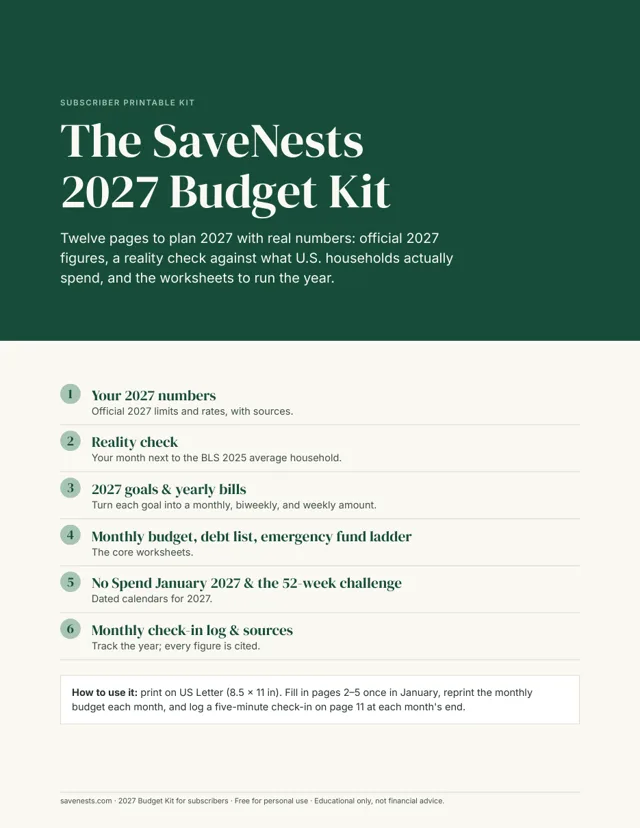
Free for subscribers
Get the 2027 Budget Kit
A 12-page printable PDF: official 2027 numbers (HSA limits, the 3.6% COLA), your month next to the BLS average household, goals and yearly bills, a monthly budget, a debt list, an emergency fund ladder, a No Spend January 2027 calendar, and dated 52-week challenge charts. Every figure is cited.