Every January, a lot of people promise themselves they'll "spend less this year." By March, most of them can't say what that meant. A low buy year fixes the vague part. You decide, in writing, which kinds of things you won't buy for 12 months, which things you'll still buy under clear conditions, and where the money you don't spend is going to land. Then you live with that list instead of arguing with yourself at every checkout.
It's not a vow of poverty and it's not a no-spend challenge stretched to a full year. You still buy groceries, pay bills, replace the shampoo when it runs out, and go out for dinner on a birthday. What changes is the stuff you buy on autopilot, like the fourth hoodie or the gadget that does what your old one already does. This guide walks through the rules, a template you can copy, and a plan for 2027 that starts on Friday, January 1.
What is a low buy year?
A low buy year is a 12-month plan to cut back on non-essential purchases using a short set of rules you write yourself. The rules usually name a few categories you'll stop buying (say, clothes, decor, and makeup), a few that are allowed only when you've used something up or it breaks, and a small number of planned purchases you're allowed to make on purpose. Essentials stay untouched.
It sits between two better-known challenges. A no-spend month pauses almost everything non-essential for a few weeks. A no buy year bans whole categories outright for 12 months. A low buy year is the softer version, and for most people that's exactly why it lasts.
| No-spend month | Low buy year | No buy year | |
|---|---|---|---|
| How long | About 30 days | 12 months | 12 months |
| What's paused | Almost all non-essential spending | A few chosen categories, plus impulse buys | Whole categories, no exceptions |
| Exceptions | Very few | Replacements, planned purchases, a fun-money number | Usually none |
| Best for | A quick reset after a big month | Changing habits without feeling deprived | People who already know their trigger categories |
If you want a short warm-up first, No Spend January 2027 has a dated calendar and rules for the first month. Many people use it as month one.
Why a low buy year makes sense going into 2027
Most of a household budget isn't up for debate. Rent, insurance, and the car payment are what they are. The room to change is in the flexible lines, and those add up to more than people expect. In the Bureau of Labor Statistics' Consumer Expenditure Survey for 2025, released October 29, 2026, the average household spent $81,905 for the year. Five categories where a low buy year usually does its work came to $13,577 of that, or about $1,131 a month.
| Category | 2025 average a year | About a month |
|---|---|---|
| Food away from home | $4,142 | $345 |
| Entertainment | $4,084 | $340 |
| Household furnishings and equipment | $2,355 | $196 |
| Apparel and services | $2,010 | $168 |
| Personal care products and services | $986 | $82 |
| Total | $13,577 | $1,131 |
These are national averages, and entertainment in the BLS survey is a broad bucket that includes admissions, streaming and audio-visual gear, pets, toys, and hobbies. Your lines may be higher or lower. The point is scale: this is where a few clear rules move real money.
Prices also haven't stopped rising. The Consumer Price Index for all items rose 3.7 percent in the 12 months to September 2026, and before seasonal adjustment the gasoline index was 37.4 percent higher in October 2026 than a year earlier. When essentials cost more, the money has to come from somewhere. A low buy year lets you choose where, instead of finding out on the card statement.
Step 1: Pick a reason and a dollar goal
"Spend less" isn't a goal. "Pay off the $2,400 card balance by September" is. Before you write a single rule, decide what the year is for. Write it at the top of your rules page.
Then put a number on it. One simple way: look at what you spent on the flexible lines over the last two or three months and decide what share you'll cut. Using the national averages above as an illustration, cutting those five categories by a quarter would free about $3,394 a year, or roughly $283 a month. Your own number will differ. If you've never tracked spending, the monthly budget calculator is a quick way to see what's left after bills.
Step 2: Write your low buy year rules
The rules are the whole system, so keep them short enough to fit on one page. I find it easiest to sort everything into three lists.
1. Not buying this year
Pick two to four categories where you already own plenty and buy mostly on impulse. Clothes, shoes, decor, kitchen gadgets, books you won't get to, beauty products, tech accessories, and hobby supplies are the usual suspects. Be specific: "no new clothes except work shoes when mine wear through" is a rule you can follow. "Buy less clothing" isn't.
2. Buying only when a condition is met
This is the list that keeps a low buy year from turning miserable. Items here are allowed, but only when something specific happens: you've used the last of it, it broke and can't be repaired, or it's on your planned-purchase list. Toiletries, cleaning supplies, and makeup often go here with a "use it up first" rule. So does anything you'd replace anyway, like a phone charger or running shoes.
3. Always fine
Write down what's never restricted, so you don't feel guilty about it: groceries, bills, medicine, kids' needs, gifts within your holiday budget, and repairs. Keep one or two things you love on it, too. A year that cuts everything you enjoy won't make it to spring.
Low buy year rule ideas you can borrow
- Use it up first: no new toiletries, makeup, or cleaning products until the current one is empty.
- One in, one out for clothes: anything new replaces something that's worn out, and the old one leaves the house.
- A 30-day list: anything not on your rules list waits 30 days on a written list before you can buy it.
- Planned purchases: allow yourself a small number of deliberate buys each quarter, chosen in advance.
- Repair, borrow, or buy used before buying new.
- Gifts come from the gift budget, not from your own spending money.
- Fun money is guilt-free: spending inside your number is never a rule break.
- Sales don't create new needs. A discount only counts on something already on your list.
Step 3: Give allowed spending a real number
A low buy year still needs a line for wants. Without one, you'll either feel deprived or spend anyway and call the whole year a failure. Pick a monthly fun-money amount based on what you actually spend now, then trim it a little at a time. If takeout and small treats ran $400 last month, starting at $150 is a cut you'll fight daily. Start at $300 and adjust after a quarter.
Keep it visible. A separate debit card, a cash envelope, or a running total in your phone all work. Cash Stuffing for Beginners shows the envelope version if you like seeing the money leave. The 100 Envelope Challenge is a dated way to fill those envelopes toward a set total. The method is the same one in How to Stop Overspending Without Feeling Restricted, stretched to twelve months.
Step 4: Make impulse buys a little harder
Small changes to your surroundings outlast willpower:
- Unsubscribe from store emails and turn off sale notifications in shopping apps.
- Remove saved card numbers from the sites you buy from most, so every purchase means typing it in.
- Keep a running "wanted" list in your phone. Writing an item down scratches the itch more often than you'd think.
- Before any buy-now-pay-later checkout, count every installment against this month's fun money. The CFPB notes that while many BNPL loans don't charge interest, most charge late fees for missed payments.
Step 5: Send the money somewhere on payday
Money you don't spend has a way of getting spent anyway unless it moves. Pick one destination per goal and set an automatic transfer for payday, so the savings happen before you see the balance. If card debt is the goal, the debt avalanche vs snowball comparison helps you pick which balance gets it.
- Card debt first. Credit card accounts that were charged interest averaged a 22.36 percent rate in the third quarter of 2026, according to the Federal Reserve. Every dollar you don't spend on a want and send to that balance earns that rate back. How to Pay Off Credit Card Debt helps you pick an order.
- A starter emergency fund. In the Fed's survey of household finances for 2025, 63 percent of adults said they'd cover a surprise $400 expense with cash or its equivalent, which means 37 percent wouldn't. A low buy year is a good way to get into the first group.
- Sinking funds for things you'll buy anyway. Christmas 2027, car repairs, and the annual insurance bill aren't surprises. Sinking funds spread them across the year so December doesn't undo your progress.
Where you keep the money matters a little too. The FDIC's national average rate on savings accounts was 0.39 percent as of November 16, 2026, and the 12-month CD average was 1.81 percent. Many FDIC-insured accounts pay more than the average, so compare a few before you park a year of savings.
A low buy year template you can copy
Here's a sample filled in for one person. The categories and amounts are illustrations. Swap in your own.
| Category | Rule | Exceptions |
|---|---|---|
| Clothes and shoes | Not buying | Replace work shoes or a coat if worn out; one in, one out |
| Home decor | Not buying | None; rearrange or swap with friends instead |
| Beauty and toiletries | Use it up first | Buy a replacement when the current one is empty |
| Books | Library first | Two planned purchases a quarter |
| Tech and gadgets | Only if broken and can't be repaired | Phone or laptop replacement after a repair quote |
| Eating out | $120 a month | Birthdays and work events come from the same line |
| Fun money | $150 a month | Spend it on anything, no guilt |
| Savings goal | $283 a month to the card balance | Raise it when a quarter comes in under |
If you like paper, the 2027 budget planner has monthly pages where the rules and a running total can live together, and How to Budget for 2027 covers setting the bigger numbers for the year.
A simple 2027 calendar for a low buy year
- January 1 (Friday): write your rules, set up the payday transfer, and do the subscription pass. Consider a no-spend January as month one.
- End of each month: add up fun money and the savings transfer. Ten minutes is enough.
- March 31, June 30, September 30: quarterly check. Pick that quarter's planned purchases, look at the 30-day list, and adjust any rule that keeps breaking.
- Late November: Black Friday sales only for items already on your list. The Black Friday budget guide helps.
- December: holiday gifts come from the Christmas sinking fund you've been filling all year, not from new debt.
What to do when you break a rule
You will. A sale, a bad week, a friend's wedding you didn't plan for. One purchase doesn't end the year. Write down what you bought and what it cost, take it out of fun money or the next month's flexible lines, and move on. If the same rule breaks two or three months in a row, the rule is wrong, not you. Loosen it, add an exception, or move that category to the "buying with conditions" list.
Low buy year checklist
- Write down why you're doing it and a dollar goal for the year.
- List two to four categories you won't buy.
- List what's allowed only when used up, broken, or planned.
- List what's always fine, including one or two things you love.
- Set a monthly fun-money number from your real spending.
- Unsubscribe from store emails and remove saved cards.
- Cancel subscriptions nobody used in the last 30 days.
- Set an automatic payday transfer to your goal.
- Check in monthly, adjust quarterly, and don't quit over one slip.
Questions readers ask
What is a low buy year?
A low buy year is a 12-month plan to cut non-essential spending using rules you write yourself. You name a few categories you won't buy, a few you'll buy only when something is used up or broken, and what's always allowed, like groceries and bills. The money you don't spend goes to a set goal.
What's the difference between a low buy year and a no buy year?
A no buy year bans whole categories with no exceptions for 12 months. A low buy year is softer: it allows replacements, a small number of planned purchases, and a monthly fun-money amount. Because it's less strict, it's easier for most people to keep going all year.
What are good low buy year rules?
Common rules include using up toiletries and makeup before buying more, one in and one out for clothes, a 30-day waiting list for anything not on your rules, a few planned purchases each quarter, repair or buy used before buying new, and a guilt-free fun-money number each month.
How much can you save with a low buy year?
It depends on what you spend now. As an illustration, the average household spent $13,577 in 2025 on food away from home, entertainment, furnishings, apparel, and personal care, according to the BLS. Cutting that by a quarter would free about $3,394 a year, or roughly $283 a month.
Can I still buy gifts during a low buy year?
Yes. Gifts usually go on the always-fine list, as long as they come from a set gift or holiday budget rather than your personal spending money. A Christmas sinking fund filled monthly through the year makes December much easier.
When should I start a low buy year?
Any month works, but January 1 is a natural start. In 2027 it falls on a Friday. Many people open with a no-spend January as a reset, then switch to the softer low buy rules from February.
Sources
- U.S. Bureau of Labor Statistics, Consumer Expenditures 2025 (news release, October 29, 2026)Average annual expenditures $81,905; food away from home $4,142; entertainment $4,084; household furnishings and equipment $2,355; apparel and services $2,010; personal care products and services $986 (Table 1).
- U.S. Bureau of Labor Statistics, Consumer Price Index, October 2026Gasoline (all types) +37.4% unadjusted, 12 months ended October 2026; most October 2026 12-month changes not published because October 2025 data were not collected.
- U.S. Bureau of Labor Statistics, CPI-U All items, U.S. city average (series CUUR0000SA0)September 2025 324.800; September 2026 336.940 (+3.7%).
- Federal Reserve, G.19 Consumer Credit (November 6, 2026)Commercial bank interest rate on credit card accounts assessed interest: 22.36% (2026 Q3).
- Board of Governors of the Federal Reserve System, Economic Well-Being of U.S. Households in 2025 (SHED report, May 2026)63 percent of adults would cover a hypothetical $400 emergency expense completely with cash or its equivalent; 37 percent would not.
- FDIC, National Rates and Rate Caps (as of November 16, 2026)National average savings rate 0.39%; 12-month CD 1.81%.
- Consumer Financial Protection Bureau, What is a Buy Now, Pay Later (BNPL) loan?Many BNPL loans don't charge interest, but most charge late fees for missed payments.
Mohamed Ouhammouche
Mohamed Ouhammouche founded and runs SaveNests, a budgeting site that helps beginners build simple budgets. This guide was reviewed by the SaveNests Editorial Desk under the editorial and fact-checking policies.
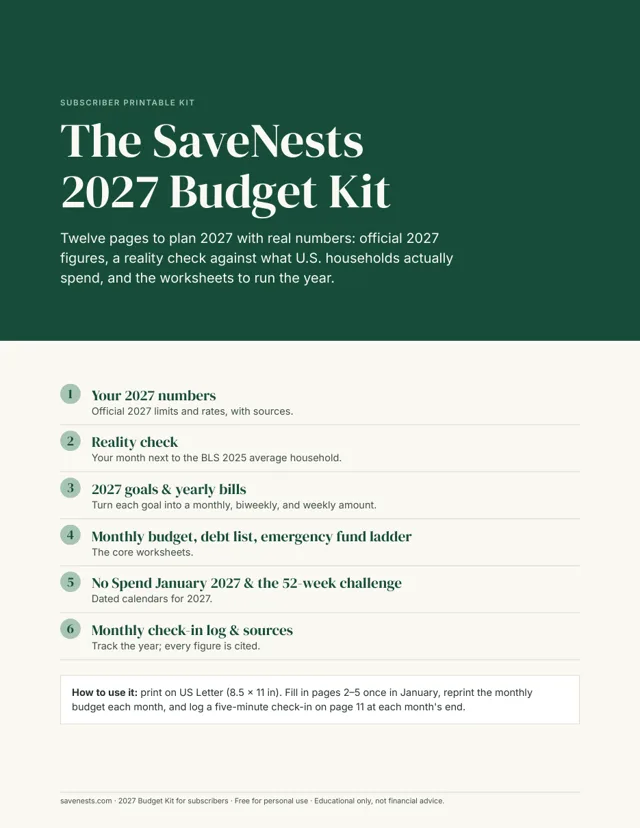
Free for subscribers
Get the 2027 Budget Kit
A 12-page printable PDF: official 2027 numbers (HSA limits, the 3.6% COLA), your month next to the BLS average household, goals and yearly bills, a monthly budget, a debt list, an emergency fund ladder, a No Spend January 2027 calendar, and dated 52-week challenge charts. Every figure is cited.