Most advice on how to stop overspending sounds like a diet plan. Cut out coffee. Delete every shopping app. Stop eating out. It works for a few days, and then a long week, a birthday, or a sale breaks the streak, and the whole budget starts to feel like a failure.
The approach here is different. You don't need to ban the things you enjoy. You need to know which few categories actually blow up your month, decide ahead of time how much you'll spend on wants, and put a little friction between you and the purchases you regret. That's a plan you can keep through November and December, when the pressure to spend is at its highest.
Overspending is usually a planning gap, not a character flaw
If money disappears before the month ends, you're in big company. In the Federal Reserve's survey of household finances in 2025, only 41 percent of adults said they always or often had money left over at the end of the month. Thirty percent said rarely or never.
That gap matters, because money left over is how savings get built. In the same survey, 86 percent of adults who always had money left at the end of the month had savings to cover three months of expenses. Among those who never did, it was 13 percent.
Overspending also tends to hide on a card. Eighty-two percent of adults had a credit card in 2025, and 45 percent of cardholders carried a balance at least once in the prior year. Credit card accounts that paid interest averaged a 22.36 percent rate in the third quarter of 2026, according to the Federal Reserve's November 6, 2026 consumer credit release. So a month that runs $200 over doesn't just cost $200 if it rides on a card for a while.
None of that means you're bad with money. It means spending decisions are being made at the register instead of on payday. The steps below move them back to payday.
Step 1: Track what you spend for two to four weeks
Before you cut anything, find out where the money actually goes. The Consumer Financial Protection Bureau's free spending tracker suggests recording every purchase for a month, or for one or two weeks if a month feels like too much. Keep receipts in an envelope, or write down the amount and what it was for when there's no receipt. Then add up each category by week.
Don't change your habits during the tracking period. You're collecting evidence, not performing. When you're done, the CFPB suggests asking a few plain questions:
- Which expenses surprised you?
- Where did you spend on things you now consider unnecessary?
- Are you paying for services or subscriptions you don't really use?
- Are there fees on a card or account you could get rid of?
- How does your weekday spending differ from your weekend spending?
Your bank and card statements can fill in anything you missed. If the tracking turns up a month that doesn't balance at all, start with the bills in How to Create a Budget When Money Is Tight before working on wants.
Step 2: Find the three categories that move your month
Rent, car payments, and insurance don't change much from one month to the next. Overspending almost always lives in the flexible lines: eating out, shopping, entertainment, and the small stuff that doesn't feel like a purchase. Look at your tracker and circle the three categories with the biggest totals that you chose in the moment.
For context, here's what the average US household spent on a few of those flexible categories in 2025, according to the Bureau of Labor Statistics Consumer Expenditure Survey released October 29, 2026, along with how fast those prices rose in the 12 months to September 2026 (the latest full-year comparison, because October 2025 prices weren't collected).
| Category | 2025 average a year | About a month | Price change, year to Sept 2026 |
|---|---|---|---|
| Food away from home | $4,142 | $345 | +3.5% |
| Entertainment | $4,084 | $340 | +2.3% (recreation services) |
| Apparel and services | $2,010 | $168 | +3.4% (apparel) |
These averages aren't targets, and your numbers may be much higher or lower. They're useful in one way: if your eating-out line is far above $345 a month, that's probably where your plan has the most room. Average spending on eating out rose 5.0 percent from 2024 to 2025, and restaurant prices rose faster than grocery prices over the last year (3.5 percent versus 1.8 percent for food at home). They kept climbing in October 2026, when the food away from home index rose another 0.5 percent and full-service meals 0.7 percent. So moving a couple of takeout nights back to the kitchen stretches further than it used to. 25 Realistic Ways to Save on Groceries covers the grocery side.
Pick only three. Trying to fix ten categories at once is exactly the kind of strict plan that collapses after a week.
Step 3: Give fun money a real number
This is the part that keeps you from feeling restricted. Instead of treating wants as whatever's left (which usually means nothing is left, and then you spend anyway), give them a line in the budget with a dollar amount. Call it fun money, personal spending, or blow money. The name doesn't matter. The number does.
- Set it from your tracker, not from a wish. If you spent $400 on takeout and shopping last month, a $150 fun-money line is a cut you'll fight every day. Try $300 first, then trim.
- Make it guilt-free. Spending inside the fun-money number isn't overspending. That's the point.
- Give each adult their own amount if you share money, so nobody has to justify a coffee.
- Keep it visible. A separate debit card, a cash envelope, or a note on your phone with the running total all work. Cash Stuffing for Beginners shows the cash version.
If you follow the 50/30/20 rule, fun money comes out of the 30 percent for wants. If you use zero-based budgeting, it's just one more line that gets a job. Either way, the monthly budget calculator lets you see whether the number fits.
Step 4: Use a pause rule that's specific
"Think before you buy" isn't a rule. A rule has a number and a time in it. Here's a simple one: anything over a set amount that isn't on your list waits 48 hours. Pick the amount that fits your budget, maybe $30, maybe $75.
- Put the item in a note or leave it in the online cart. Don't check out.
- Write down the price and which budget line it would come from.
- After 48 hours, ask: do I still want it, and is there room in that line this month?
- If yes, buy it without guilt. If you forgot about it, that's money you kept.
The pause isn't a ban. Plenty of things you buy after 48 hours are worth buying. It just moves the decision away from the moment a countdown timer or a "only 2 left" banner is making it for you.
Step 5: Add friction where you overspend
It's easier to change your surroundings than your willpower. A few small changes that make impulse buys a little slower:
- Remove saved card details from the shopping sites and apps you use most, so every purchase means typing the number.
- Unsubscribe from store emails and turn off sale notifications. You can always visit a store when you need something.
- Delete the food delivery app from your home screen, or keep it but set the delivery nights in advance.
- Go through your statement for recurring charges and cancel the subscriptions you didn't use last month. Before you sign up for a free trial, put the end date in your calendar.
- Shop with a list, and check a store's weekly ad only for items already on it.
Step 6: Watch the borrowing that hides overspending
Paying later can make a purchase feel smaller than it is. Sixteen percent of adults used Buy Now, Pay Later in 2025, up from 15 percent the year before, according to the Fed. Among those users, 26 percent paid late at least once, and 11 percent had a BNPL payment trigger an overdraft or non-sufficient-funds fee from their bank. Nearly half of BNPL users bought clothing or accessories this way, and one in five used it for groceries or food delivery.
Store credit cards bring their own trap. A promotion that says "no interest if paid in full within 12 months" is a deferred-interest plan. The CFPB explains that if any of the balance is left at the end of the period, or you're more than 60 days late on a minimum payment, you can be charged all the interest going back to the purchase date. And minimum payments usually won't pay off the balance in time.
A simple guardrail: if you couldn't pay for it in cash this month, it counts against this month's fun money anyway, or it waits. If card balances are already part of the picture, Debt Avalanche vs Snowball helps you choose which one to pay down first.
How to stop overspending during the holidays
November and December pack sales, gifts, travel, and food into a few weeks, so overspending is easier than at any other time of year. The same tools still work, with a couple of adjustments:
- Set the total first. Decide the holiday number before the sales start, then split it by person. How Much to Spend on Christmas Gifts walks through the math.
- Shop sales from a list. Use the Black Friday budget guide to write down what you're buying and the price you'd pay anyway, so a discount on something you didn't plan to buy doesn't count as savings.
- Be wary of "buy before prices go up." In the Fed's 2025 survey, 18 percent of adults said they'd made a major purchase earlier than planned because they expected prices to rise. Sometimes that's smart. It's only smart if the purchase was already on your list.
- Try a short reset. No Spend November is a month-long experiment that pauses non-essential spending with exceptions you choose, and it's a good way to rebuild the habit before December.
- Give next year's holidays a sinking fund, so December stops being a surprise you pay for in January.
- Plan a softer reset for the new year. A low buy year applies these same steps to 12 months: a few categories you don't buy, replacements only when something runs out or breaks, and a fun-money number that stays.
What to do the week the plan breaks
It will break at some point. A friend's birthday dinner, a bad day, a sale on something you really wanted. That week doesn't erase the plan. Here's how to recover without throwing everything out:
- Write down what happened and the amount. No commentary needed.
- Take the overage from the fun-money line or one of your flexible categories for the rest of the month. Don't cut groceries you need or skip a bill.
- If the same category breaks two months in a row, the number was probably wrong. Raise it a little and lower a different line.
- If the problem keeps being the same situation (late-night scrolling, shopping when stressed, payday splurges), add friction to that situation specifically.
Overspending checklist
- Track every purchase for two to four weeks without changing anything.
- Circle the three flexible categories with the biggest totals.
- Set a fun-money number based on what you actually spent, then trim slowly.
- Pick a pause rule: anything over $___ that isn't on the list waits 48 hours.
- Remove saved cards, unsubscribe from store emails, and cancel unused subscriptions.
- Treat BNPL and store-card promotions as spending from this month.
- Set a holiday total before the sales start.
- When a week goes over, cover it from a flexible line and adjust next month.
Questions readers ask
How do I stop overspending money?
Track your spending for two to four weeks, then pick the three flexible categories with the biggest totals. Give wants a set dollar amount in your budget, use a specific pause rule (for example, anything over $50 that isn't on your list waits 48 hours), and remove easy ways to buy, like saved cards and store emails.
Why do I keep overspending every month?
Usually because spending decisions are made at the register instead of on payday. Wants that don't have a number in the budget tend to take whatever's left, and then some. Setting a fun-money amount from your real spending and tracking against it closes that gap.
How much fun money should I budget?
Start with what you actually spent on wants last month, then trim gradually. A number far below your real spending is likely to fail. If you use the 50/30/20 rule, fun money comes out of the 30 percent for wants, but a tight month may only have room for a small amount, and that's fine.
What is the 48-hour rule for spending?
A personal rule that any unplanned purchase over an amount you choose waits 48 hours before you buy it. You write down the price and which budget line it would come from. If you still want it and there's room, you buy it. If you forget about it, you kept the money.
How can I stop overspending on a credit card?
Pay for flexible categories from a debit card or cash envelope, remove saved card numbers from shopping sites, and treat anything you put on the card as spending from this month's budget. Carrying a balance is expensive: card accounts that paid interest averaged 22.36 percent in the third quarter of 2026, according to the Federal Reserve.
Is Buy Now, Pay Later a good way to control spending?
It spreads a payment out, but it doesn't make the purchase smaller. In the Fed's 2025 survey, 26 percent of BNPL users paid late at least once and 11 percent had a BNPL payment trigger an overdraft or NSF fee. Count every installment against your budget for the month you buy.
How much does the average household spend on eating out?
In the BLS Consumer Expenditure Survey for 2025, released October 29, 2026, the average household spent $4,142 on food away from home, about $345 a month, up 5.0 percent from 2024. Restaurant prices rose 3.5 percent in the 12 months to September 2026, faster than grocery prices at 1.8 percent, so a couple of extra home-cooked dinners stretch further than they used to.
Is a low buy year a good way to stop overspending?
It can be, if the rules are realistic. A low buy year names a few categories you won't buy for 12 months, allows replacements when something runs out or breaks, and keeps a monthly fun-money amount. That makes it a longer version of the steps in this guide rather than a strict ban that collapses after a week.
Sources
- Board of Governors of the Federal Reserve System, Economic Well-Being of U.S. Households in 2025 (SHED report, May 2026)Money left over always/often 41% (never 12%, rarely 18%); three months of savings: 86% (always have money left) vs 13% (never); 82% have a credit card, 45% of cardholders carried a balance; BNPL use 16% (15% prior year), 26% of users paid late, 11% had an overdraft/NSF fee, 49% bought clothing or accessories, 20% groceries or food delivery; 18% made a major purchase earlier than planned because they expected prices to rise.
- U.S. Bureau of Labor Statistics, Consumer Expenditures 2025 (news release, October 29, 2026)Average consumer unit, 2025: food away from home $4,142 (+5.0% from 2024); entertainment $4,084; apparel and services $2,010 (Table 1).
- U.S. Bureau of Labor Statistics, CPI-U index levels, September 2025 and September 2026 (food away from home series CUUR0000SEFV; also food at home, apparel, recreation services, all items)12 months to September 2026: food away from home +3.5%, food at home +1.8%, apparel +3.4%, recreation services +2.3%, all items +3.7% (detailed table 2).
- U.S. Bureau of Labor Statistics, Consumer Price Index, October 2026October 2026, seasonally adjusted: food away from home +0.5%, full service meals +0.7%, limited service meals +0.4%; 12-month changes not published for most series because October 2025 data were not collected.
- Federal Reserve, G.19 Consumer Credit (November 6, 2026 release)Commercial bank interest rate on credit card accounts assessed interest: 22.36% (2026 Q3).
- Consumer Financial Protection Bureau, Your Money, Your Goals: Spending trackerTrack spending for a month (or one to two weeks), collect receipts, total categories by week, separate obligations from wants.
- Consumer Financial Protection Bureau, Track your spending with this easy toolQuestions to ask after tracking: surprising expenses, unnecessary spending, unused subscriptions, fees, weekday vs weekend spending.
- Consumer Financial Protection Bureau, I got a credit card promising no interest for a purchase if I pay in full within 12 months. How does this work?Deferred interest: interest back to the purchase date if not paid in full or more than 60 days late on a minimum payment; minimum payments usually won't clear the balance in time.
Mohamed Ouhammouche
Mohamed Ouhammouche founded and runs SaveNests, a budgeting site that helps beginners build simple budgets. This guide was reviewed by the SaveNests Editorial Desk under the editorial and fact-checking policies.
Free for subscribers
Get the 2027 Budget Kit
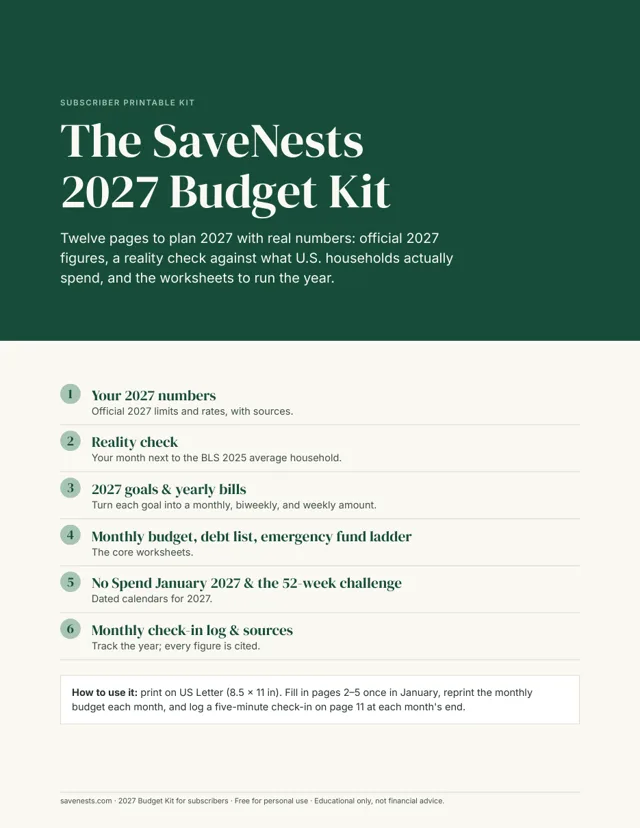
A 12-page printable PDF: official 2027 numbers (HSA limits, the 3.6% COLA), your month next to the BLS average household, goals and yearly bills, a monthly budget, a debt list, an emergency fund ladder, a No Spend January 2027 calendar, and dated 52-week challenge charts. Every figure is cited.