
If every payday feels like a short-term loan against next month's bills, you are not failing at adulting. You are in the same cash-flow squeeze a large share of US adults describe every year. The fix is not a prettier spreadsheet. It is a short sequence that creates a little air between this paycheck and the next one—and keeps a surprise car repair from becoming a credit-card spiral.
This guide walks through that sequence with current Federal Reserve, BLS, and FDIC numbers, a worked illustration, and a 30-day checklist. It will not invent income you do not have. It will show where most leaks hide and which dollars to protect first. If the month already cannot cover rent and food, pair this with How to Create a Budget When Money Is Tight.
The short answer
Stop living paycheck to paycheck by doing five things in order: track where the money goes for two weeks, build a bare-bones budget that funds needs first, cut or pause spending that is not a need, park $500–$1,000 in a separate starter buffer, and automate a small transfer on payday so savings happen before leftovers disappear. Then point extra cash at high-interest debt. Skip the hustle myths until the buffer exists.
- Track every outflow for 14 days (bank app, notes, or the CFPB spending tracker).
- Plan the month from take-home pay: housing, utilities, food, transport, insurance, debt minimums—then everything else.
- Build a $500–$1,000 cash buffer in an insured savings account before aggressive investing or big lifestyle upgrades.
- Automate even $25–$50 per paycheck; raise it after the month balances.
- Pay more than the minimum on revolving debt once the buffer can catch a small shock.
What "paycheck to paycheck" actually means
For this guide it means: after required bills and basic living costs, little or no cash remains before the next payday, so a modest surprise means a card, a late fee, or borrowing from family. You can earn a solid income and still feel this way if housing, childcare, or debt leave no margin. It is a cash-flow design problem—not a personality flaw. The fix is a buffer and a written plan so the next deposit is not already fully claimed.
How common the squeeze is (2025 data)
In the Federal Reserve's Survey of Household Economics and Decisionmaking for 2025 (published May 2026), 16 percent of adults did not pay all of their bills in full in the prior month. Including people who paid everything but had difficulty doing so, 28 percent struggled with bills. Among adults with family income under $25,000, 34 percent missed paying something in full.
The emergency side of the same report is just as useful. Sixty-three percent of adults said they would cover a $400 expense with cash or its equivalent—leaving 37 percent who would not. Fifty-five percent said they had rainy-day savings covering three months of expenses. Among adults who struggled with bills, the most common coping steps were cutting other expenses (48 percent), paying a bill late (42 percent), and putting a bill on a credit card to pay over time (23 percent).
- Cash or equivalent63%
- Would not (other means / unable)37%
Federal Reserve SHED 2025 (May 2026 report)
Prices help explain why a paycheck that used to stretch can feel short. For the 12 months ending September 2026, the BLS all-items CPI-U rose 3.7 percent, with food up 2.5 percent and energy up 20.4 percent. Those are national averages, not your rent line—but they are why "I used to make this work" is a real observation, not an excuse.
Step 1: Track spending for two weeks
You cannot fix a leak you have not named. For the next 14 days, write down every outflow the day it happens: debit, card, cash, app payments, and automatic subscriptions. Sort them into three buckets: fixed needs (rent, utilities, insurance, minimum debt payments), variable needs (groceries, gas or transit, medications), and discretionary (dining out, streaming add-ons, marketplace buys, impulse shopping).
The Consumer Financial Protection Bureau publishes a free spending tracker if you want a printable sheet. Your bank's category labels are fine too—just correct the ones that dump "Amazon" into a vague miscellaneous pile.
- Circle three discretionary patterns that surprise you (for example, $12 delivery fees three times a week).
- List every subscription and the last time you used it.
- Note any fee you paid twice (late fees, overdraft, NSF)—those are high-interest "interest" by another name.
If tracking makes spending feel louder rather than clearer, switch methods—not goals. Some people do better with cash stuffing for groceries and gas while bills stay electronic. Others need a weekly money date instead of daily logging. The point is a truthful picture, not a perfect journal.
Step 2: Build a bare-bones budget from take-home pay
Open the monthly budget calculator or a one-page sheet. Start with take-home pay—what actually lands after taxes and payroll deductions. Start from deposits after taxes and deductions; How to Budget an Irregular Paycheck covers months when those deposits swing.
Assign dollars in this order until the month balances or you see the true shortfall:
- Housing and required utilities
- Groceries and basic household essentials
- Transport to work (gas, transit, required car costs)
- Insurance due this month and medications
- Minimum debt payments
- A tiny starter buffer line (even $25–$50)
- Everything flexible last
Percentage rules like 50/30/20 can wait. When the month is tight, needs first is the whole trick. Zero-based budgeting helps because every take-home dollar gets a job before the month starts—including the job "buffer."
Step 3: Cut leaks that are not needs
After the bare-bones plan is written, look at the discretionary bucket from your two-week track. You are not trying to erase joy forever. You are trying to free $100–$300 a month long enough to build a buffer. Common high-yield cuts:
- Unused or lightly used subscriptions (streaming add-ons, apps, boxes). Cancel or pause; you can always restart.
- Delivery and dining patterns that are habit, not celebration. Keep one planned treat with a dollar cap.
- Impulse marketplace and same-day shipping. Use a 48-hour wait for anything not on a written list.
- Bank fees you can avoid with alerts, a different account setup, or paying a bill two days earlier.
If the calendar is about to get expensive, a short freeze helps. No Spend November is a written pause on discretionary spending while bills and groceries stay allowed—useful when holiday ads start before you have a buffer. For ongoing impulse spending, How to Stop Overspending Without Feeling Restricted covers the habit side.
Step 4: Build a $500–$1,000 starter buffer
A full three-to-six-month emergency fund is the long game. While you are paycheck to paycheck, the immediate job is a starter cushion that covers common small shocks without a new card balance. Many people aim for $500 first, then $1,000. Use the emergency fund calculator once you know your essential monthly bills; the full walkthrough is in How to Build a $1,000 Emergency Fund.
Park the buffer in a separate insured savings account—not in the checking account you swipe from. In October 2026 the FDIC national average savings rate was 0.38 percent (published October 19, 2026). That is a floor, not a goal. Competitive high-yield savings accounts often pay more; confirm FDIC or NCUA insurance yourself and ignore screenshot APYs that do not match the bank's current offer.
- Open or label a savings balance named "buffer" or "starter emergency."
- Automate a transfer the morning after payday (details in the next step).
- Do not touch it for wants, sales, or "I deserve this." It is for true emergencies: urgent car repair, medical copay, a bill that would otherwise bounce.
- After you hit $1,000 and the month has a little room, grow toward one month of essentials, then more.
Step 5: Automate pay-yourself-first
Waiting to see what is left at month-end renews the cycle. Move a fixed amount to the buffer as soon as pay lands—even $25 or $50 per paycheck beats a $200 goal you cancel. How Much Should I Save Each Month? covers timing. After the starter buffer is funded, point the same automation at extra debt payments, a fuller emergency fund, or sinking funds. How Much Should I Save Each Month? helps pick a rate once the month stops breaking.
High-interest debt vs. the buffer
Credit cards make paycheck-to-paycheck living expensive. The Federal Reserve's G.19 consumer credit report put the average APR on commercial-bank credit card accounts assessed interest at 22.36 percent in August 2026 (released October 7, 2026). All accounts averaged 21.19 percent. At roughly 22 percent, every $1,000 you carry costs about $18 a month in interest if the balance sits—before new purchases.
A practical order for most people in this squeeze:
- Keep making at least the minimum on every debt.
- Build the small cash buffer first so the next surprise does not add to the card.
- Then send extra payments to the highest-APR revolving balance (avalanche) or the smallest balance if you need a quick win (snowball). Compare methods in Debt Avalanche vs Snowball.
- Use the debt payoff calculator and How to Pay Off Credit Card Debt for fixed-payment math.
Step 6: Raise income carefully (after the leaks)
Cutting alone has a floor. If rent and childcare already eat most of take-home pay, you need more money in, not only less money out. Treat income moves as part of the plan, not a shame spiral:
- Ask about extra hours, a shift differential, or a raise with a written list of contributions—not a vague "I need more."
- Sell one unused item and put 100 percent of the proceeds into the buffer.
- A short-term side gig can help if net pay after taxes, gas, and childcare is real. For swinging deposits, see How to Budget an Irregular Paycheck.
- Check benefits on official agency pages (assistance, utility programs, tax credits)—not random social posts.
If income is simply low most months, How to Save Money on a Low Income focuses on smaller levers without pretending a percentage rule will stretch rent.
Holiday season warning
November and December are when thin budgets most often add card debt that lingers into spring. The National Retail Federation forecasts $1.013 trillion in US holiday retail sales for November 1–December 31, 2026 (+4.2% vs 2025)—national activity, not your gift budget, but it explains the inbox pressure.
Before Black Friday browsing, write a total holiday cap funded from money you already have or can save from the remaining paychecks—not from a card limit. How to Budget for Christmas Without Going Into Debt and Black Friday Budget walk through the cap, the list, and how interest erases "deals." If you are mid-challenge, keep No Spend November rules for anything not on a pre-written list.
A 30-day plan to get a little ahead
- Days 1–14: Track every outflow. List subscriptions. Note fees.
- Day 15: Write the bare-bones budget from take-home pay. Use the monthly budget calculator.
- Days 15–20: Cancel or pause at least one unused subscription. Set a dining-out cap or a short no-spend window for discretionary categories.
- Day 21: Open or label the buffer savings account. Automate $25–$50 (or more) for the next payday.
- Days 22–30: Send any freed-up cash to the buffer until you hit $500, then keep going toward $1,000. Keep debt minimums current.
- Day 30: Review. If the month balanced with room, raise the automation. If not, cut one more leak or add one income move—and re-run the bare-bones plan.
Getting out of paycheck-to-paycheck living is rarely one dramatic month. It is a buffer that finally exists, a plan that names needs first, and an automatic transfer that happens even on tired weeks. Start with the next payday. Protect the first $500 like it is already spoken for—because that is the whole point.
Questions readers ask
How do I stop living paycheck to paycheck?
Track spending for two weeks, build a bare-bones budget that funds needs first, cut discretionary leaks, save a $500–$1,000 cash buffer in a separate insured account, and automate a small payday transfer. Then put extra money toward high-interest debt while keeping minimums current.
How much should I have in a starter emergency fund?
Many people start with $500, then $1,000, before growing toward one or more months of essential bills. The Federal Reserve's 2025 SHED found 37 percent of adults would not cover a $400 expense with cash or equivalent—so even a small separate buffer changes how the next surprise lands.
Should I pay off debt or build savings first?
Keep making minimum payments on every debt. Build a small cash buffer first so a surprise does not add to the card, then send extra payments to high-interest revolving balances. At a 22.36 percent average APR on cards assessed interest (Fed G.19, August 2026), carrying a balance is expensive—but so is having zero cash when a tire blows.
What if my income barely covers rent and food?
Use a tight-month order of operations: take-home pay, committed bills, food, transport, then anything flexible. A no-spend challenge cannot create income. Look at benefits, hours, and a careful income bump while you cut only true non-needs. See How to Create a Budget When Money Is Tight and How to Save Money on a Low Income.
How long does it take to stop living paycheck to paycheck?
A usable starter buffer can take a few paychecks if you free $100–$300 a month; a fuller emergency fund takes longer. The milestone that matters first is having cash for a small emergency without new debt—not matching someone else's three-month target overnight.
Does the 50/30/20 rule work if I am paycheck to paycheck?
Often not at first. If needs already exceed 50 percent of take-home pay, forcing 20 percent into savings by cutting food is not a plan. Fund needs, start a small buffer, and grow the savings rate later. 50/30/20 is a direction, not a grade.
Where should I keep my buffer?
In an FDIC-insured bank or NCUA-insured credit union savings account, separate from everyday checking. The October 2026 FDIC national average savings rate was 0.38 percent; shop for a competitive insured APY and confirm the offer on the institution's site.
Sources
- Board of Governors of the Federal Reserve System, Economic Well-Being of U.S. Households in 2025 (SHED, May 2026)16% did not pay all bills in full; 28% struggled with bills; 63% would cover $400 with cash or equivalent; 55% had three months of rainy-day savings; coping actions among those who struggled include cutting expenses (48%), paying late (42%), using a credit card (23%).
- Federal Reserve, Consumer Credit G.19 (released October 7, 2026)August 2026 commercial bank credit card plans: 22.36% APR on accounts assessed interest; 21.19% on all accounts.
- FDIC, National Rates and Rate Caps – October 2026 (published October 19, 2026)National average savings rate 0.38%.
- U.S. Bureau of Labor Statistics, Consumer Price Index Summary (September 2026)All-items CPI-U up 3.7% over 12 months; food up 2.5%; energy up 20.4%.
- National Retail Federation, Forecasts 2026 Holiday Sales Growth (October 15, 2026)Holiday retail sales forecast $1.013 trillion for Nov. 1–Dec. 31, 2026 (+4.2% vs 2025); excludes auto dealers, gas stations, and restaurants.
- Consumer Financial Protection Bureau, Spending tracker (Your Money, Your Goals)Free worksheet for sorting recent spending before building a bare-bones plan.
Mohamed Ouhammouche
Mohamed Ouhammouche founded and runs SaveNests, a budgeting site that helps beginners build simple budgets. This guide was reviewed by the SaveNests Editorial Desk under the editorial and fact-checking policies.
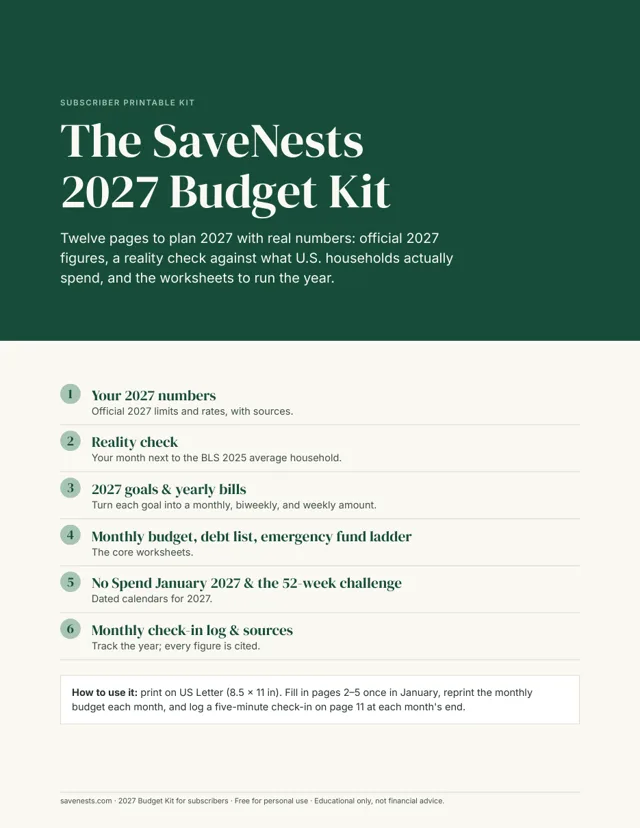
Free for subscribers
Get the 2027 Budget Kit
A 12-page printable PDF: official 2027 numbers (HSA limits, the 3.6% COLA), your month next to the BLS average household, goals and yearly bills, a monthly budget, a debt list, an emergency fund ladder, a No Spend January 2027 calendar, and dated 52-week challenge charts. Every figure is cited.