"How much should I save each month?" is one of those questions that gets a tidy answer online and a messier one in real life. The tidy answer is usually 20 percent of take-home pay. The messier truth is that plenty of households can't hit that number yet, the national personal saving rate is nowhere near 20 percent, and the better question is what you're saving for first.
This guide walks through the common rules of thumb, what the Federal Reserve and BEA data actually show, worked paycheck examples at 10, 15, and 20 percent, and a priority order that keeps a surprise car repair from wiping out progress.
The short answer
Aim for about 20 percent of take-home pay toward savings and debt payoff when that fits. If it doesn't, start lower and protect a starter emergency fund first. Then grow the rate as the budget allows.
- A classic target is the 50/30/20 budget: about 20 percent of after-tax income for savings plus extra debt payments.
- That 20 percent is a rule of thumb, not a law. Rent, childcare, and medical costs can push needs well past 50 percent.
- On a tight month, even 5 or 10 percent, pointed at the right goal, beats waiting for a perfect plan.
- When money is scarce, order matters more than the percentage: small cash buffer, then high-interest debt, then a fuller emergency fund, then retirement and sinking funds.
What the data says about how much people actually save
The Bureau of Economic Analysis tracks the personal saving rate (FRED series PSAVERT): personal saving as a share of disposable personal income. In August 2026 it was 4.0 percent. In September 2026 it was 3.8 percent. That figure is a national average across every household, including people with no room to save and people who save a lot. It is not a target for your paycheck. It does show why "just save 20 percent" can feel disconnected from what many families are managing.
The Federal Reserve's Survey of Household Economics and Decisionmaking for 2025 (published May 2026) fills in the emergency side. Sixty-three percent of adults said they would cover a $400 expense entirely with cash or its equivalent, unchanged from 2022 through 2025. Fifty-five percent said they had rainy-day savings for three months of expenses, unchanged from 2024 and down from 59 percent in 2021. By family income, that three-month cushion was far from even: 21 percent of adults in households under $25,000, 39 percent at $25,000–$49,999, 55 percent at $50,000–$99,999, and 75 percent at $100,000 or more.
- Under $25k21%
- $25–49k39%
- $50–99k55%
- $100k+75%
Federal Reserve SHED 2025 (May 2026 report)
So "how much should I save" depends less on matching a national average and more on closing the gaps that show up in those numbers: a few hundred dollars for small surprises, then enough to ride out a rough quarter without new high-interest debt.
The 50/30/20 "save 20 percent" rule, with honest caveats
In All Your Worth, Elizabeth Warren and Amelia Warren Tyagi popularized splitting after-tax income into roughly 50 percent needs, 30 percent wants, and 20 percent savings. In that framing, the 20 percent "savings" slice includes building an emergency fund, retirement contributions, and extra payments on debt. Our full walkthrough is in The 50/30/20 Budget Rule Explained.
Three caveats matter before you treat 20 percent as a grade:
- It is take-home pay, not salary. Taxes and benefits come out first.
- Needs means must-pay essentials (housing, utilities, groceries, insurance, minimum debt payments), not everything you currently spend.
- If rent alone is 45 percent of take-home, forcing 20 percent into savings by cutting food to nothing is not a plan. Shrink the savings rate, raise income, or cut a true need where you can, and grow the rate later.
Worked examples: $3,000 and $5,000 take-home
These examples use take-home pay (what hits your account after taxes). They show 10, 15, and 20 percent monthly, plus a rough biweekly amount if you're paid every other week (monthly × 12 ÷ 26).
| Rate | Per month | Per biweekly paycheck (approx.) | Per week (approx.) |
|---|---|---|---|
| 10% | $300 | $138 | $69 |
| 15% | $450 | $208 | $104 |
| 20% | $600 | $277 | $138 |
| Rate | Per month | Per biweekly paycheck (approx.) | Per week (approx.) |
|---|---|---|---|
| 10% | $500 | $231 | $115 |
| 15% | $750 | $346 | $173 |
| 20% | $1,000 | $462 | $231 |
If your take-home is closer to $2,000, 10 percent is $200 a month. That is still enough to finish a starter fund in about five months at $200, or faster with a 30-day savings challenge stacked on top. For low-income months, How to Save Money on a Low Income shows where small amounts often come from.
Where the money should go first when cash is tight
A savings rate without a priority list often funds the wrong thing first. Here is a practical order that matches how most households get hurt:
- Starter emergency fund (often $500–$1,000). Stops a $400 surprise from becoming new card debt. See How to Build a $1,000 Emergency Fund.
- High-interest revolving debt. Credit card accounts assessed interest averaged 22.36 percent in August 2026 (Federal Reserve G.19, released October 7, 2026). Paying that down usually beats earning bank interest. Full plan: How to Pay Off Credit Card Debt.
- Fuller emergency fund (commonly 3–6 months of essential bills). This is the rainy-day cushion only 55 percent of adults reported in 2025.
- Retirement contributions, especially any employer match you would otherwise leave on the table.
- Sinking funds for bills you can see coming (car registration, insurance deductibles, holidays). Guide: Sinking Funds for Bills You Can See Coming.
You can work more than one step at once. A common pattern is a small automatic transfer to the starter fund, minimums on every debt, and every leftover dollar on the highest-rate card until the starter fund is full. Then flip: keep a tiny refill transfer to savings and send the rest to debt.
Save more, or pay debt first?
Compare the rates honestly. In October 2026, the FDIC's national average deposit rates (published October 19) were 0.38 percent for savings, 0.07 percent for interest checking, 0.63 percent for money market accounts, and 1.76 percent for 12-month CDs. Competitive high-yield savings accounts often pay many times the national average; shop current offers yourself and confirm FDIC or NCUA insurance rather than trusting a screenshot of an APY.
Against that, a card charging about 22 percent interest costs far more each month than even a strong savings rate earns. Beyond a starter cushion, extra dollars usually belong on the card. Once high-interest balances are gone, the same monthly amount can refill a fuller emergency fund and then long-term goals without fighting 22 percent drag.
How much of my paycheck (or salary) should I save?
Search phrases like "how much of my paycheck should I save" and "how much should I save from my salary" usually want a percentage. Use take-home for the 50/30/20-style math. Employer retirement contributions are often calculated on gross pay; treat the match as part of your savings rate even if it never appears in checking.
- Paid weekly: divide your monthly savings target by about 4.33.
- Paid biweekly: multiply the monthly target by 12, then divide by 26.
- Paid twice a month (1st and 15th): split the monthly target in half each payday.
Automation beats willpower here. Schedule the transfer for the day after payday so the money leaves before it feels spendable. How Much Should I Save Each Month? covers setup details that keep you from reversing the transfer two days later.
Where to keep monthly savings
- Emergency and sinking-fund money: a separate insured savings or money market account, not the checking account you spend from.
- Use the FDIC national averages above as a floor, not a goal. Many online savings accounts pay far above 0.38 percent; verify insurance and withdrawal rules yourself.
- Retirement money: tax-advantaged accounts (401(k), IRA) according to your eligibility, not a regular savings account meant for next month's car repair.
- Do not park a starter emergency fund in stocks or crypto. A repair bill does not wait for a rebound.
How to raise your savings rate without blowing up the month
- Pick a starter percentage you can keep for three months (even 5 percent).
- Name the first $500 or $1,000 so the money has a job.
- After each raise, windfall, or paid-off bill, bump the automatic transfer by 1–2 percentage points before lifestyle spending expands.
- Review once a quarter: essentials, high-interest balances, then the next savings target.
- If the month never balances, fix the budget first with How to Create a Budget When Money Is Tight rather than inventing a savings rate you will reverse.
Monthly savings checklist
- Write down take-home pay for a normal month.
- Choose a starting rate (10, 15, or 20 percent if it fits; lower if it doesn't).
- Convert that to a per-paycheck transfer.
- Point it at the next priority: starter fund, high-interest debt, fuller emergency fund, retirement match, sinking funds.
- Automate the transfer the day after payday.
- Recheck the rate when income or bills change.
Questions readers ask
How much should I save each month?
A common rule of thumb is about 20 percent of take-home pay for savings plus extra debt payoff (the "20" in 50/30/20). If that squeezes essentials, start lower—often 5 to 10 percent—and grow it. Put the first dollars toward a small emergency fund, then high-interest debt, then a fuller rainy-day balance.
How much of my paycheck should I save?
Use take-home pay, not gross salary, for percentage rules. On $3,000 take-home, 10 percent is $300 a month (about $138 per biweekly paycheck); 20 percent is $600 a month (about $277 biweekly). Adjust for your bills rather than forcing a percentage that overdraws checking.
Is saving 20 percent of my income realistic?
It can be, but it is not universal. The BEA personal saving rate was 3.8 percent in September 2026, a national average that includes households with little room to save. Treat 20 percent as a long-term direction. Many people build toward it after housing and debt are under control.
Should I save money or pay off debt first?
Build a small cash buffer first so surprises do not refill the card, then send extra money to high-interest debt. Card accounts assessed interest averaged 22.36 percent in August 2026, while the FDIC national average savings rate was 0.38 percent in October 2026. Beyond a starter cushion, paying the card usually wins on math.
How much should I have in an emergency fund?
A common starter target is $1,000 (or one month of essentials if that is smaller). A fuller fund is often described as three to six months of essential bills. In the Fed's 2025 survey, 55 percent of adults had three months set aside. Use your own expense number in an emergency fund calculator rather than copying someone else's total.
Does a 401(k) contribution count toward how much I should save?
Yes. Retirement contributions—especially an employer match—are part of your savings rate. Just do not count them as your emergency fund. Keep short-term surprise money in a separate insured savings account you can reach without taxes or penalties.
What if I live paycheck to paycheck?
Start with a tiny automatic transfer (even $10–$25 per payday) toward a starter fund, and look for one bill or subscription to cut. Focus on order: buffer, then debt, then bigger goals. Guides on saving on a low income and automating small transfers are more useful than jumping straight to 20 percent.
Sources
- Board of Governors of the Federal Reserve System, Economic Well-Being of U.S. Households in 2025 (SHED, May 2026)63% would cover a $400 expense with cash or equivalent (unchanged 2022–2025); 55% had rainy-day savings for 3 months (unchanged from 2024, down from 59% in 2021); by income: <$25k 21%, $25–49k 39%, $50–99k 55%, $100k+ 75%.
- Federal Reserve, Savings and Investments chapter (2025 SHED web edition)Narrative summary of emergency savings and retirement preparedness findings.
- U.S. Bureau of Economic Analysis via FRED, Personal Saving Rate (PSAVERT)Aug 2026: 4.0%; Sep 2026: 3.8% (seasonally adjusted annual rate).
- Federal Reserve, Consumer Credit G.19 (released October 7, 2026)August 2026 commercial bank credit card plans: 22.36% on accounts assessed interest.
- FDIC, National Rates and Rate Caps – October 2026 (published October 19, 2026)National averages: savings 0.38%, interest checking 0.07%, money market 0.63%, 12-month CD 1.76%.
- Consumer Financial Protection Bureau, An essential guide to building an emergency fundAmount depends on your situation; set a specific goal and save automatically.
- Elizabeth Warren and Amelia Warren Tyagi, All Your Worth (on the 50/30/20 framework)Source of the widely cited needs/wants/savings percentage split applied to after-tax income.
Mohamed Ouhammouche
Mohamed Ouhammouche founded and runs SaveNests, a budgeting site that helps beginners build simple budgets. This guide was reviewed by the SaveNests Editorial Desk under the editorial and fact-checking policies.
Free for subscribers
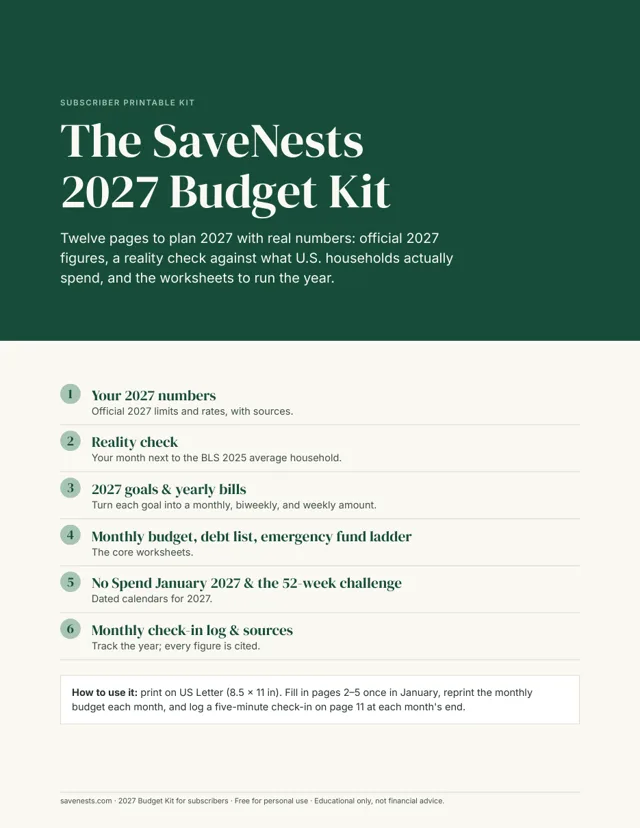
Get the 2027 Budget Kit
A 12-page printable PDF: official 2027 numbers (HSA limits, the 3.6% COLA), your month next to the BLS average household, goals and yearly bills, a monthly budget, a debt list, an emergency fund ladder, a No Spend January 2027 calendar, and dated 52-week challenge charts. Every figure is cited.