Most savings advice starts with a percentage. Save 20 percent. Save 10 percent. Pay yourself first. If your paycheck barely covers rent, food, and the electric bill, that advice doesn't feel motivating. It feels like proof that saving is something other people do.
It isn't. Saving on a low income works, but it works differently. The amounts are smaller, the first goal is closer, and a lot of the money comes from lowering bills and catching one-time money rather than from cutting small pleasures. Here's a step-by-step way to start, with the real numbers on how common this struggle is and a list of the costly traps to step around.
Why the usual savings advice doesn't fit a small paycheck
If saving feels impossible, you're not unusual. In the Federal Reserve's survey of household finances in 2025, only 19 percent of adults with income under $25,000 said they always or often had money left over at the end of the month, compared with 59 percent of adults earning $100,000 or more. Just 21 percent of adults under $25,000 had enough set aside to cover three months of expenses, and 39 percent of those earning $25,000 to $49,999 did.
The gap is even sharper for small emergencies. Among adults with income under $50,000, 40 percent said they could not cover even a $100 emergency expense using only their savings, and 61 percent couldn't cover $500.
That's why a percentage is the wrong place to start. Twenty percent of a tight paycheck might be the grocery money. A dollar amount you can actually move, like $5 or $10 a week, is a plan you can keep. If you want to see where percentage budgets come from, the 50/30/20 rule explains it, including why it bends when rent is high.
Step 1: Pick a first goal you can actually see
Skip "three to six months of expenses" for now. That's a fine long-term target, but on a small income it's so far away it stops feeling real. Use a ladder of small goals instead:
- $100. Enough for a prescription, a cheap car fix, or a late fee you'd otherwise pay.
- $400. The amount the Fed uses as its test emergency. In 2025, 63 percent of all adults said they would cover a $400 surprise with cash or its equivalent, and 12 percent said they could not pay it right now by any means.
- $1,000. A real starter emergency fund. How to Build a $1,000 Emergency Fund has a step-by-step plan for this rung.
The Consumer Financial Protection Bureau suggests basing your goal on the kind of unexpected expenses you've actually had before. If last year's surprises were a $250 car repair and a $90 copay, $400 is a goal built on your own life, not someone else's rule.
Step 2: Look for savings in your bills before your coffee
Cutting a $4 coffee is the classic tip, and on a tight budget there may not be a coffee to cut. Your bills are usually the bigger opportunity, because one phone call can lower them every month without any daily willpower. Go through your bill list with these questions:
- Phone and internet. The FCC's Lifeline program gives eligible households a discount of up to $9.25 a month on phone, internet, or bundled service (up to $34.25 on Tribal lands). You can qualify with household income at or below 135 percent of the federal poverty guidelines or by taking part in programs such as SNAP, Medicaid, federal public housing assistance, SSI, or Veterans Pension benefits. Only one Lifeline benefit is allowed per household.
- Heating and cooling. The Low Income Home Energy Assistance Program (LIHEAP) helps with energy bills, shutoff prevention, and weatherization through state and local agencies. You can find where to apply at energyhelp.us or by calling the National Energy Assistance Referral line at 1-866-674-6327. LIHEAP never charges a fee, so treat anyone asking for one as a scam. Practical Ways to Lower a Home Energy Bill covers the no-cost fixes too.
- Food. If your household might qualify for SNAP or WIC, check with your state agency or dial 211, the free referral line for local help. Then compare your grocery spending with a benchmark: in September 2026, USDA's Thrifty Food Plan, its lowest-cost healthy diet cooked at home, came to $253.90 a month for a woman aged 20 to 50 and $319.00 for a man the same age (in a four-person household; USDA suggests adding 20 percent for someone living alone). 25 Realistic Ways to Save on Groceries has the tactics.
- Insurance, subscriptions, and the phone plan itself. Call and ask for a cheaper plan, a lower rate, or a loyalty discount.
- Due dates. The CFPB notes you can ask creditors, landlords, and utilities to adjust due dates so bills line up with your pay. That doesn't save money directly, but it stops the late fees and overdrafts that quietly eat a small budget.
Whatever a call saves, move that exact amount to savings the same month. If you lower the phone bill by $15, the $15 transfer is already in your budget, and you never feel the difference.
Step 3: Make the transfer small and automatic
The CFPB calls automatic saving one of the easiest ways to stay consistent: set up a recurring transfer from checking to savings and decide how much and how often. On a small income, two details matter more than the amount.
- Time it for the day after payday, not the day before. A transfer that hits when your balance is lowest can trigger an overdraft fee, which the CFPB warns about specifically. Moving money the day after the paycheck lands means it goes out while the money is there.
- Start smaller than you think. A $5 weekly transfer that runs all year beats a $50 transfer you cancel after three weeks.
If your employer pays by direct deposit, ask whether you can split your paycheck between two accounts. Then a small slice goes straight to savings before you see it, which is the work version of paying yourself first. Here's what small, steady amounts add up to:
| Saved each week | After 3 months (13 weeks) | After 6 months (26 weeks) | After 1 year (52 weeks) |
|---|---|---|---|
| $5 | $65 | $130 | $260 |
| $10 | $130 | $260 | $520 |
| $15 | $195 | $390 | $780 |
| $20 | $260 | $520 | $1,040 |
At $10 a week, you pass the $100 rung in under three months and the $400 rung in 40 weeks. If you're paid every two weeks, set the transfer per paycheck instead: $20 per paycheck is 26 transfers and $520 a year. How to Budget Biweekly Paychecks shows how to line up bills with each check so the transfer never lands on a short week. If a game works better than a schedule for you, the 30-day savings challenge has flat versions that start small.
Step 4: Catch the one-time money
On a small income, the biggest deposits to savings often aren't weekly. They're the few times a year when extra money shows up. The CFPB names a tax refund as one of the easiest ways to start an emergency fund when you have limited ability to save. Decide in advance what share of each of these goes to savings, even if it's half:
- Your tax refund, especially if it includes the Earned Income Tax Credit. For tax year 2025, the maximum EITC ranged from $649 with no qualifying children to $8,046 with three or more, depending on income and filing status. The IRS has an EITC Assistant to check whether you qualify, and gig and self-employment income count as earned income.
- A third paycheck. If you're paid every two weeks, two months a year usually have three paydays. If your budget runs on two checks a month, the third one is free to save.
- Cash gifts, rebates, and refunds. Birthday money, a returned deposit, a utility credit, or money from selling something you no longer use.
- Paid-off bills. When a loan or a buy now, pay later plan ends, keep "paying" it into savings for a few months.
Step 5: Keep it where you won't spend it but can reach it
Emergency savings needs two things that pull against each other: it should be easy to get to in a real emergency and slightly annoying to get to on a Tuesday night. A separate savings account at a bank or credit union usually does both. Deposits at FDIC-insured banks are protected up to $250,000 per depositor, per bank, per ownership category, and credit unions have similar federal coverage through the NCUA.
If you don't have a bank account, you're not alone: the Fed found that 77 percent of adults with income under $25,000 had one in 2025, compared with nearly all adults earning $100,000 or more. The CFPB lists a prepaid card or cash at home as other options, with the warning that cash can be lost, stolen, or destroyed. If you keep savings in cash, a labeled envelope works; Cash Stuffing for Beginners shows how to run it.
What not to cut to make savings happen
Saving shouldn't come from cuts that cost more later. Leave these alone even when the budget is tight:
- Medicine and needed medical care. Ask about generics, a 90-day supply, or a payment plan instead of skipping a refill.
- Food your household needs. Trade down to store brands and cheaper proteins, but don't save by going hungry.
- Insurance that protects your income or car. Shop it or raise a deductible carefully, but don't let it lapse.
- Minimum debt payments. Missing them brings late fees and credit damage that cost more than the transfer you'd make.
- Rent and utilities. If these are the problem, it's a call to the landlord or utility, not a reason to skip saving or to pay late.
The expensive traps that undo small savings
When there's no cushion, a surprise bill usually turns into borrowing. In the Fed's survey, among all adults, 15 percent said they would put a $400 emergency on a credit card and pay it off over time, 10 percent would borrow from friends or family, and 2 percent would use a payday loan, deposit advance, or overdraft. Each of these can make the next month harder:
- Carrying a card balance. Credit card accounts that paid interest averaged a 22.36 percent rate in August 2026, according to the Federal Reserve. If you already carry balances, Debt Avalanche vs Snowball helps you decide which one to pay down first once your starter fund is in place.
- Payday loans and overdrafts. The fees on a small, short loan can be large relative to what you borrowed. Even $100 in savings can be the difference between paying a surprise outright and borrowing.
If there's nothing left to save this month
Some months the math simply doesn't work, and no trick fixes too little income. That's not a failure. In a month like that, the goal changes: protect the essentials, avoid new fees, and take any help you're eligible for. Write your real numbers down with How to Create a Budget When Money Is Tight, call 211 for local help with food, rent, or utilities, and restart the transfer at $5 the first week you can.
Once savings starts working, give future costs their own small piles so the emergency fund stays for emergencies. A sinking fund for car registration or the holidays does that, and the savings goal calculator shows how long a goal will take at the amount you can afford.
Low-income savings checklist
- Pick your first rung: $100, then $400, then $1,000.
- Call one bill provider this week and ask for a lower rate or plan.
- Check Lifeline, LIHEAP, and SNAP or WIC eligibility, or call 211.
- Set a $5 to $20 automatic transfer for the day after payday.
- Ask your employer about splitting direct deposit into savings.
- Decide now what share of your tax refund and any third paycheck goes to savings.
- Keep savings in a separate account (or a labeled envelope) you don't use for spending.
- Don't cut medicine, needed food, insurance, or minimum payments to save.
- When the starter fund is built, add a sinking fund for the next predictable bill.
Questions readers ask
How can I save money on a low income?
Start with a small dollar goal like $100 or $400 instead of a percentage. Lower your bills first (phone, energy, insurance, subscriptions), check aid like Lifeline, LIHEAP, and SNAP, set a small automatic transfer for the day after payday, and save part of one-time money such as a tax refund.
How much should I save if I'm living paycheck to paycheck?
Any amount you can keep up. The CFPB notes that even a small amount can provide some financial security. A $10 weekly transfer adds up to $520 in a year, and $5 a week is $260. Start low enough that you won't cancel it, then raise it when a bill goes down.
Is the 20 percent savings rule realistic on a low income?
Often not, at least at first. When rent, food, and utilities take most of a paycheck, 20 percent may not exist. A fixed dollar amount and a first goal of $100 to $400 are more realistic, and the percentage can grow as income rises or bills fall.
Where should I keep a small emergency fund?
A separate savings account at a bank or credit union is a good default: it keeps the money out of daily spending but available in an emergency, and deposits at FDIC-insured banks are insured up to $250,000 per depositor, per bank, per ownership category. A prepaid card or a labeled cash envelope also works, but cash can be lost or stolen.
What is the Saver's Credit?
An IRS tax credit for low- and moderate-income workers who contribute to an IRA, a workplace retirement plan, or an ABLE account. For 2026 it's worth 50, 20, or 10 percent of contributions, with income limits of $40,250 for single filers, $60,375 for heads of household, and $80,500 for joint filers. The maximum credit is $1,000, or $2,000 for joint filers.
Should I pay off debt or save first on a low income?
Most people do best building a small cushion first, even $400 to $1,000, while making minimum payments. Without one, the next surprise usually goes on a credit card, where accounts that paid interest averaged 22.36 percent in August 2026. Once the starter fund is in place, put extra money toward debt.
Sources
- Board of Governors of the Federal Reserve System, Economic Well-Being of U.S. Households in 2025 (SHED report, May 2026)Money left over always/often: 19% (income under $25,000) vs 59% ($100,000+); three months of savings: 21% (under $25,000), 39% ($25,000–$49,999); under $50,000: 40% could not cover $100 and 61% could not cover $500 from savings; $400 expense: 63% cash or equivalent, 12% unable to pay, 15% credit card carried, 10% borrow from family or friends, 2% payday loan/deposit advance/overdraft; bank account: 77% of under-$25,000 adults.
- Consumer Financial Protection Bureau, An essential guide to building an emergency fundBase the goal on past unexpected expenses; even a small amount helps; automatic transfers, split direct deposit, tax refunds, cash-flow and due-date adjustments; overdraft caution; bank, prepaid card, or cash options.
- Federal Communications Commission, Lifeline Support for Affordable CommunicationsUp to $9.25 a month ($34.25 on Tribal lands); income at or below 135% of federal poverty guidelines or participation in SNAP, Medicaid, public housing, SSI, Veterans Pension; one benefit per household.
- U.S. Department of Health and Human Services, Administration for Children and Families, LIHEAPHelp with energy bills, crises, weatherization; apply via energyhelp.us or NEAR hotline 1-866-674-6327; LIHEAP does not charge a fee.
- USDA, Official USDA Thrifty Food Plan: U.S. Average, September 2026Female 20–50: $253.90 a month; male 20–50: $319.00; costs for individuals in four-person households, add 20% for one person.
- Internal Revenue Service, Earned income and EITC tablesTax year 2025 maximum credit: $649 (no children), $4,328 (one), $7,152 (two), $8,046 (three or more); gig and self-employment income count as earned income.
- Internal Revenue Service, 401(k) limit increases to $24,500 for 2026 (Saver's Credit limits) and Notice 2025-672026 Saver's Credit income limits: $80,500 joint, $60,375 head of household, $40,250 single; 50% rate up to $48,500 / $36,375 / $24,250 (Notice 2025-67).
- Internal Revenue Service, Retirement Savings Contributions Credit (Saver's Credit)Credit of 50%, 20%, or 10% of contributions; maximum $1,000 ($2,000 joint); age 18+, not a student, not a dependent.
- FDIC, Deposit Insurance FAQsStandard coverage of $250,000 per depositor, per insured bank, for each ownership category.
- Federal Reserve, G.19 Consumer Credit (October 2026 release)Average interest rate on credit card accounts assessed interest: 22.36% (August 2026).
Mohamed Ouhammouche
Mohamed Ouhammouche founded and runs SaveNests, a budgeting site that helps beginners build simple budgets. This guide was reviewed by the SaveNests Editorial Desk under the editorial and fact-checking policies.
Free for subscribers
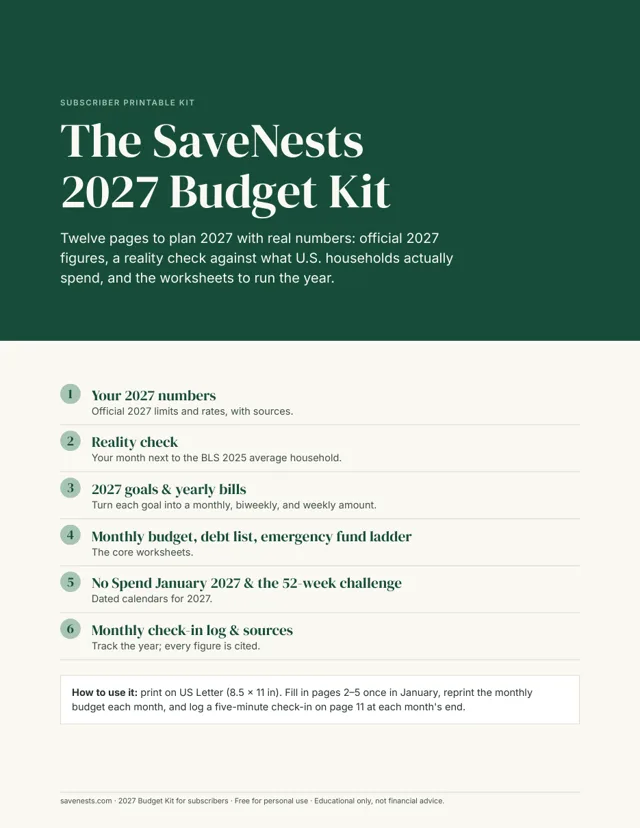
Get the 2027 Budget Kit
A 12-page printable PDF: official 2027 numbers (HSA limits, the 3.6% COLA), your month next to the BLS average household, goals and yearly bills, a monthly budget, a debt list, an emergency fund ladder, a No Spend January 2027 calendar, and dated 52-week challenge charts. Every figure is cited.