Most energy-saving lists are written for someone who owns a big house and enjoys hardware stores. Unplug your toaster. Buy a smart thermostat. Replace your windows. Some of that helps, some barely registers, and some isn't yours to change if you rent.
This guide starts with the bill itself, because you can't cut a number you haven't read. Then it covers the no-cost changes with the biggest effect, the cheap fixes worth a few dollars, what renters can and can't do, and where to look for help if the bill is already more than you can pay. It's written for US households heading into winter, when heating is the line that moves.
What this winter is expected to cost
Every October the U.S. Energy Information Administration publishes a Winter Fuels Outlook. The 2026–27 edition, released October 6, 2026, forecasts what the average household will spend on its main heating fuel from November through March:
| Main heating fuel | Nov–Mar forecast | Change vs last winter |
|---|---|---|
| Natural gas | $640 | Down 9% |
| Electricity | $1,196 | Up 4% |
| Propane | $1,246 | Down 3% |
| Heating oil | $2,115 | Up 21% |
Your bill will be different. These are national averages, and EIA says a colder or warmer winter than its forecast would change them. But two things in the outlook are worth knowing. More than 40 percent of US homes heat mainly with electricity, and EIA expects those bills to rise about 4 percent on average, with a 9 percent jump in the West because of a colder forecast. And homes on heating oil, about 3 percent of households and mostly in the Northeast, face the sharpest increase: a forecast average of $5.26 a gallon, 34 percent higher than last winter.
Electricity is also simply pricier than a year ago. EIA's Electric Power Monthly puts the average US residential price at 18.31 cents per kilowatt-hour in July 2026, up from 17.45 cents in July 2025. The same habits simply cost more this year.
Step 1: Read the bill before you change anything
Pull up your last bill and the one from the same month last year. Most utilities show a 12-month usage chart, either on the paper bill or in your online account. You're looking for four things:
- Usage, not dollars: kilowatt-hours (kWh) for electricity, therms or hundred cubic feet (CCF) for gas. Dollars move with prices; usage is what you control.
- The fixed charge: a monthly customer or service fee you pay even if you use nothing. No habit change will touch it.
- Your rate plan: a flat rate, tiers that get pricier as you use more, or time-of-use pricing where evenings cost more. The plan decides which changes pay off.
- Your winter peak: if January usage is double September's, heating is most of the bill, and that's where to focus.
Write the winter-month numbers on the bill organizer next to the due dates. It turns a vague "the bill is high" into something you can track.
Step 2: The free changes that move the bill most
According to the Department of Energy's Energy Saver guide, heating and cooling together are usually the biggest energy users in a home, about 32 percent of energy use, and water heating is second at about 18 percent. So the free changes that matter most are the ones that touch heat and hot water.
Turn the thermostat down at night and when you're out
DOE says you can save as much as 10 percent a year on heating and cooling by turning the thermostat down 7 to 10°F for 8 hours a day in fall and winter. Sleep hours are the easy eight. You don't need a smart thermostat; a basic programmable one, or a reminder on your phone, does the same job.
Turn the water heater down to 120°F
DOE recommends setting the water heater to 120°F, which it calls safe for most people. It's a two-minute job on a gas dial or an electric heater's thermostat (turn off the power to an electric heater first, and follow the manual). In the laundry, using warm water instead of hot can cut a load's energy use in half, and cold water saves more, since most of a washer's energy goes into heating water.
Use the windows and fans you already have
- Open curtains on sunny windows during the day and close them at night to hold the heat in, as DOE suggests.
- Switch ceiling fans to clockwise on low in winter to push warm air down from the ceiling.
- Move furniture and rugs off vents, registers, and radiators so heat can reach the room.
- Close the fireplace damper when there's no fire. An open damper is a hole in the roof.
Cut the standby power, without obsessing
DOE says electronics that keep drawing power when they're switched off could add 5 to 10 percent to a monthly utility bill. You don't need to unplug the toaster. Put the TV, game console, and streaming boxes on one power strip and switch it off at night, unplug chargers you're not using, and turn on sleep settings on computers. That's most of it.
Step 3: Cheap fixes worth a few dollars
These cost money, but usually less than one winter month's savings, and none of them need a contractor.
- Seal drafts. DOE calls air leaks among the biggest sources of energy loss and says sealing them can save 10 to 20 percent on heating and cooling bills. Weatherstripping for a drafty door, a door sweep, foam gaskets behind outlet covers on outside walls, and a tube of caulk are the starter kit. On a windy day, hold a lit incense stick near window and door edges; if the smoke blows sideways, you've found a leak.
- Change the furnace filter. A clogged filter makes the system work harder. DOE says to clean or replace it once a month or as the manufacturer recommends. A filter costs less than a pizza.
- Swap the bulbs you use most. An ENERGY STAR LED uses up to 90 percent less energy than an old incandescent and lasts 15 to 25 times longer, according to DOE. Start with the kitchen and living room, not the closet. Holiday lights count too: LED strings use a fraction of the power of the old ones.
If you rent: what's yours to change
Renters can do almost everything in Steps 1 and 2: the thermostat, the water heater if it's in your unit, curtains, fans, bulbs, power strips, and removable weatherstripping or plastic window kits. What's usually not yours to change: insulation, windows, the furnace, and the water heater itself.
For those, put the request in writing. A short email saying the bedroom window leaks cold air, or the furnace filter hasn't been changed, creates a record. If heat is included in your rent, the landlord pays the fuel bill, but drafts still make you cold and space heaters still raise your electric bill, so it's still worth asking.
Space heaters: cheaper only for one room
A space heater can lower the bill if you heat one room you're sitting in and turn the central heat down for the rest of the house. It raises the bill if you run it on top of the furnace, and DOE notes that electric heat can be more expensive than other fuels.
Safety comes first. The U.S. Fire Administration says to keep anything that can burn at least 3 feet from space heaters and other heat sources, to turn space heaters off when you leave the room or go to bed, and to never use an oven to heat your home.
Upgrades: do the math before you buy
New windows, a heat pump, attic insulation, or a smart thermostat can all lower bills, but they cost far more than a winter of savings. Before you buy, divide the price by the realistic yearly saving. If the answer is 15 years and you plan to move in three, it's not a money-saving move for you.
One thing has changed: the federal Energy Efficient Home Improvement Credit, which covered 30 percent of things like insulation, doors, windows, and home energy audits, applied only to improvements made through December 31, 2025, according to the IRS. Don't count on that credit for work done in 2026. Check your utility and state for rebates instead, and ask whether the utility offers a home energy assessment, which DOE says some do. It shows where the house actually leaks before you pay for the wrong fix.
Put winter bills in the budget before they arrive
Lowering usage is half the job. The other half is not being surprised. Winter heating is the definition of a bill you can see coming, so treat it like one:
- Find your highest winter bill from last year and use it as this year's January line in your budget.
- Subtract a normal fall bill. The difference is your winter bump.
- Add up the bump across November to March and spread it over the months you have left. That's a sinking fund.
- Ask your utility about budget billing, which averages your payments over the year. It doesn't lower what you use, and there's usually a settle-up amount at the end of the year, but it keeps January from swallowing the grocery money.
If the month is already tight, How to Create a Budget When Money Is Tight shows the order to pay things in, with utilities near the top. December also brings gifts and travel; How to Budget for Christmas helps you size that fund so it doesn't compete with the heating bill. If winter driving is also adding up, How to Save Money on Gas covers the pump, not the furnace. And a No Spend November is a good way to free up cash for both.
If you can't pay the bill
Call the utility before the due date, not after the shutoff notice. Ask about payment arrangements, budget billing, and any hardship or low-income discount programs. Get any agreement in writing.
Then check two federal programs, run through your state:
- LIHEAP, the Low Income Home Energy Assistance Program, can help with heating bills, prevent shutoffs, restore service, and sometimes repair heating equipment. Eligibility depends on income and your state's rules. Start at energyhelp.us, or call the National Energy Assistance Referral line at 1-866-674-6327.
- The Weatherization Assistance Program makes low-income homes more efficient for free. DOE says households that get weatherization save $372 or more a year on average. Apply through your state's weatherization office.
One warning from HHS: LIHEAP does not give grants directly to individuals and doesn't charge a fee for help. If someone calls offering a LIHEAP grant for a fee, it's a scam. Also, each state sets its own rules about when utilities can disconnect service for nonpayment, and many limit shutoffs in winter. USA.gov's help with energy bills page points you to your state's rules. If a big bill hits before help arrives, this is exactly what a starter emergency fund is for.
Winter energy bill checklist
- Compare last month's usage with the same month last year.
- Note your rate plan and the fixed charge.
- Set the thermostat 7 to 10°F lower for sleep hours (gently, if you have a heat pump).
- Set the water heater to 120°F and wash laundry in cold or warm water.
- Open sunny curtains by day, close them at night, and clear the vents.
- Put electronics on a power strip you switch off at night.
- Seal the worst draft, change the furnace filter, and swap the bulbs you use most.
- Ask about a free home energy assessment before buying an upgrade.
- Budget your winter bump as a monthly set-aside, or ask about budget billing.
- If you're behind, call the utility first, then check LIHEAP and weatherization.
Run the whole month through the monthly budget calculator once you have your winter number. More ways to spend less without giving up what matters are on the Frugal living hub.
Questions readers ask
What is the fastest way to lower my energy bill?
Turn the thermostat down 7 to 10°F for about 8 hours a day, usually while you sleep. The Department of Energy says that can save as much as 10 percent a year on heating and cooling. Setting the water heater to 120°F and sealing obvious drafts are the next quick wins.
How much will heating cost this winter?
EIA's 2026–27 Winter Fuels Outlook forecasts average November-to-March spending of $640 for homes heated mainly with natural gas, $1,196 for electricity, $1,246 for propane, and $2,115 for heating oil. Your bill depends on your home, your rate, and the weather.
Does unplugging things really save money?
A little. DOE says electronics that draw power while switched off could add 5 to 10 percent to a monthly bill. A power strip for the TV and console and unplugging idle chargers covers most of it. Heating and hot water matter far more.
Is it cheaper to use a space heater?
Only if you heat one room and turn the central heat down for the rest of the house. Running a space heater on top of the furnace raises the bill. Keep it 3 feet from anything that can burn and turn it off when you leave the room or go to bed.
How can renters lower their energy bill?
Renters control the thermostat, curtains, fans, bulbs, power strips, laundry settings, and removable weatherstripping or window kits. Insulation, windows, and heating equipment are the landlord's, so report drafts and maintenance problems in writing.
Is there still a tax credit for energy-efficient home improvements?
The federal Energy Efficient Home Improvement Credit applied to improvements made through December 31, 2025, according to the IRS. For work done in 2026, check your utility and state for rebates instead.
Where can I get help paying my heating bill?
Call your utility first and ask about payment plans and hardship programs. Then check LIHEAP at energyhelp.us or 1-866-674-6327, and your state's Weatherization Assistance Program. LIHEAP never charges a fee to apply.
Sources
- U.S. Energy Information Administration, Winter Fuels Outlook 2026–27 (October 6, 2026)Base-case November–March average household expenditures: natural gas $640 (−9%), electricity $1,196 (+4%; West +9%), propane $1,246 (−3%), heating oil $2,115 (+21%); heating oil price $5.26 per gallon (+34%). More than 40% of homes heat mainly with electricity; heating oil about 3% of households.
- U.S. Energy Information Administration, Mixed outlook for energy expenditures this winter (Today in Energy, October 7, 2026)Summary of the 2026–27 Winter Fuels Outlook.
- U.S. Energy Information Administration, Electric Power Monthly, Table 5.6.AAverage US residential electricity price: 18.31 cents per kWh in July 2026 versus 17.45 cents in July 2025 (preliminary).
- U.S. Department of Energy, Energy Saver: Tips on Saving Money and Energy in Your Home (2022)Heating and cooling about 32% of home energy use; water heating about 18%; thermostat setback of 7–10°F for 8 hours a day saves as much as 10% a year (heat pump caveat); sealing air leaks saves 10–20% on heating and cooling; water heater at 120°F; warm instead of hot laundry halves a load's energy; standby electronics could add 5–10% to a monthly bill; ENERGY STAR LEDs use up to 90% less energy and last 15–25 times longer; clean or replace furnace filters monthly or as recommended.
- U.S. Department of Energy, Weatherization Assistance ProgramWeatherized households save on average $372 or more a year, according to a national evaluation.
- Administration for Children and Families, Low Income Home Energy Assistance Program (LIHEAP)What LIHEAP covers; apply via energyhelp.us or NEAR at 1-866-674-6327; LIHEAP does not provide direct grants to individuals or charge a fee.
- USAGov, Get help with energy billsLIHEAP and WAP eligibility steps; each state has its own utility disconnection policy.
- Internal Revenue Service, Energy Efficient Home Improvement CreditCredit of up to $3,200 a year for qualifying improvements made through December 31, 2025.
- U.S. Fire Administration, Heating fire safetyKeep anything that can burn at least 3 feet from heat sources; turn space heaters off when leaving the room or going to bed; never use an oven to heat a home.
Mohamed Ouhammouche
Mohamed Ouhammouche founded and runs SaveNests, a budgeting site that helps beginners build simple budgets. This guide was reviewed by the SaveNests Editorial Desk under the editorial and fact-checking policies.
Free for subscribers
Get the 2027 Budget Kit
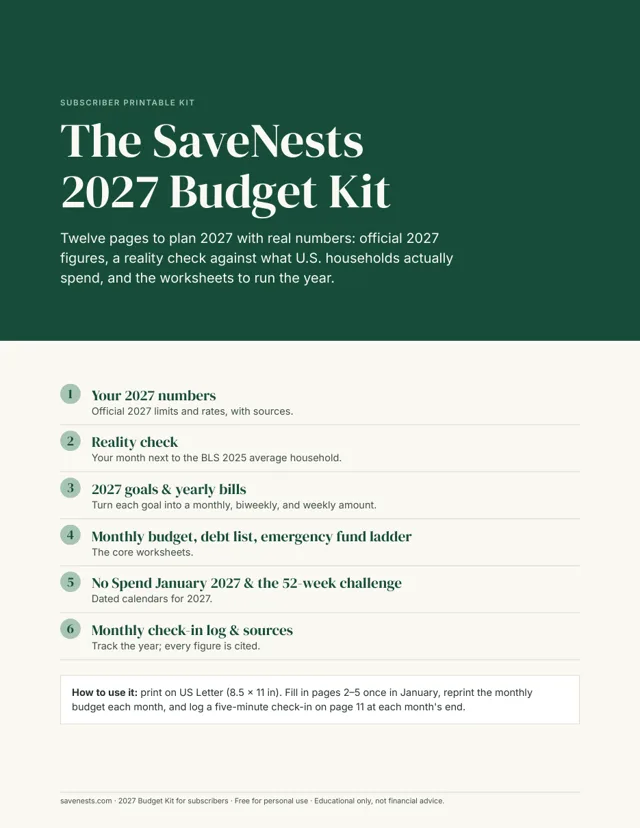
A 12-page printable PDF: official 2027 numbers (HSA limits, the 3.6% COLA), your month next to the BLS average household, goals and yearly bills, a monthly budget, a debt list, an emergency fund ladder, a No Spend January 2027 calendar, and dated 52-week challenge charts. Every figure is cited.