
Search for a family of four budget and you'll find a hundred sample spreadsheets: a couple in Ohio on $85,000, a family in California on $200,000, someone's "we feed four people on $400 a month" post. They're fun to read, and they're almost useless. They come with somebody else's rent, somebody else's childcare bill, and kids whose ages may be nothing like yours.
This guide skips the fake family. It gives you national numbers as context, then a method for building the plan from your own pay, your own bills, and the specific costs that change once there are four people in the house. If you've never made a budget at all, the Budgeting for beginners hub covers the basics, and this page picks up from there.
What does a family of four actually spend?
The best national source is the Bureau of Labor Statistics' Consumer Expenditure Surveys. In the 2025 tables, released October 29, 2026, four-person households spent an average of $108,233 for the year, about $9,019 a month. That was slightly less than the $109,002 they spent in 2024, even as spending across all households rose to $81,905. Here's how the biggest categories break down:
| Category | Per year (2025) | Per month (2025) | Per year (2024) |
|---|---|---|---|
| Housing (incl. utilities and household operations) | $35,229 | $2,936 | $34,389 |
| Transportation | $18,641 | $1,553 | $19,527 |
| Food at home | $8,912 | $743 | $8,697 |
| Food away from home | $6,139 | $512 | $5,847 |
| Healthcare | $7,284 | $607 | $7,629 |
| Entertainment | $4,125 | $344 | $4,995 |
| Education | $2,865 | $239 | $2,668 |
| Apparel and services | $2,816 | $235 | $2,653 |
| All spending | $108,233 | $9,019 | $109,002 |
Before you compare yourself to that table, look at who's in it. In 2025 the same households had an average income before taxes of $164,387, 2.1 earners, 2.4 vehicles, and 1.4 children under 18. Some of the "four people" are adult kids, grandparents, or roommates, and high earners pull the averages up. It's a blend of very different households, not a normal family.
What the table is good for is proportions. Housing, transportation, and food together came to about 64 percent of spending in 2025, and housing alone took 32.5 percent. Food was the line that grew: groceries rose about 2.5 percent and eating out about 5 percent from 2024, while transportation and entertainment fell. That's true in most family budgets: three lines decide whether the month works, and everything else is fine-tuning. If yours is tight, those three are where a change actually moves the number.
Step 1: Start with both take-home paychecks
Budget what lands in the account, not salaries. Health insurance premiums for four people, retirement contributions, and taxes come out first, and on a family plan the premium alone can be a big bite. Pull up the last two pay stubs for each earner and write down the net amount and the pay dates.
Two incomes rarely arrive on the same schedule. One parent might be paid every other Friday and the other on the 15th and 30th. Lay the paydays out on a calendar next to the big bills. Rent due on the 1st might need to come from the paycheck that lands on the 25th, not the one on the 5th. If you're paid biweekly, two months a year will have a third paycheck. Don't count on it for regular bills. Give it a job ahead of time, like the sinking funds below or the emergency fund.
If one income bounces around (tips, commission, gig work), budget the lowest recent month and treat anything above it as extra when it arrives.
Step 2: List the bills you can't skip
These are the lines where something bad happens if you don't pay: rent or mortgage, utilities, phones, car payment and insurance, minimum debt payments, and childcare you need in order to work. Write the amount and due date of each. The free bill organizer is a blank page made for exactly this list. If those lines already eat most of the take-home pay, How to Create a Budget When Money Is Tight walks through what to do first.
Step 3: Price the lines that grow with kids
This is where a family budget stops looking like a couple's budget with two extra seats. Use your receipts or bank history from the last two or three months:
- Groceries, school lunches, and snacks
- Childcare, before- and after-school care, and summer camp
- Health costs: copays, prescriptions, glasses, dental, and the deductible
- Clothes and shoes (kids outgrow them, so this line rarely shrinks)
- School fees, supplies, field trips, picture day, and fundraisers
- Sports, lessons, and activity fees, plus the gear and the gas to get there
- Diapers, wipes, toiletries, and household supplies
- Birthday parties, including gifts for other kids' parties
- A phone line for an older child, and allowance if you give one
How much to budget for food
The USDA publishes the cost of a nutritious diet cooked at home at four price levels, updated monthly for inflation. For its reference family (a man and woman aged 20 to 50 and two kids, one 6 to 8 and one 9 to 11), the October 2026 numbers, issued in November 2026, were:
| Plan | Per month | Per week (approx.) |
|---|---|---|
| Thrifty | $1,024.60 | $237 |
| Low-cost | $1,129.00 | $261 |
| Moderate-cost | $1,392.70 | $321 |
| Liberal | $1,684.60 | $389 |
Use these as a range to sanity-check your number, not a target. Ages matter a lot: in the same October report, the thrifty cost for a boy aged 14 to 19 was $326.50 a month, compared with $209.30 for a child aged 6 to 8. Two teenagers can push a family well past the reference numbers. The plans also assume every meal is made at home, so takeout, school lunches you buy, and coffee runs go on their own line. If your grocery line is the one that keeps running over, 25 Realistic Ways to Save on Groceries has the store habits that make the biggest difference, and cash envelopes work well for a weekly grocery limit.
Childcare gets its own line
For families who pay for it, childcare is often the second-biggest bill after housing. In the Federal Reserve's survey of 2025, one in four parents of children under 13 used paid childcare in the week before the survey. Among families paying for both childcare and housing, the median childcare payment was $1,083 a month, over half of the median housing payment of $1,900. Families using 20 or more hours a week paid a median of $1,517.
The Labor Department's National Database of Childcare Prices shows how much location and age matter. In 2022, full-day care for one child ranged from $6,552 to $15,600 a year, depending on the child's age, the county, and whether care was in a center or a home. Even part-day care for school-age kids ran $5,943 to $9,211 a year.
Two things help. First, ask whether your employer offers a dependent care FSA. Starting in 2026, the IRS says the amount you can exclude from income rose from $5,000 to $7,500 a year ($3,750 if married filing separately), if your employer's plan allows it. You can't use the same expenses for both the FSA and the Child and Dependent Care Credit. Second, budget for school breaks: summer camp and holiday care often cost more than the school-year schedule, on dates you already know.
Step 4: Turn once-a-year costs into a monthly set-aside
Families get ambushed by costs that aren't monthly but aren't surprises either: back-to-school in August, two birthdays, the holidays, car registration, a winter coat for a kid who grew three inches. Add up each one for the year and divide by 12. That's a sinking fund, and it turns a $600 August into $50 a month. December gets its own fund too; How to Budget for Christmas shows how to size it from the paychecks you have left, and Christmas on a Budget for Kids splits the kids' share into an equal cap per child with the four-gift rule.
Keep these separate from the emergency fund. A broken water heater is an emergency. School shoes are not. If you don't have a cushion yet, a $1,000 starter emergency fund is a reasonable first goal even while the sinking funds are small.
Step 5: Put it together (an example, not a target)
Here's how the lines might fit for a made-up family with $7,200 a month in combined take-home pay, two kids in elementary school, one car payment, and after-school care. Every number here is invented to show the arithmetic. Your rent, your childcare, and your kids' ages will change all of it.
| Line | Monthly | Notes |
|---|---|---|
| Rent or mortgage | $2,100 | 29% of take-home |
| Utilities and internet | $380 | Average of last winter and summer bills |
| Phones | $120 | Two adult lines |
| Groceries and household supplies | $1,300 | Food near the USDA low-cost level, plus $150 supplies |
| Car payment | $420 | |
| Gas, car insurance, maintenance | $520 | Maintenance set aside monthly |
| After-school care | $900 | Summer camp funded separately below |
| Health costs not taken from pay | $150 | Copays, prescriptions |
| Debt minimums | $200 | One credit card, one student loan |
| School and activities | $150 | Fees, supplies, one sport each |
| Clothes and shoes | $120 | |
| Eating out and family fun | $250 | |
| Sinking funds | $300 | Holidays, birthdays, back to school, summer camp, car registration |
| Emergency fund | $200 | |
| Buffer | $90 | For the thing you forgot |
| Total | $7,200 | Every dollar has a job |
Notice what happens to a percentage rule here. Housing and utilities, groceries, transportation, childcare, and debt minimums alone take about 81 percent of take-home pay. That's not a failed 50/30/20 budget; it's a normal family with childcare costs. Giving every dollar a line, the way zero-based budgeting does, suits families better, because small lines drift when nobody names them. The monthly budget calculator runs the totals in your browser if you'd rather not do it by hand.
Two incomes: decide who pays what
Couples argue less about money when the system is decided once, not every time a bill comes. Three common setups:
- Fully joint: both paychecks go into one account, and every bill and goal is paid from it. Simple to track, but it needs agreement on personal spending.
- Proportional: each person moves a share of the household bills into a joint account based on income. If one take-home pay is $4,300 and the other is $2,900, that's about 60/40. Each keeps the rest for personal spending.
- Bill-by-bill: one person pays housing, the other pays childcare and groceries. Easy to start, but it gets lopsided fast when one bill rises.
Whichever you pick, give each adult a small amount of no-questions-asked personal money. It prevents the grocery line from quietly becoming the fun line.
Plan for tax-time money on purpose
Many families get a larger refund in February or March because of the Child Tax Credit. For the 2026 tax year, the IRS says it's worth up to $2,200 per qualifying child under 17, and families with little or no tax liability may get up to $1,700 per child back as the refundable Additional Child Tax Credit. Couples filing jointly get the full credit with income up to $400,000. Don't build the monthly budget around a refund, but decide before it arrives where it goes: the emergency fund, a high-interest card (see Debt Avalanche vs Snowball for the order), or next year's sinking funds.
The 20-minute monthly money meeting
A family budget is a habit, not a document. Once a month, a few days before the first big bill, sit down for 20 minutes with the bank app and the calendar and ask the same five questions:
- What actually came in last month, and what's coming in this month?
- Which lines ran over, and was it a one-time thing or the new normal?
- What's on the calendar this month: birthdays, school events, a trip, a bill that only comes once a year?
- Are the sinking fund and emergency fund transfers still happening?
- Is there one thing we want to change next month, and who's doing it?
Older kids can join for part of it. Seeing that the birthday party has its own line is a better money lesson than a lecture.
Family of four budget checklist
- Write down both take-home paychecks and their pay dates.
- List the bills you can't skip, with amounts and due dates.
- Price food using your receipts, then compare with the USDA range for your kids' ages.
- Give childcare, school, activities, clothes, and health their own lines.
- Add up once-a-year costs, divide by 12, and set up the transfers.
- Keep an emergency fund transfer running, even a small one.
- Decide who pays what if there are two incomes.
- Give every remaining dollar a line, including a small buffer.
- Decide in advance where a tax refund or third paycheck goes.
- Put the 20-minute meeting on the calendar for next month.
Prefer paper? The one-page budget on Budget printables has room for both paychecks at the top and the family lines down the side.
Questions readers ask
How much does a family of four spend per month?
In BLS Consumer Expenditure Survey data for 2025, released October 29, 2026, four-person households spent an average of $108,233 a year, about $9,019 a month. That average includes high earners and households with adult members, so build your budget from your own pay and bills instead.
How much should a family of four budget for groceries?
The USDA's October 2026 food plans put the cost of food at home for its reference family of four (two adults and children aged 6 to 8 and 9 to 11) at $1,024.60 a month on the thrifty plan, $1,129.00 on low-cost, and $1,392.70 on moderate-cost. Families with teenagers usually need more.
How much does childcare cost for a family?
In the Federal Reserve's 2025 survey, families who paid for both childcare and housing had a median childcare payment of $1,083 a month. Labor Department data for 2022 put full-day care for one child at $6,552 to $15,600 a year depending on age, county, and type of care.
What are the main budget categories for a family of four?
Housing and utilities, transportation, food, childcare, health costs, debt payments, school and activities, clothes, fun, sinking funds for once-a-year costs, and an emergency fund. Housing, transportation, and food usually take the biggest share.
Does the 50/30/20 rule work for a family of four?
It's a useful check, but many families with childcare spend well over half of take-home pay on needs. That isn't failure. Giving every dollar a line usually works better than forcing a percentage split.
Should couples combine finances for a family budget?
There's no single right setup. Joint accounts are simplest to track, and a proportional split by income feels fair when pay is uneven. Pick one, and give each adult some personal money.
How do I budget for kids' expenses that aren't monthly?
Add up the yearly cost of birthdays, back-to-school, holidays, camps, and similar expenses, divide by 12, and move that amount into a separate sinking fund each month so the cost is ready when the date arrives.
How much does a family of four spend on food a month, including eating out?
In the BLS Consumer Expenditure Survey for 2025, four-person households spent $8,912 on food at home and $6,139 on food away from home, a combined $15,051 a year, or about $1,254 a month. Groceries alone averaged about $743 a month.
How much should a family of four budget for Christmas gifts for the kids?
There's no official amount. Set one kids' total from cash you'll have by December 24, split it into an equal cap per child, and count stockings, wrapping, and gifts from Santa inside it. Christmas on a Budget for Kids walks through the four-gift rule and a sample plan.
Sources
- U.S. Bureau of Labor Statistics, Consumer Expenditure Surveys, Table 1400: Size of consumer unit, 2025 and 2024Four-person consumer units, 2025: average annual expenditures $108,233 (2024: $109,002); income before taxes $164,387; housing $35,229 (32.5%); transportation $18,641; food at home $8,912; food away from home $6,139; healthcare $7,284; entertainment $4,125; education $2,865; apparel and services $2,816; 2.1 earners, 2.4 vehicles, 1.4 children under 18.
- U.S. Bureau of Labor Statistics, Consumer Expenditures 2025 news release (October 29, 2026)All consumer units averaged $81,905 in spending in 2025, up from $78,535 in 2024.
- USDA Food Plans: Monthly Cost of Food Reports (October 2026, issued November 2026)Thrifty plan reference family of four: $1,024.60 a month ($236.50 a week). Low-cost ($1,129.00), moderate-cost ($1,392.70), and liberal ($1,684.60) totals summed from the October 2026 individual costs for a male and female 19 to 50 and children 6 to 8 and 9 to 11. Thrifty: male 14 to 19 $326.50, child 6 to 8 $209.30 a month.
- Federal Reserve, Economic Well-Being of U.S. Households in 2025 (May 2026)Childcare section: one in four parents of children under 13 used paid childcare; median monthly childcare payment $1,083 versus $1,900 median housing; $1,517 versus $2,000 for 20 or more hours a week.
- U.S. Department of Labor, Women's Bureau, NEW DATA: Childcare costs remain an almost prohibitive expense (November 19, 2024)National Database of Childcare Prices, 2022: full-day care for one child $6,552 to $15,600 a year; part-day care for school-age children $5,943 to $9,211.
- Internal Revenue Service, Child and Dependent Care Credit informationBeginning in tax year 2026, the dependent care benefits exclusion rose from $5,000 to $7,500 ($2,500 to $3,750 married filing separately); the same expenses can't be used for both the credit and the exclusion.
- Internal Revenue Service, Child Tax CreditUp to $2,200 per qualifying child; refundable Additional Child Tax Credit up to $1,700 per child; full credit up to $400,000 income for joint filers; child generally must be under 17 at year end.
Mohamed Ouhammouche
Mohamed Ouhammouche founded and runs SaveNests, a budgeting site that helps beginners build simple budgets. This guide was reviewed by the SaveNests Editorial Desk under the editorial and fact-checking policies.
Free for subscribers
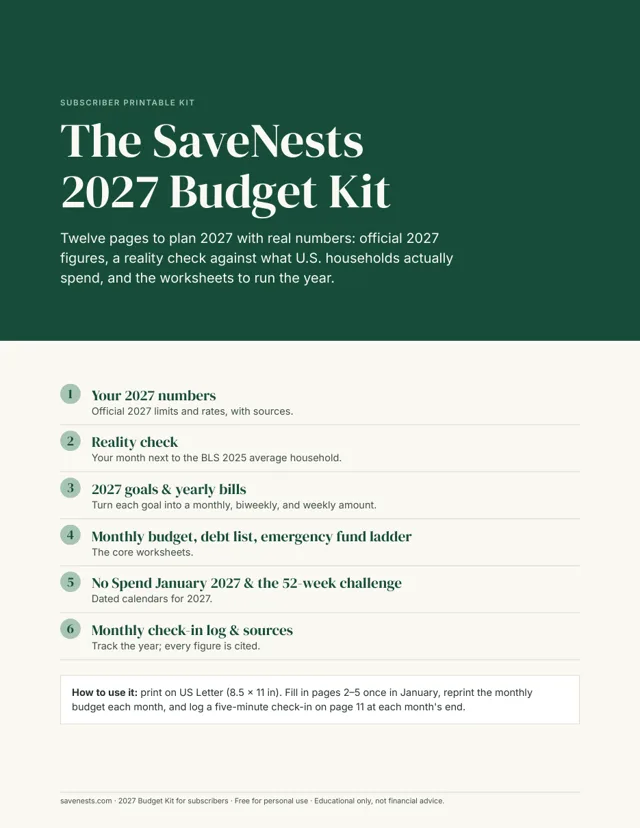
Get the 2027 Budget Kit
A 12-page printable PDF: official 2027 numbers (HSA limits, the 3.6% COLA), your month next to the BLS average household, goals and yearly bills, a monthly budget, a debt list, an emergency fund ladder, a No Spend January 2027 calendar, and dated 52-week challenge charts. Every figure is cited.