Zero-based budgeting sounds like a spreadsheet hobby until you try the short version. The idea is simple: your assignments for the month add up to your take-home pay, and the leftover line is zero. Zero does not mean an empty bank account. It means every dollar already has a job — rent, groceries, a bus pass, fun money, a transfer to savings — before the month starts spending itself.
Fidelity's explainer puts it the same way: every dollar of take-home gets a job, and savings is assigned at the start rather than hoped for at the end. This guide is the month-one version built for beginners who abandoned a forty-category template. You will use about ten lines, a pencil or the monthly budget calculator, and a weekly ten-minute check. If you want the wider beginner map first, start at Budgeting for beginners.
What "zero" actually means
Write your take-home for the month at the top of the page. Below it, list the jobs you are giving that money. When the jobs add up to the income number, you are done planning. The checking balance can still hold a cushion; that cushion is itself an assignment ("buffer" or "emergency") if you name it. What you are not doing is spending freely and hoping something is left on the 28th.
A common myth is that zero-based means you drain the account down to $0 every payday. That is not the method. Fidelity is explicit: zero is about the plan, not an empty account. If $200 sits in checking as next week's gas and groceries already assigned, that is still a zero-based month.
Why beginners abandon zero-based budgets
Most people do not quit because the math is hard. They quit because the first template asks for streaming, pets, gifts, haircuts, subscriptions, clothing, household, dining, coffee, hobbies, and six more lines before lunch. By category twelve the plan feels like homework, and the month never gets a finished first draft.
Month one only needs enough categories to catch the leaks and protect the bills. You can split groceries into "home" and "work lunches" later. Right now you need a list short enough that you will actually fill in the dollars tonight.
A short category list for month one (about ten lines)
Use this starter set. Drop a line you do not have (no childcare? skip it). Add one only if last month's statement proves you need it.
- Housing — rent or mortgage, plus renters or homeowners insurance if it is due this month
- Utilities and phone — electricity, heat, water, internet, the phone you need for work
- Groceries — food and basic household supplies bought at the store, not restaurants
- Transport — car payment, gas, transit pass, or rides you need to earn income
- Debt minimums — the required payment on every card, loan, or BNPL plan
- Insurance and medical — premiums, prescriptions, and expected copays this month
- Childcare or other fixed must-pay — only if you truly have one
- Fun money — a small, honest want line so the plan is not a punishment diet
- Sinking funds — monthly set-asides for bills you can see coming (insurance, holidays, car registration)
- Emergency / savings — the transfer you make on purpose, not the leftover hope
That is roughly ten jobs. If your household has two adults with separate fun money, that can be one more line. Resist going past twelve in month one. For irregular bills inside line nine, Sinking Funds: 20 Categories and How to Calculate Them shows the divide-by-months math.
A worked example: $3,600 take-home to zero
Numbers below are an illustration for one household, not a recommendation for your rent or your city. The point is the shape: income at the top, assignments that sum to the same number.
| Job (category) | Assigned | Notes |
|---|---|---|
| Housing | $1,350 | Rent |
| Utilities and phone | $240 | Electric, water, internet, phone |
| Groceries | $480 | Food at home plus basics |
| Transport | $320 | Car payment $220 + gas $100 |
| Debt minimums | $210 | Card and student loan minimums |
| Insurance and medical | $95 | Prescriptions and a planned copay |
| Fun money | $120 | Eating out, coffee, small wants |
| Sinking funds | $185 | Car registration + holiday set-aside |
| Emergency / savings | $400 | Assigned on payday, not leftover |
| Buffer in checking | $200 | Named cushion for timing gaps |
| Total assignments | $3,600 | Income minus jobs = $0 |
Notice savings is $400 in this illustration — the same size as the classic emergency-expense question in the Federal Reserve's Survey of Household Economics and Decisionmaking. In the 2025 SHED report, 63 percent of adults said they would cover a $400 emergency with cash or its equivalent, unchanged from recent years. That still leaves more than a third who would not. Assigning a starter transfer is how a zero-based plan answers that gap instead of waiting for a "good month."
The same report found that 59 percent of adults had at least one major unexpected expense in the prior twelve months — vehicle repair (30 percent), a house or appliance cost (22 percent), or a medical expense (21 percent) among the common ones. Only 41 percent always or often had money left at month end, and 16 percent did not pay all of their bills in full in the prior month. A plan that treats savings as optional leftover is swimming against those numbers.
Savings is an assignment, not a leftover
This is the piece that separates zero-based budgeting from "I'll see what's left." You put the savings job on the page with rent. If the month is tight, the savings number might be $50 instead of $400 — but it is still a line with a dollar amount and a payday transfer, not a wish.
A practical first target for many beginners is a starter $1,000 emergency fund. Keep it in a separate insured deposit account so it is harder to spend by accident; the FDIC's deposit insurance explainer covers how bank deposit insurance works within limits. Credit unions have parallel NCUA coverage.
If income varies, Fidelity's guidance matches what tight-month planners already do: base the month on your lowest recent take-home months, fund the must-pays from that base, and assign anything above the base only after it actually arrives. Do not average a fat month with a thin one and then wonder why week three broke.
Paid every two weeks? Build the month from two take-home checks, not yearly pay divided by 12, and give each bill the paycheck that lands before its due date. How to Budget Biweekly Paychecks walks through that split and what to do with the two extra checks a year.
When the plan goes positive or negative
If you have money left after assignments
Give it a job before it becomes an accidental shopping month. Common good jobs:
- Add it to the emergency line until you hit your starter goal
- Raise a sinking fund that is behind (holiday, car repair, annual insurance)
- Make an extra payment above the minimum on the highest-interest debt
- Bump the buffer if payday timing keeps scaring you
Do not leave a large unassigned surplus in checking "just in case" without naming the case. Unnamed money gets spent.
If assignments exceed income
Cut flexible lines first. Fun money, grocery padding, and optional sinking-fund goals move before rent, utilities, debt minimums, or the medicine you need. If the gap is still large after those cuts, you are in a tight-month problem, not a spreadsheet problem — use How to Create a Budget When Money Is Tight for the order of operations when bills already eat most of take-home pay.
Never "fix" a negative plan by deleting the grocery line or pretending a minimum payment is optional. A honest short plan beats a pretty plan that ignores food.
A weekly ten-minute check
Zero-based fails when you write it once and never look again. Once a week, take ten minutes:
- Open the bank and card statements for the last seven days.
- Match spending to your short list. Groceries over? Note by how much.
- Move dollars between flexible jobs if needed (fun money into groceries, not rent into fun money).
- Confirm the savings transfer already left or is still scheduled.
- Write one sentence: what almost blew the week.
If you do not know where money went last month, spend one week with the CFPB's free spending tracker before you lock next month's assignments. Sorting real transactions beats inventing category limits from memory.
Zero-based vs 50/30/20 vs cash stuffing
These tools solve different jobs. You can use more than one, but know which problem each one is for.
| Method | What it does | Best when |
|---|---|---|
| Zero-based (this guide) | Every dollar gets a specific job until assignments equal income | You want detail without a huge template, and savings must be named |
| 50/30/20 | Three percentage buckets: needs, wants, savings/debt | You want a quick split check and fixed costs are not already huge |
| Cash stuffing | Variable spending comes from labeled envelopes (often cash) | Card swipes in groceries, gas, or eating out keep going over |
The 50/30/20 Budget Rule Explained is buckets, not line items. It is faster to start and weaker when you need to see exactly which job ate the week. Cash stuffing for beginners is a spending control for a few categories; the envelopes still need a zero-based (or other) plan behind them so you know how much cash to withdraw. Zero-based is the assignment layer. Cash stuffing is one way to enforce a few of those assignments.
Paper, one-page printable, or monthly calculator
You do not need software for month one. Three workable paths:
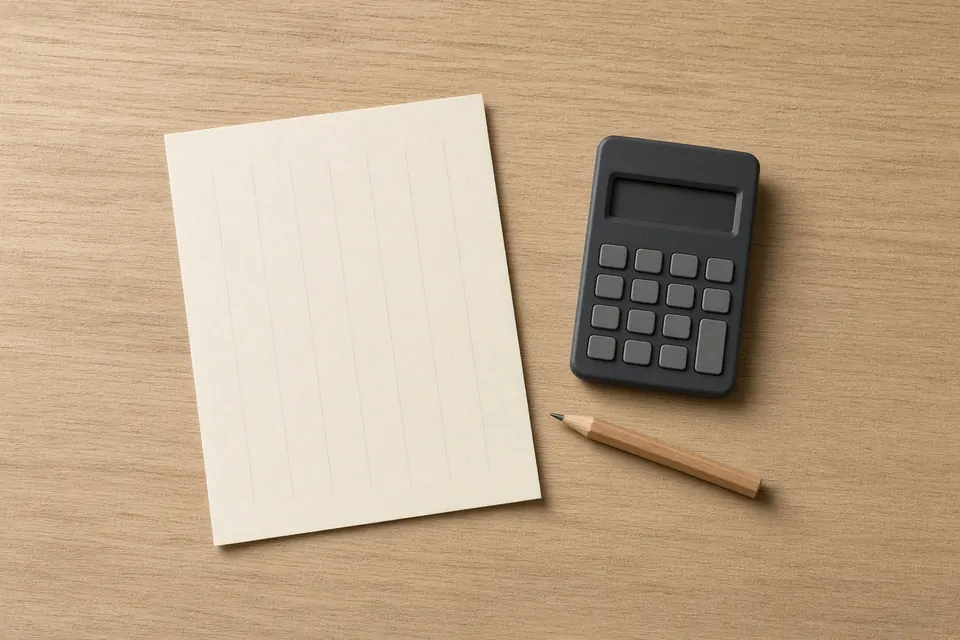
- Paper and a basic calculator: income at the top, ten lines, running total at the bottom until it hits zero.
- One-page printable: One-Page Budget Printable: How to Use It and the hub at budget printables if you want a fridge-friendly sheet.
- On-screen math: the monthly budget calculator runs in your browser and does not send your numbers to us.
Pick one path and finish a draft in one sitting. A half-finished app setup is worse than a messy page that already balances.
Starting a zero-based budget in January 2027
January is the easiest month to start, because the year's once-a-year bills are fresh in your statements. The catch is prices. A plan copied from last January will probably come up short, because prices for all items rose 3.7 percent in the 12 months to September 2026, according to the Bureau of Labor Statistics, and some everyday lines moved more. For the full January setup, see how to budget for 2027.
| Budget line | 12-month change |
|---|---|
| All items | +3.7% |
| Gasoline | +34.2% |
| Electricity | +4.4% |
| Shelter | +3.2% |
| Food away from home | +3.5% |
| Food at home | +1.8% |
National averages won't match your bills, so don't add 3.7 percent to every line. Re-price each assignment from what you actually paid in October, November, and December, then give the leftover a job. Gas is the line most likely to be stale. If you carry a card balance, give the debt line more than the minimum where you can: credit card accounts charged interest averaged 22.36 percent in August 2026, according to the Federal Reserve. The year-end financial checklist covers the December steps that feed this plan, like listing every debt and finding annual bills. If last year's plan kept breaking because of small purchases, How to Stop Overspending Without Feeling Restricted pairs well with a zero-based month.
A seven-day setup for your first zero-based month
- Day 1: Write last month's take-home (or the lowest of the last two or three months if pay varies).
- Day 2: List the ten jobs from this guide. Cross out any you do not have.
- Day 3: Fill dollars from real bills and last month's spending, not from wishes.
- Day 4: Assign savings and sinking funds before fun money. Adjust until the total equals income.
- Day 5: Schedule the savings transfer for the day after payday.
- Day 6: Put the weekly check on your calendar (same day each week, ten minutes).
- Day 7: Tell anyone who shares the household money what the fun-money and grocery numbers are.
After month one, you can split a category that kept overrunning. You earned that complexity by finishing a real month first.
Common month-one mistakes
- Building forty categories before the first payday transfer exists.
- Calling zero an empty account and then overdrafting on purpose.
- Leaving savings as "whatever is left" so it is never left.
- Using a fat average income when this month's deposits will be thinner.
- Skipping the weekly check, then blaming the method when week three surprises you.
- Cutting debt minimums or groceries on paper to make the math look pretty.
Zero-based budgeting for beginners works when the list is short, the savings line is real, and you revisit the plan while the month is still happening. The spreadsheet maze is optional. The jobs are not.
Questions readers ask
What is zero-based budgeting in plain English?
You give every dollar of take-home pay a job until your assignments equal your income for the month. The plan hits zero; your bank account does not have to.
Does zero-based budgeting mean my account should be empty?
No. Zero refers to unassigned money in the plan. A named buffer or upcoming grocery money still sitting in checking is fine.
How many categories should a beginner use?
About 8 to 12 for month one. Add more only after a category keeps going over and you need to see why.
How is zero-based different from the 50/30/20 rule?
50/30/20 uses three percentage buckets. Zero-based assigns specific dollar jobs (rent, groceries, savings transfer) until they equal income. Buckets are faster; jobs are more precise.
Where does savings go in a zero-based budget?
On its own line, assigned at the start of the month and preferably transferred on payday. It is not whatever survives on the last day.
What if my income changes every month?
Build the plan on your lowest recent months for must-pay bills, then assign extra income only after it arrives. Do not budget bills against an optimistic average.
Can I combine zero-based budgeting with cash stuffing?
Yes. Use zero-based to set the dollar jobs, then put a few overspending categories (often groceries, gas, eating out) into envelopes so the limit is physical.
What should I do if the plan goes negative?
Cut flexible lines first — fun money, grocery padding, optional sinking goals — before touching rent, utilities, debt minimums, or required medical costs. If it is still short, switch to a tight-month line-by-line plan.
How do I start a zero-based budget for the new year?
Pull your last two or three months of statements, list January's take-home pay, and assign every dollar to a short list of 8–12 lines, starting with essentials, debt minimums, and savings. Add a monthly set-aside for each once-a-year bill you find, and check the plan weekly in January.
Should I change my zero-based budget when prices rise?
Yes, but from your own bills rather than a national average. Prices for all items rose 3.7 percent in the 12 months to September 2026 (BLS), with gasoline up 34.2 percent. Re-price each line from what you recently paid and take the difference from flexible lines.
Sources
- Fidelity Learn, What is zero-based budgeting and how does it work? (February 25, 2026)Every dollar of take-home gets a job; zero does not mean an empty bank account; savings is assigned at the start; variable income can use lowest recent months as a base.
- Board of Governors of the Federal Reserve System, Economic Well-Being of U.S. Households in 2025 (SHED report, May 2026)63% of adults would cover a $400 emergency with cash or equivalent; 59% had a major unexpected expense in the prior 12 months; 41% always/often had money left at month end; 16% did not pay all bills in full in the prior month.
- FRED, Unexpected Expenses, All Adults (SHED $400 series)Time series for the share of adults who would cover a $400 unexpected expense with cash or equivalent (63% in 2025).
- Consumer Financial Protection Bureau, Spending tracker (Your Money, Your Goals)Free worksheet for sorting recent spending into categories before setting assignment amounts.
- U.S. Bureau of Labor Statistics, Consumer Price Index, September 2026 (released October 14, 2026)12 months to September 2026: all items +3.7%, gasoline +34.2%, electricity +4.4%, shelter +3.2%, food away from home +3.5%, food at home +1.8% (Table A).
- Federal Reserve, G.19 Consumer Credit (October 2026 release)Average interest rate on credit card accounts assessed interest: 22.36% (August 2026).
- FDIC, Understanding Deposit InsuranceDeposit insurance covers deposit accounts at FDIC-insured banks, within coverage limits.
Mohamed Ouhammouche
Mohamed Ouhammouche founded and runs SaveNests, a budgeting site that helps beginners build simple budgets. This guide was reviewed by the SaveNests Editorial Desk under the editorial and fact-checking policies.
Free for subscribers
Get the 2027 Budget Kit
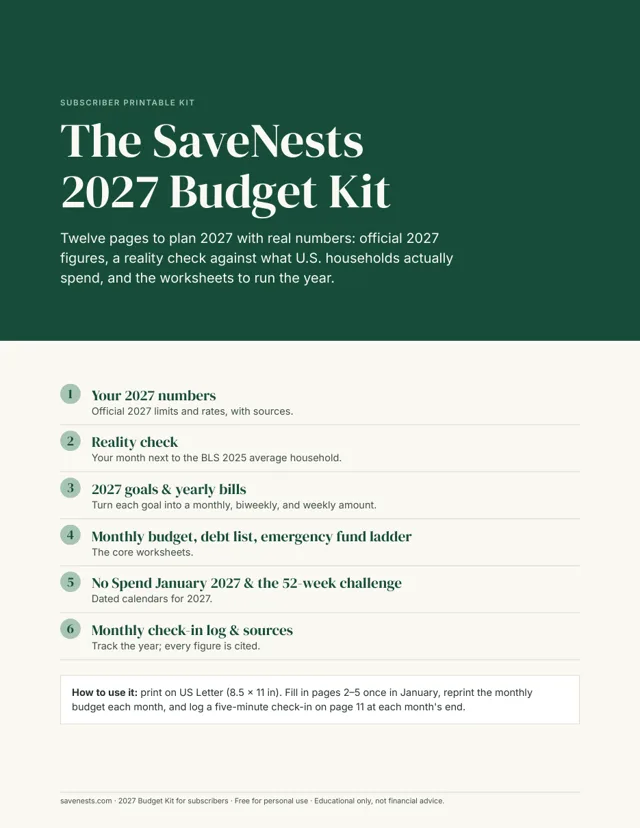
A 12-page printable PDF: official 2027 numbers (HSA limits, the 3.6% COLA), your month next to the BLS average household, goals and yearly bills, a monthly budget, a debt list, an emergency fund ladder, a No Spend January 2027 calendar, and dated 52-week challenge charts. Every figure is cited.