
Most budget templates ask for one monthly income number. If you live on tips, commissions, gig payouts, freelance invoices, overtime, or seasonal hours, that blank line is the first place the plan goes wrong. An average that looks fine on paper can assign bills you cannot cover in a thin month. A better habit is the opposite: plan from a cautious base, then decide what surplus is for after a fatter deposit shows up.
This guide walks through that base-month method with a worked example, a surplus order for fat months, a careful note on tax set-asides for self-employed income, and an optional two-account setup. It is planning help, not tax advice. For salaried biweekly pay with steadier deposits, use How to Budget Biweekly Paychecks instead.
The short answer
Budget irregular income from a cautious base—usually the lowest of your last three to twelve months of take-home deposits—not from your best month or a hopeful average. Fund rent, utilities, food, transport, minimum debt payments, and other essentials from that base only. When a bigger month arrives, assign the surplus on purpose: buffer first, then taxes if you owe them, then high-interest debt, then sinking funds and longer-term savings.
- Write down actual deposits for recent months; pick the lowest realistic base you can defend.
- Build essentials and a tiny cushion from that base with the monthly budget calculator.
- Park anything above the base until the month is real, then follow a surplus order.
- If you are self-employed, treat tax set-asides as spoken-for money—see the IRS pages on estimated taxes, not as spending cash.
Who this is for
Use this method if your deposits swing enough that last month's total would break this month's bills. Common patterns:
- Tips and service work that spike on weekends or holidays and sag in slow weeks
- Commission or bonus-heavy sales roles
- Gig and platform payouts that vary with demand
- Freelance and contract work with uneven invoices
- Hourly jobs with overtime one month and cut hours the next
- Seasonal work (retail peaks, summer construction, school-year schedules)
If every deposit is already spoken for by rent and groceries, pair this with How to Create a Budget When Money Is Tight. The base-month idea still applies; the order of bills matters even more. If income is simply too low most months, How to Save Money on a Low Income covers smaller levers and benefits checks.
How to pick your base month
Open your bank app or pay stubs and list take-home deposits by calendar month for as far back as you can usefully go—three months minimum, up to twelve if the year has slow seasons. Use money that actually landed after taxes and automatic deductions. Use deposits after taxes and deductions only; How to Budget an Irregular Paycheck covers building a month when those deposits swing.
- List each month's total take-home (all jobs and platforms that fund the household).
- Cross out one-time windfalls you cannot count on (a single huge tip night, a rare bonus, selling a car).
- Choose the lowest remaining month as your planning base—or a slightly higher number only if that lowest month was a true one-off (illness, unpaid leave) that will not repeat.
- Write the rule down: "Bills and essentials this month are planned from $X."
Here is a made-up six-month trail so the math is clear. These figures are an illustration, not a claim about anyone's real income:
| Month | Take-home deposits | Notes |
|---|---|---|
| March | $2,400 | Slow tips; no overtime |
| April | $3,100 | Normal |
| May | $2,750 | Two quiet weekends |
| June | $4,200 | Festival tips + overtime |
| July | $3,400 | Solid |
| August | $2,900 | Normal |
The average of those six months is about $3,125. If you budgeted from $3,125, March's $2,400 would be $725 short before you bought a single "want." Budgeting from the $2,400 base means April through August each create surplus you can assign after the money arrives. That is the whole method.
Fund essentials from the base only
With the base written down, build the month in the same order you would on a tight paycheck: committed bills, then food and transport, then everything flexible. Zero-based budgeting works well here because every base dollar gets a job before the month starts—and leftover "jobs" for surplus wait until surplus exists.
Using the $2,400 base from the sample:
| Line | Amount | Type |
|---|---|---|
| Rent | $1,100 | Essential |
| Utilities + phone | $220 | Essential |
| Groceries | $350 | Essential |
| Transit / gas | $140 | Essential |
| Debt minimums | $150 | Essential |
| Insurance due this month | $90 | Essential |
| Tiny buffer / starter savings | $50 | Protected |
| Flexible (household, small wants) | $300 | Flexible |
| Total | $2,400 | — |
Notice what is missing: a big "fun" line, aggressive extra debt payments, and a large sinking-fund transfer. Those wait for surplus months. The $50 buffer line is small on purpose—it exists so a $40 surprise does not bounce a utility payment. Growing that cushion is the first job of a fat month; see How to Build a $1,000 Emergency Fund once you have a repeatable surplus pattern.
What to do when a fat month hits
A fat month is any month where deposits land above your base. Do not raise the base mid-month just because one payday looked good. Wait until the money is in the account, subtract the base plan you already funded, and assign the difference in this order:
- Refill or grow the buffer / starter emergency fund until you have a cash cushion you trust for your bills (often $500–$1,000 to start).
- Set aside taxes if you are responsible for estimated payments or under-withholding (details in the next section). This money is not optional spending.
- Pay extra on high-interest revolving debt. Credit card accounts assessed interest averaged 22.36 percent in August 2026 (Federal Reserve G.19, released October 7, 2026)—far above what a typical savings account earns.
- Fund sinking funds for bills you can see coming (car registration, insurance, holidays, equipment).
- Then raise ongoing savings or retirement contributions. How Much Should I Save Each Month? helps pick a rate once the month is stable enough to keep one.
If a "fat" month is still short of the base, you are in a tight month, not a surplus month. Skip the wish list and use the tight-month order of operations instead.
Tax set-aside note for self-employed income
If you are paid without normal paycheck withholding—true freelance, many gig platforms, or side 1099 work—federal income tax and self-employment tax are often your job to send in over the year. The IRS explains that estimated tax is how many people pay income tax and self-employment tax as they earn. This is general information, not a recommendation of a filing method, a form, or an amount for your return.
- Read the IRS overview of estimated taxes and About Form 1040-ES.
- Self-employment tax covers Social Security and Medicare for people who work for themselves; the IRS summarizes the combined 15.3 percent rate on net earnings (with details and limits on the self-employment tax page). Income tax sits on top of that and depends on your whole return.
- A common planning habit is to move a fixed percentage of each self-employed deposit into a separate savings balance labeled for taxes as soon as the money arrives. Many people start in a rough 25–30 percent range of net self-employed profit as a buffer for combined income and self-employment tax, then adjust after they run the Form 1040-ES worksheet or talk with a tax professional. Your correct figure may be higher or lower.
- Uneven income has its own rules for estimated payments and possible penalty relief when income arrives unevenly; Publication 505 and Form 2210 cover those details on IRS.gov.
Optional two-account (holding) setup
You do not need a special product to budget irregular pay. A second insured account is only a tool to keep base money and surplus money from mixing in the spending account.
- Account A (holding / paycheck catcher): every deposit lands here first.
- Once or twice a month, transfer the base amount to Account B (bills and spending) and run the month from B.
- Leave surplus, tax set-asides, and sinking funds in A (or in named sub-balances) until you assign them.
Where you park a buffer, compare offers yourself. In October 2026 the FDIC's national average savings rate was 0.38 percent (published October 19, 2026)—a floor, not a goal. Competitive high-yield savings accounts often pay more; confirm FDIC or NCUA insurance and withdrawal rules rather than trusting a screenshot of an APY.
How this differs from biweekly salaried budgeting
A steady biweekly salary usually lets you split the same monthly bills across 26 paychecks and automate transfers on payday. Irregular income breaks that automation: the payday amount is not known in advance, and some months never reach the "normal" total. That is why this guide starts from a low base instead of from paycheck-day percentages.
If your main job is salaried and only a side hustle swings, budget the salary with the biweekly paycheck guide and run the side income through the base-and-surplus rules above. Mix the two only on paper once a month so the swinging dollars do not rewrite the steady plan.
Irregular paycheck checklist
- List 3–12 months of take-home deposits.
- Circle the lowest realistic month; that is your base.
- Build essentials + a tiny buffer from the base only.
- Keep flexible spending inside what the base can honestly hold.
- When deposits exceed the base, assign surplus in order: buffer, taxes, high-interest debt, sinking funds, then longer-term savings.
- If you are self-employed, move a tax set-aside before you spend surplus; use IRS estimated-tax resources to figure your own number.
- Optional: catch deposits in a holding account and transfer only the base to spending.
- Recheck the base after a lasting raise, a new job mix, or a season change—not after one good weekend.
When the base month finally balances with a little room, you can tighten the plan with Budgeting for beginners habits and grow the savings rate without pretending every month will match June.
Questions readers ask
How do you budget with an irregular paycheck?
Plan from a cautious base—usually the lowest of your last three to twelve months of take-home deposits—not from an average or your best month. Fund essentials from that base only. When a fatter month arrives, assign the surplus on purpose: buffer, taxes if you owe them, high-interest debt, sinking funds, then longer-term savings.
Should I use average income or my lowest month?
Use the lowest realistic recent month (or a close cautious figure) as the base for bills. An average can assign rent and groceries you cannot cover in a thin month. Treat anything above the base as surplus to assign after it lands.
How many months of income history should I look at?
Three months is a useful minimum. Up to twelve months helps if you have slow seasons. Ignore one-time windfalls you cannot count on. Recheck the base when your job mix or season changes, not after a single good payday.
What should I do with extra money in a high-earning month?
Keep the base plan unchanged. Put surplus toward a cash buffer first, then tax set-asides if you are responsible for estimated taxes, then extra payments on high-interest debt, then sinking funds and ongoing savings. Write the split the day the deposit arrives.
How much should freelancers set aside for taxes?
There is no single percentage that fits everyone. The IRS explains estimated taxes and Form 1040-ES for people who expect to owe tax as they earn, and self-employment tax is generally 15.3 percent on net earnings for Social Security and Medicare, with income tax on top. Many people use a rough 25–30 percent of net self-employed profit as a starting planning buffer, then adjust with the IRS worksheets or a tax professional. This is general information, not filing advice.
Do I need two bank accounts to budget irregular income?
No. A second insured account is optional. It helps if deposits and bill money keep getting mixed. A simple version is: all pay lands in a holding account, you transfer only the base amount to a spending account, and surplus stays parked until you assign it.
How is this different from budgeting biweekly paychecks?
Biweekly salaried budgeting assumes a known paycheck you can split across 26 pays a year. Irregular income does not give you that certainty, so you plan bills from a low base and assign surplus only after it arrives. If you have both a steady salary and a swinging side hustle, budget them separately and combine the numbers once a month.
Sources
- IRS, Estimated taxesGeneral rules on paying tax as you earn through withholding or estimated payments; not a filing recommendation.
- IRS, About Form 1040-ES, Estimated Tax for IndividualsWorksheet and instructions individuals often use to figure estimated tax.
- IRS, Self-employment tax (Social Security and Medicare taxes)Explains the combined 15.3 percent self-employment tax on net earnings (12.4 percent Social Security + 2.9 percent Medicare), with wage-base and deduction details on IRS.gov.
- Board of Governors of the Federal Reserve System, Economic Well-Being of U.S. Households in 2025 (SHED, May 2026)16% did not pay all bills in the prior month; 63% would cover a $400 expense with cash or equivalent (37% would not).
- Federal Reserve, Consumer Credit G.19 (released October 7, 2026)August 2026 commercial bank credit card plans: 22.36% APR on accounts assessed interest.
- FDIC, National Rates and Rate Caps – October 2026 (published October 19, 2026)National average savings rate 0.38%.
Mohamed Ouhammouche
Mohamed Ouhammouche founded and runs SaveNests, a budgeting site that helps beginners build simple budgets. This guide was reviewed by the SaveNests Editorial Desk under the editorial and fact-checking policies.
Free for subscribers
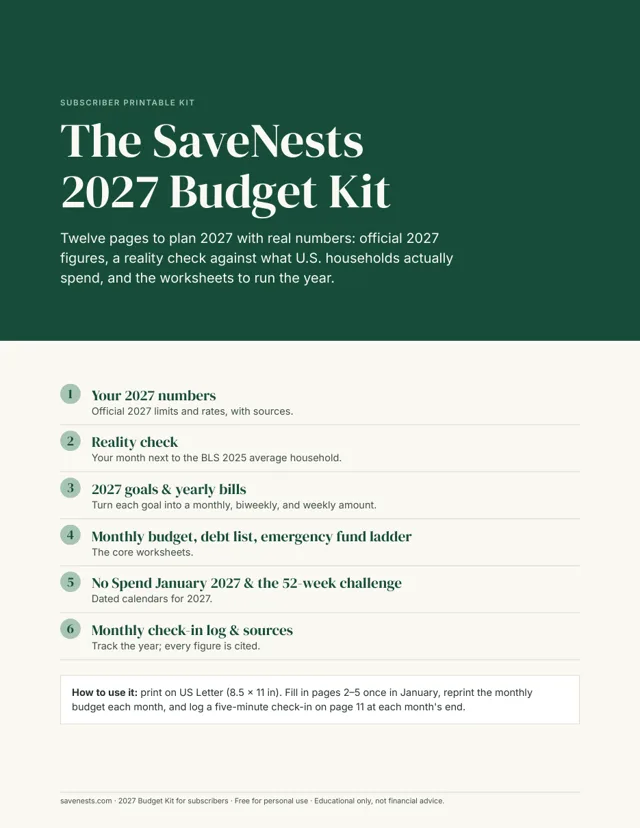
Get the 2027 Budget Kit
A 12-page printable PDF: official 2027 numbers (HSA limits, the 3.6% COLA), your month next to the BLS average household, goals and yearly bills, a monthly budget, a debt list, an emergency fund ladder, a No Spend January 2027 calendar, and dated 52-week challenge charts. Every figure is cited.