Getting paid every two weeks sounds simple until you try to line it up with bills that run on a monthly calendar. Rent wants its money on the 1st, the car payment on the 18th, and your paychecks land on whatever Fridays the payroll calendar says. One check feels roomy and the next one is gone before the weekend.
The fix isn't a fancier app. It's a short routine: budget from two paychecks a month, give every bill a paycheck, even out the big ones, and plan for the months when a third check shows up. Here's how I'd set it up, with a sample budget you can copy and the 2027 three-paycheck months already worked out.
Why biweekly pay feels harder to budget
You're in big company. In the Bureau of Labor Statistics' most recent snapshot (February 2023), biweekly was the most common pay schedule, used by 43.0 percent of private employers, ahead of weekly at 27.0 percent, semimonthly at 19.8 percent, and monthly at 10.3 percent. Bigger employers lean on it even more: 66.6 percent of establishments with 1,000 or more workers paid every two weeks.
The math is what makes it tricky. A year has 52 weeks, so a biweekly schedule pays you 26 times, not 24. Most months you get two checks. Two months a year (sometimes three, as you'll see below) you get three. If you divide your yearly pay by 12 and budget that amount every month, you're counting money that won't arrive until one of those third-paycheck months, and the months in between come up short.
Timing problems are common. In the Federal Reserve's survey of 2025, 16 percent of adults said they didn't pay all their bills in full the month before, and among people who struggled with bills, 42 percent paid at least one late. Only 41 percent said they always or often had money left over at the end of the month. Some of that is simply not enough income, and no calendar trick fixes that. But part of it is a good paycheck arriving four days after a bill was due, and that part you can fix.
Step 1: Write down your next six paydays and the take-home amount
Open your pay stub or payroll app and write down your next six paydays with the actual deposit amount, not your salary or gross pay. Taxes, health insurance, and retirement contributions come out first, and only what reaches your account can pay a bill. If your hours change, use the lowest check from the past two or three months as your planning number and treat anything above it as a bonus.
Then note the month each payday falls in. That list is the skeleton of the whole budget. Couples with two pay schedules do this for both and put them on the same calendar.
Step 2: List every bill with its due date
Next, list everything that leaves your account on a schedule: rent or mortgage, utilities, phone, internet, insurance, car payment, minimum debt payments, childcare, subscriptions. Write the amount and the due date next to each one. The Consumer Financial Protection Bureau has a free worksheet built for this; it also asks whether you've ever paid each bill late and what the late fee is, which tells you which due dates matter most.
Leave out day-to-day spending like groceries and gas for now. Those don't have a due date, so they get handled differently in Step 4. If you're not sure you've caught everything, scan our budget categories list of 84 categories; annual bills and payroll deductions are the ones people miss most.
Step 3: Give every bill a paycheck
This is the step that makes biweekly pay work. Go down your bill list and assign each one to the paycheck that arrives before its due date, with a few days of cushion for bank processing. A simple way to think about it:
- Paycheck 1 is the first payday of the month. It covers bills due from about that day through the day before the second payday.
- Paycheck 2 is the second payday. It covers bills due from then until the next month's first payday, including anything due on the 1st of next month.
- Rent due on the 1st usually comes out of the previous month's second paycheck. That surprises people the first time they map it out, and it's why the first week of the month feels tight.
Now total each column. Almost everyone finds one paycheck carrying far more than the other, usually the one that covers rent. That imbalance, not overspending, is often why one half of the month always feels broke.
Step 4: Put day-to-day spending on a two-week clock
Groceries, gas, household supplies, and personal spending don't care about due dates, so give them a fixed amount every paycheck. If you know your monthly numbers, convert them to a per-paycheck amount by multiplying by 12 and dividing by 26. A $500 monthly grocery budget becomes about $231 per paycheck; $160 a month for gas becomes about $74. If you track weekly, just double it.
The same amount every two weeks is easier to stick to than a monthly number, because a two-week window is short enough to feel. It also pairs well with cash stuffing: withdraw the per-paycheck amount on payday and split it into envelopes, and when the grocery envelope is empty, the next one arrives in a few days rather than at the end of the month.
Not sure where to start? Here's what the average household spent in 2025 on a few everyday lines, according to the Bureau of Labor Statistics' Consumer Expenditure Survey (released October 29, 2026), converted to a per-paycheck amount. Use them as a sanity check on your own numbers, not as targets.
| Category | Per year (2025) | Per paycheck (÷ 26) |
|---|---|---|
| Groceries (food at home) | $6,491 | $250 |
| Food away from home | $4,142 | $159 |
| Utilities, fuels, and public services | $4,931 | $190 |
| Gasoline and other fuels | $2,503 | $96 |
| Entertainment | $4,084 | $157 |
| Personal care products and services | $986 | $38 |
Re-check these lines every few months, because prices haven't stood still. In the October 2026 Consumer Price Index, released November 10, food prices rose 0.5 percent in one month (groceries 0.4 percent, restaurant and takeout food 0.5 percent) and electricity rose 0.9 percent, while gasoline was up 37.4 percent from a year earlier. A per-paycheck grocery or gas amount you set last spring may already be short.
Step 5: Even out the lopsided paycheck
Once you see which check is overloaded, you have three practical fixes. Most people use a mix.
Split the biggest bill across both checks
Set aside half of rent (or the mortgage) from every paycheck, and pay it when it's due. Some people call this the half-payment method. You don't pay the landlord in halves; you just move half the rent into savings or a separate checking account each payday so the full amount is waiting. The same trick works for car insurance billed every six months or any bill big enough to swamp one check. That's really a sinking fund with a short horizon.
Ask to move a due date
Many lenders, utilities, and card issuers will move a due date if you ask. The CFPB's worksheet suggests asking when a bill falls a week or more ahead of the income meant to cover it, and it offers simple wording: "I am requesting a change in my bill payment due date for my [company] bill. I would prefer to have my bill payment due date be on the __th of each month." Ask when the change takes effect and how much the next bill will be, because moving a date later can make the first bill after the change bigger. It's a courtesy, not a right, so some companies will say no.
Build a small buffer
The long-term fix is to get one paycheck ahead: enough in checking to pay any bill the day it's due regardless of which Friday the money lands. That takes time, so start with $100 to $300 and grow it from the extra paychecks (more on those below). It works hand in hand with a starter emergency fund, but keep the two separate. The buffer smooths timing; the emergency fund is for the car repair. Once the emergency fund is more than a few hundred dollars, compare savings accounts: the FDIC's national average was only 0.39 percent for savings and 0.64 percent for money market accounts as of November 16, 2026, and many FDIC-insured banks and NCUA-insured credit unions pay more.
A sample biweekly budget
Here's how the steps look on a take-home check of $1,800 every two weeks. The bills, dates, and amounts are made up to show the method, not a recommendation for what yours should be.
| Line | Paycheck 1 (first payday) | Paycheck 2 (second payday) |
|---|---|---|
| Take-home pay | $1,800 | $1,800 |
| Half of rent ($1,350 due on the 1st) | $675 | $675 |
| Internet (due the 8th) | $60 | |
| Electric (due the 12th) | $140 | |
| Credit card minimum (due the 15th) | $90 | |
| Car payment (due the 18th) | $310 | |
| Phone (due the 22nd) | $65 | |
| Car insurance (due the 25th) | $130 | |
| Groceries (two weeks) | $231 | $231 |
| Gas (two weeks) | $74 | $74 |
| Personal and household | $80 | $80 |
| Savings transfer | $75 | $75 |
| Left for buffer or sinking funds | $375 | $160 |
Splitting rent keeps both checks workable, but paycheck 2 is still tighter. Asking the insurer to move the $130 car insurance payment to the 10th would shift it into paycheck 1 and leave $245 and $290 at the end of each check, close to even. That's the kind of small change that ends the "broke every other week" feeling. If you like giving every dollar a job, this layout is a zero-based budget done per paycheck; if you prefer broad buckets, you can sort the same lines with the 50/30/20 rule.
Three-paycheck months in 2027
Because you budget the month from two checks, the third one in a month is genuinely free money for the plan. Which months get one depends on your exact payday. Here are the two possible patterns for people paid every other Friday in 2027:
| If your first 2027 Friday payday is | Three-paycheck months | Paydays in 2027 |
|---|---|---|
| January 1 | January, July, December | 27 |
| January 8 | April, October | 26 |
Two things to check on your own payroll calendar. January 1, 2027 is New Year's Day, and employers often pay before a holiday, so that check may land on December 31, 2026 instead, which changes what counts as a 2027 paycheck. And if you're paid on a different weekday, count it yourself: start from your next payday, add 14 days at a time, and circle any month with three dates. It takes five minutes and you only do it once a year. Then fold those checks into your 2027 budget.
What to do with the extra paycheck
Decide before it arrives, or it gets absorbed into a normal month without anyone noticing. A good order for most people:
- Top up the one-paycheck buffer until bills no longer depend on which Friday it is.
- Build or refill your emergency fund.
- Fund the sinking funds for the year's lumpy costs: car registration, holidays, back-to-school. If December is a three-paycheck month for you, that check is a ready-made Christmas budget instead of a credit card bill.
- Put a chunk toward high-interest debt. Credit card accounts that were charged interest averaged a 22.36 percent rate in the third quarter of 2026, according to the Federal Reserve's November 6, 2026 G.19 release. An extra $500 to a card at that rate saves real money, and the debt avalanche or snowball helps you pick which one.
- Keep a small slice, maybe 10 percent, for something you'll enjoy. A plan you like is a plan you keep.
On the $1,800 example, two extra paychecks are $3,600 a year that the regular budget never relied on. That's a full starter emergency fund plus a holiday fund, without cutting a single grocery trip.
Common biweekly budgeting mistakes
- Budgeting from gross pay or from yearly pay divided by 12. Use two actual take-home checks a month.
- Assigning rent to the first check of the month when it's due on the 1st. That money has to be there before the 1st, so it comes from the previous month's checks.
- Ignoring bills that aren't monthly. Car insurance, annual subscriptions, and registration fees need a per-paycheck set-aside or they wreck a random month.
- Treating the third paycheck as a raise. Your regular spending should look exactly the same in a three-paycheck month.
- Never re-checking. Re-do the bill map whenever a due date, your rent, or your pay changes.
Biweekly paycheck budget checklist
- Write your next six paydays and take-home amounts.
- List every bill with its amount and due date.
- Assign each bill to the paycheck that arrives before it's due.
- Convert groceries, gas, and personal spending to per-paycheck amounts (monthly × 12 ÷ 26).
- Total each paycheck and spot the lopsided one.
- Set aside half of rent from every check, and ask to move one or two due dates if needed.
- Start a $100 to $300 buffer in checking.
- Circle your three-paycheck months for 2027 and decide now what each extra check is for.
If you'd rather run the numbers on screen, the monthly budget calculator works in your browser, and more beginner guides live on the Budgeting hub.
Questions readers ask
How do you budget biweekly paychecks?
Write down your paydays and take-home pay, list your bills with due dates, and assign each bill to the paycheck that arrives before it's due. Give groceries, gas, and personal spending a fixed amount per paycheck. Then even out the heavier check by splitting rent across both and asking to move a due date.
How many paychecks do you get a year if you're paid biweekly?
Usually 26, because a year has 52 weeks. That's two more than a twice-a-month schedule. In some years the calendar gives a biweekly schedule 27 paydays; for people paid every other Friday starting January 1, 2027, the count is 27, though a holiday may move that first check to December 31, 2026.
How do I turn a monthly budget into a biweekly one?
Multiply the monthly amount by 12 and divide by 26. For example, $500 a month for groceries is about $231 per paycheck. For income, budget from two paychecks a month rather than yearly pay divided by 12, so the extra checks stay extra.
Which months have three paychecks in 2027?
For every-other-Friday paydays, it depends on your first 2027 payday. If it's January 1, the three-paycheck months are January, July, and December. If it's January 8, they're April and October. For other weekdays, count forward 14 days at a time from your next payday.
What should I do with a third paycheck?
Decide before it arrives. A common order is a one-paycheck buffer in checking, then the emergency fund, then sinking funds for holidays and annual bills, then extra payments on high-interest debt, with a small slice for something you enjoy.
Can I change a bill's due date to match my paycheck?
Often, yes. Many companies and credit card issuers will move a due date if you ask by phone or online. The CFPB notes it's a courtesy rather than a right, and that moving a date later can make the first bill after the change higher, so ask how and when the change takes effect.
What budget categories should a biweekly budget have?
Split them by timing. Bills with due dates (rent, utilities, phone, insurance, car payment, debt minimums) get assigned to a specific paycheck. Day-to-day lines (groceries, gas, household, personal, fun money) get a fixed amount every paycheck. Annual costs (car registration, holidays, memberships) get a small sinking-fund transfer from each check. Our budget categories list has 84 to choose from.
How much should I budget per paycheck for groceries?
Start from your own receipts: take your monthly grocery spending, multiply by 12, and divide by 26. For context, the average household spent $6,491 on food at home in 2025, according to the BLS, which works out to about $250 per biweekly paycheck. Grocery prices rose 0.4 percent in October 2026 alone, so check the number every few months.
Sources
- U.S. Bureau of Labor Statistics, Length of pay periods in the Current Employment Statistics survey (February 2023 data)Share of private establishments by pay period: biweekly 43.0%, weekly 27.0%, semimonthly 19.8%, monthly 10.3%; biweekly 66.6% among establishments with 1,000+ employees.
- Board of Governors of the Federal Reserve System, Economic Well-Being of U.S. Households in 2025 (SHED report, May 2026)41% always or often had money left over at month end; 16% did not pay all bills in full in the prior month; 42% of those who struggled with bills paid one or more late; 86% of those who always had money left over had three months of savings vs. 13% of those who never did.
- Consumer Financial Protection Bureau, Request a change in your bill due date (worksheet)Bill schedule worksheet; consider a due date change if a bill falls a week or more before the income that covers it; sample request wording; due date changes are a courtesy, not a right; a later date can make the first bill higher.
- Consumer Financial Protection Bureau, Bill calendar (Your Money, Your Goals)Printable monthly calendar for mapping bills against paydays.
- Federal Reserve, G.19 Consumer Credit (November 6, 2026)Commercial bank interest rate on credit card accounts assessed interest: 22.36% (2026 Q3).
- U.S. Bureau of Labor Statistics, Consumer Expenditures in 2025 (released October 29, 2026), Table 1Average household spending in 2025: food at home $6,491; food away from home $4,142; utilities, fuels, and public services $4,931; gasoline and other fuels $2,503; entertainment $4,084; personal care $986.
- U.S. Bureau of Labor Statistics, Consumer Price Index, October 2026 (released November 10, 2026)Seasonally adjusted October changes: food +0.5%, food at home +0.4%, food away from home +0.5%, electricity +0.9%; gasoline +37.4% over 12 months (not seasonally adjusted).
- FDIC, National Rates and Rate Caps (November 16, 2026)National average rates: savings 0.39%, money market 0.64%.
Mohamed Ouhammouche
Mohamed Ouhammouche founded and runs SaveNests, a budgeting site that helps beginners build simple budgets. This guide was reviewed by the SaveNests Editorial Desk under the editorial and fact-checking policies.
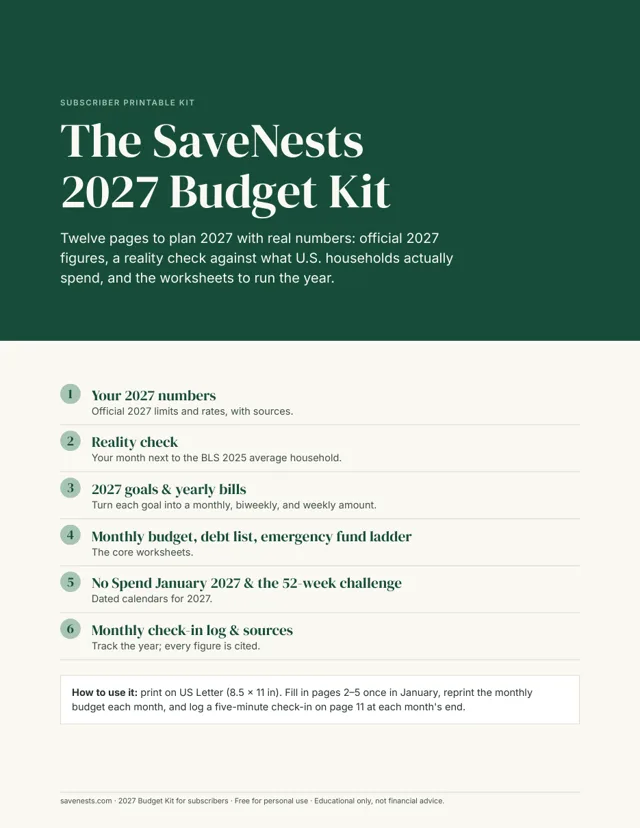
Free for subscribers
Get the 2027 Budget Kit
A 12-page printable PDF: official 2027 numbers (HSA limits, the 3.6% COLA), your month next to the BLS average household, goals and yearly bills, a monthly budget, a debt list, an emergency fund ladder, a No Spend January 2027 calendar, and dated 52-week challenge charts. Every figure is cited.