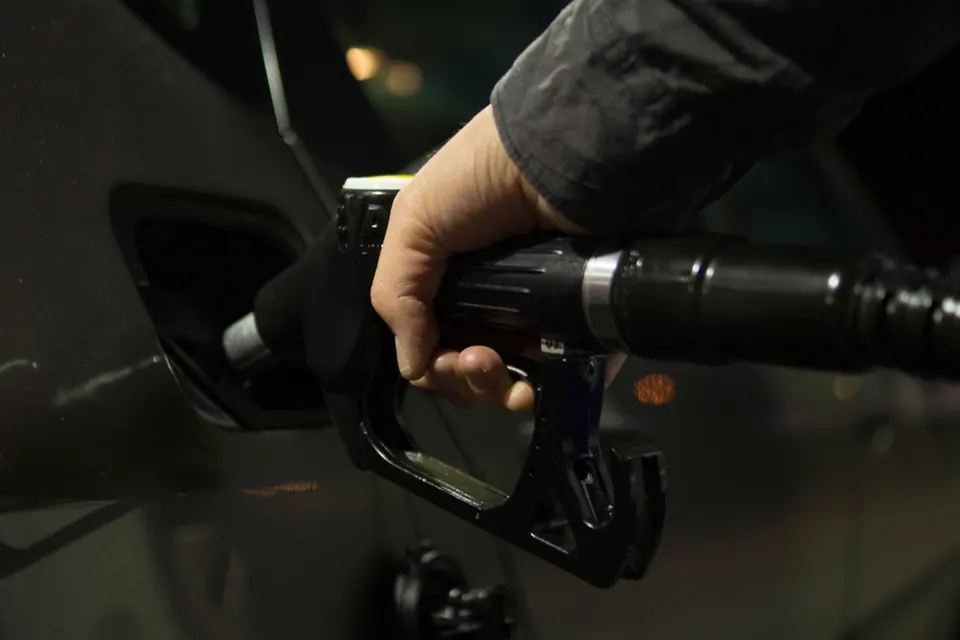
Gas is one of those costs that feels out of your hands. You can't pick the price on the sign, and you still have to get to work, school, the store, and, this week, maybe a Thanksgiving table a few hundred miles away. But the price per gallon is only half the bill. The other half is how many gallons you buy, and that part you control more than you might think.
Below: what gas costs right now, how to find your own number, and 15 ways to spend less. The percentages come from the Department of Energy and EPA's fueleconomy.gov and other government sources, not gadget ads, and every example is labeled so you can swap in your own car and miles.
What gas costs right now
Gas has been the fastest-rising line in a lot of budgets this year. In the Bureau of Labor Statistics' October 2026 Consumer Price Index, released November 10, gasoline prices were up 37.4 percent from a year earlier. Regular unleaded was up 38.6 percent and premium 31.4 percent.
The good news is that the pump price has been falling for a few weeks. The Energy Information Administration put the national average for regular at $4.153 a gallon on November 2, $3.995 on November 9, and $3.805 on November 16, 2026. That's still $0.743 more than a year earlier, and the gap between regions is big:
| Area | Price per gallon | Change from a year ago |
|---|---|---|
| U.S. average | $3.805 | +$0.743 |
| Gulf Coast | $3.293 | +$0.693 |
| Midwest | $3.604 | +$0.697 |
| Rocky Mountain | $3.696 | +$0.747 |
| East Coast | $3.707 | +$0.754 |
| West Coast | $4.933 | +$0.813 |
| Texas | $3.216 | +$0.632 |
| California | $5.387 | +$0.911 |
In August 2026, EIA estimated crude oil was 50 percent of the pump price, refining 24 percent, and distribution and taxes 13 percent each. Stations can't do much about the sign, so most of your savings will come from buying fewer gallons.
The average household spent $2,503 on gasoline and other fuels in 2025, about $209 a month, according to the BLS Consumer Expenditure Survey released October 29, 2026. With prices up so much since, a gas budget built on last year's receipts is probably too low.
First, find your real gas number
Before changing anything, work out what gas actually costs you. You need two numbers: how many miles you drive in a month and your car's real miles per gallon. Reset your trip meter when you fill up, and at the next fill-up divide the miles by the gallons you bought. Do it twice to get a fair average.
How you drive: the biggest free savings
1. Drive gently
Fueleconomy.gov says aggressive driving, meaning speeding, rapid acceleration, and braking, can lower gas mileage by roughly 15 to 30 percent at highway speeds and 10 to 40 percent in stop-and-go traffic. Leave space ahead, coast toward red lights, and pull away smoothly. For an aggressive driver, this one habit beats everything else here combined.
2. Slow down on the highway
Gas mileage usually drops quickly above 50 mph. Fueleconomy.gov estimates that each 5 mph over 50 is like paying an extra $0.27 a gallon (at a $3.81 gas price), and that slowing down by 5 to 10 mph improves fuel economy by 7 to 14 percent. In the example above, if most of your 40 gallons go to highway miles, 7 to 14 percent is about 2.8 to 5.6 gallons, or roughly $10.65 to $21.31 a month.
3. Use cruise control on open highway
Holding a steady speed saves gas in most cases, according to fueleconomy.gov. Skip it in bad weather.
4. Stop idling, including long winter warm-ups
Idling gets zero miles per gallon. Fueleconomy.gov says idling can use a quarter to half a gallon of fuel per hour, depending on engine size and whether the air conditioning is on, and restarting the engine takes only about 10 seconds' worth of fuel. At $3.805 a gallon, an hour of idling costs about $0.95 to $1.90.
In winter, most manufacturers recommend driving off gently after about 30 seconds, because the engine warms faster while driving. Ten minutes of warm-up every morning is about five hours of idling a month, roughly $4.76 to $9.51. Parked for more than a minute? Turning the engine off saves money, as long as you start the car no more than about 10 times a day.
Your car: small fixes that add up
5. Keep your tires at the right pressure
Under-inflated tires lower gas mileage by about 0.2 percent for every 1 psi drop across all four tires. Keeping them properly inflated improves mileage by 0.6 percent on average and up to 3 percent in some cases. Use the pressure on the sticker inside the driver's door or in your owner's manual, not the maximum printed on the tire. Check monthly, and more often now: tire pressure falls as temperatures drop.
6. Use the oil grade your manual calls for
Using the manufacturer's recommended grade of motor oil can improve gas mileage by 1 to 2 percent. Putting 10W-30 in an engine designed for 5W-30, for example, can cost you 1 to 2 percent. When you get an oil change, ask what's going in.
7. Don't ignore the check engine light
A lit check engine light can mean something as small as a loose gas cap or a problem that lowers fuel economy and leads to bigger repairs later. Fueleconomy.gov recommends having the car inspected when it comes on.
8. Lose the roof box and the trunk clutter
A large roof-top cargo box can reduce fuel economy by about 6 to 17 percent on the highway and 10 to 25 percent at 65 to 75 mph. A rear-mounted box or tray costs much less, about 1 to 5 percent on the highway. If you need a carrier for a holiday trip, take it off when you get home. Inside the car, an extra 100 pounds lowers mileage by about 1 percent, more in a small car.
9. Buy the octane your car needs, not more
Most gasoline cars are designed to run on 87 octane. Fueleconomy.gov says premium gives little to no benefit under normal driving in a car that doesn't require it, and the extra cost is typically higher than any fuel savings. The FTC gives the same advice: buy only the octane your owner's manual calls for. If your manual says premium is required, use it, because a lower grade can hurt the engine.
How much you drive: fewer miles, fewer gallons
10. Combine errands into one trip
A cold engine is a thirsty engine. Several short trips taken from a cold start can use twice as much fuel as one longer trip covering the same distance, according to fueleconomy.gov. Winter makes it worse: in city driving, a regular gas car's mileage is roughly 15 percent lower at 20°F than at 77°F, and as much as 24 percent lower on short trips of 3 to 4 miles. Do the store, pharmacy, and post office in one loop. Planning a week of meals with meal planning on a budget also cuts the mid-week grocery runs.
11. Carpool, take transit, or work from home when you can
Taking turns driving with others can cut your weekly fuel costs in half, fueleconomy.gov notes, and HOV lanes often move faster. If your employer allows a remote day or two, each one is a full round-trip commute you don't pay for.
12. Drive your most efficient car
In a two-car household, which car does the daily driving matters. Here's an example: 12,000 miles a year in a 20-mpg car uses 600 gallons, about $2,283 at $3.805. The same miles in a 30-mpg car use 400 gallons, about $1,522. That's a $761 difference a year without driving a single mile less. Save the bigger vehicle for the trips that need it.
Where and how you pay
13. Compare prices, but do the detour math
A price app can show the cheapest nearby station, but a detour costs gas too. Use your cost per mile.
Also check whether the station posts a lower cash price. Some do, and if you're already using cash stuffing for beginners style envelopes, a gas envelope makes paying cash easy.
14. Use fuel discounts and card rewards only if the math works
Grocery fuel points, warehouse club stations, and paid memberships with gas discounts can all save money, but only if you'd shop there anyway and the savings beat the membership fee. Add up what you'd actually save in a year and compare it to the fee before you sign up.
Gas rewards credit cards follow the same rule, with one more catch. The Federal Reserve's G.19 release shows the average rate on credit card accounts that paid interest was 22.36 percent in the third quarter of 2026. Say a card pays 3 percent back on $150 of gas. That's $4.50. Carry that $150 for two months and interest costs about $5.59, more than the reward. Rewards only pay if you clear the balance every month. If you're already carrying a balance, how to pay off credit card debt is a better place to put your energy.
15. Give gas its own budget line
A gas budget turns all of the above into money you keep. Set it from your last month or two of receipts and give it its own line in the monthly budget calculator. Whatever you don't spend can roll into a sinking fund for car repairs, tires, or the next road trip. If gas keeps blowing up your budget at the end of the month, how to stop living paycheck to paycheck shows how to build a small buffer.
What doesn't save gas
- Gas-saving gadgets and additives. The FTC warns that ads usually promise 12 to 25 percent better mileage, but the EPA has evaluated or tested more than 100 alleged gas-saving devices and hasn't found any that significantly improves gas mileage. Some can damage the engine or raise emissions, and no government agency endorses them.
- Premium in a car designed for regular. You pay more for little to no benefit in normal driving.
- A new air filter on a modern car. Replacing a clogged filter on fuel-injected engines, roughly early-1980s cars and newer, can improve acceleration but doesn't improve mileage, according to fueleconomy.gov.
- Long warm-ups. As above, idling gets 0 miles per gallon.
How much could you save?
Here's what the government estimates mean for the example car: 40 gallons and $152.20 a month. Don't add the rows together; the effects overlap. Pick the two or three that fit your driving and stick with them.
| Change | Fuel economy benefit | Example savings per month |
|---|---|---|
| Drive sensibly (if you drive aggressively now) | 10% to 40% | $15.22 to $60.88 |
| Slow down 5 to 10 mph (mostly highway miles) | 7% to 14% | $10.65 to $21.31 |
| Skip 10 minutes of idling a day | 0.25 to 0.5 gal per hour saved | $4.76 to $9.51 |
| Use the recommended oil grade | 1% to 2% | $1.52 to $3.04 |
| Remove 100 pounds of extra weight | About 1% | About $1.52 |
| Keep tires properly inflated | 0.6% on average | About $0.91 |
If you're driving for the holidays, holiday travel on a budget shows how to price the whole trip, and our frugal living guides have more ways to cut costs without feeling deprived.
Save money on gas checklist
- Track two tanks to get your real mpg and cost per mile.
- Set a monthly gas line from recent receipts.
- Drive gently, slow down 5 to 10 mph on the highway, and use cruise control.
- Turn the engine off instead of idling; drive off after about 30 seconds on cold mornings.
- Check tire pressure monthly, especially as it gets colder.
- Use the recommended oil grade and octane.
- Take off roof carriers and clear out trunk weight.
- Batch errands into one trip and share rides where you can.
- Compare station prices without making special detours.
- Only use fuel memberships or rewards cards if the math beats the fee and you pay in full.
Questions readers ask
What is the best way to save money on gas?
Change how you drive. Fueleconomy.gov says aggressive driving can lower gas mileage by about 15 to 30 percent at highway speeds and 10 to 40 percent in stop-and-go traffic, so accelerating smoothly, braking early, and slowing down on the highway save more than any gadget or app. Combining errands, keeping tires inflated, and not idling come next.
Does driving slower really save gas?
Yes. Mileage usually drops quickly above 50 mph. Fueleconomy.gov estimates each 5 mph over 50 is like paying about $0.27 more per gallon at a $3.81 gas price, and slowing down 5 to 10 mph improves fuel economy by 7 to 14 percent.
Is premium gas worth it?
Only if your owner's manual requires it. Most gas cars are designed for 87 octane, and fueleconomy.gov says premium gives little to no benefit in normal driving for those cars. If your car requires premium, use it, because a lower grade can damage the engine.
Do gas-saving devices and additives work?
Generally, no. The FTC says the EPA has evaluated or tested more than 100 alleged gas-saving devices and hasn't found any that significantly improves gas mileage, and some can damage the engine or raise emissions. No government agency endorses them.
Is it worth driving to a cheaper gas station?
Only if it's close or on your way. In a 25-mpg car at $3.805 a gallon, 5 extra miles costs about $0.76. A station 10 cents cheaper saves $1.20 on 12 gallons, so you come out just $0.44 ahead.
How much should I budget for gas each month?
Use your own numbers: monthly miles divided by your mpg, times your local price. For example, 1,000 miles in a 25-mpg car is 40 gallons, or about $152 at the November 16, 2026 national average of $3.805. For comparison, U.S. households spent an average of $2,503 on gasoline and other fuels in 2025, about $209 a month.
Sources
- U.S. Energy Information Administration, Gasoline and Diesel Fuel Update (released November 17, 2026)U.S. regular gasoline $4.153 (Nov. 2), $3.995 (Nov. 9), $3.805 (Nov. 16, 2026), up $0.743 from a year ago; regional and state prices for Nov. 16; August 2026 retail price $4.06 with crude oil 50%, refining 24%, distribution and marketing 13%, taxes 13%.
- U.S. Bureau of Labor Statistics, Consumer Price Index, October 2026 (released November 10, 2026), Tables A and 2Gasoline (all types) +37.4% over 12 months ended October 2026 (not seasonally adjusted); unleaded regular +38.6%; unleaded premium +31.4%.
- U.S. Bureau of Labor Statistics, Consumer Expenditures in 2025 (released October 29, 2026), Table 1Average household spending on gasoline and other fuels $2,503 in 2025, down from $2,645 in 2024; transportation $13,492.
- U.S. Department of Energy and EPA, fueleconomy.gov: Driving More EfficientlyAggressive driving lowers mileage roughly 15%-30% at highway speeds and 10%-40% in stop-and-go traffic; each 5 mph over 50 mph is like paying an extra $0.27/gallon; slowing 5-10 mph improves fuel economy 7%-14% (at $3.81/gallon); roof-top cargo box 6%-17% highway, 10%-25% at 65-75 mph; rear-mount 1%-5% highway; 100 extra pounds about 1%; idling uses a quarter to a half gallon per hour; restart takes about 10 seconds of fuel.
- fueleconomy.gov: Keeping Your Vehicle in ShapeProper tire inflation improves mileage 0.6% on average, up to 3%; about 0.2% lost per 1 psi drop; recommended oil grade improves mileage 1%-2%; replacing a clogged air filter on modern fuel-injected engines does not improve mpg.
- fueleconomy.gov: Planning and Combining TripsSeveral short cold-start trips can use twice as much fuel as one longer multipurpose trip; carpooling by taking turns can cut weekly fuel costs in half.
- fueleconomy.gov: Fuel Economy in Cold WeatherCity mileage of a conventional gas car roughly 15% lower at 20°F than at 77°F, up to 24% lower on 3- to 4-mile trips; drive off gently after about 30 seconds.
- fueleconomy.gov: Selecting the Right Octane FuelMost gasoline vehicles are designed for 87 octane; higher octane gives little to no benefit under normal driving unless required.
- Federal Trade Commission, "Gas Saving" Products: Fact or Fuelishness?Claims usually tout 12%-25% savings; EPA has evaluated or tested more than 100 alleged gas-saving devices and found none that significantly improves gas mileage; no government agency endorses gas-saving products; buy only the octane you need.
- Federal Reserve, G.19 Consumer Credit (November 6, 2026)Commercial bank interest rate on credit card accounts assessed interest: 22.36% (2026 Q3).
Mohamed Ouhammouche
Mohamed Ouhammouche founded and runs SaveNests, a budgeting site that helps beginners build simple budgets. This guide was reviewed by the SaveNests Editorial Desk under the editorial and fact-checking policies.
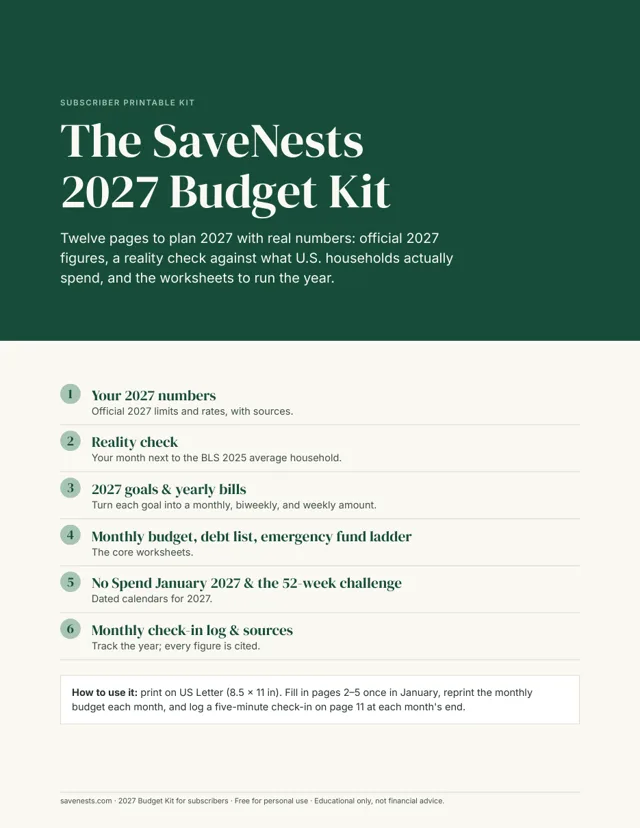
Free for subscribers
Get the 2027 Budget Kit
A 12-page printable PDF: official 2027 numbers (HSA limits, the 3.6% COLA), your month next to the BLS average household, goals and yearly bills, a monthly budget, a debt list, an emergency fund ladder, a No Spend January 2027 calendar, and dated 52-week challenge charts. Every figure is cited.