
Holiday travel is the part of the season budget that people tend to guess at. The gifts get a list and the dinner gets a menu, but the trip home is a fare you saw once, a tank of gas, and a vague idea that the rest will sort itself out. Then come the bag fees, the airport parking, the meals on the road, and one more night in a hotel, and the trip costs far more than the ticket.
This year that guess is riskier than usual, because travel prices have moved a lot faster than everything else. This guide walks through what holiday travel actually costs right now, how to build a full trip budget, and where the real savings are, using current government price data rather than vague tips.
What holiday travel costs this year
Overall consumer prices rose 3.7 percent in the 12 months to September 2026, according to the Bureau of Labor Statistics. Travel costs rose much faster. Here's how the main pieces of a trip changed over the same period.
| Trip cost | Change over 12 months |
|---|---|
| All items (overall inflation) | +3.7% |
| Airline fares | +22.4% |
| Gasoline (all types) | +34.2% |
| Public transportation | +15.6% |
| Car and truck rental | +9.1% |
| Lodging away from home | +4.4% |
| Food away from home | +3.5% |
| Food at home (groceries) | +1.8% |
The October 2026 CPI, released November 10, is the newest read. Gasoline was up 37.4 percent from October 2025, and airline fares rose another 3.8 percent from September to October before seasonal adjustment. BLS couldn't publish most other 12-month changes for October because October 2025 prices weren't collected during the government shutdown, so the September column above is the latest full-year comparison for fares, hotels, and food.
Two other numbers help put dollars on it. The Bureau of Transportation Statistics reported that the average domestic airfare in the second quarter of 2026 was $445, the highest unadjusted quarterly fare it has recorded. Round-trip tickets averaged $549 and one-way tickets $312. Those averages don't include optional fees like checked bags or seat selection. At the pump, prices have come down since late October but are still well above last year. The Energy Information Administration put the national average for regular gasoline at $3.805 a gallon for the week of November 16, 2026, down from $4.269 on October 26 but still $0.743 more than a year earlier. Prices vary a lot by region, from $3.293 on the Gulf Coast to $4.933 on the West Coast that week, and $5.387 in California.
Households are reacting. In Deloitte's 2026 holiday survey of 4,000 consumers, average planned spending on holiday activities, a category that includes travel, events, and hosting at home, fell to $666 from $694 last year. Every income group said it plans to spend less on travel and events, including a 12 percent cut among households earning under $50,000. If you're rethinking the trip, you're not alone.
Step 1: Price the whole trip, not just the ticket
The fare or the gas is usually the biggest single cost, but it's rarely more than half the story. Before you book anything, write down every line below and put a real number next to each one. Where you don't know a price, look it up. A rough guess you checked beats a precise number you invented.
| Line | What to include | Your estimate |
|---|---|---|
| Getting there | Fares for everyone, or gas, tolls, and car rental | $ |
| Airline extras | Checked bags, carry-on fees on basic fares, seat selection | $ |
| Getting to and from airports | Parking, rideshare, train, or a friend's gas money | $ |
| Lodging | Hotel or rental nights, taxes, parking at the hotel | $ |
| Food in transit | Airport meals, road-trip meals, snacks | $ |
| Food at the destination | Your share of groceries or meals out | $ |
| Gifts | Gifts you carry or ship ahead | $ |
| Home while you're away | Pet care, plant watering, mail hold | $ |
| Lost income | Unpaid days off or missed shifts | $ |
| Buffer | Delays, a missed connection, a forgotten charger | $ |
The last two lines are the ones people skip. If you're paid hourly and the trip costs you two shifts, that's part of the price. And a buffer isn't pessimism. Winter travel goes sideways often enough that a small line for surprises keeps one bad day from landing on a credit card.
Step 2: Do the drive-or-fly math honestly
For gas, the math is simple: round-trip miles divided by your car's miles per gallon, times the price per gallon. Use the price in your region, not the national average, and add tolls and parking.
Gas isn't the whole cost of driving, though. Tires, oil changes, and wear add up, and motor vehicle maintenance and repair prices rose 5.8 percent over the year to September. One way to see the full picture is the IRS business mileage rate, which is meant to cover the total cost of running a car. For the second half of 2026 it's 76 cents a mile, which would put that 600-mile trip at $456. You won't hand anyone $456, but it's a fair reminder that a long drive isn't free just because the tank was already half full. If the car is due for service anyway, get it done before the trip, not on the shoulder of the interstate.
How you drive changes the gas bill more than most people expect. According to fueleconomy.gov, slowing down by 5 to 10 mph on the highway improves fuel economy by 7 to 14 percent, and a large roof-top cargo box can cut it by 10 to 25 percent at 65 to 75 mph. On the 24-gallon trip above, 7 to 14 percent is about $6 to $13. Check tire pressure before you leave too, since it drops as temperatures fall. Our guide to how to save money on gas has the full list.
Step 3: Fly on the cheaper days
When you fly often matters more than where you book. AAA's Via magazine, in its September 2026 guide, laid out this year's pattern:
- Thanksgiving: the Tuesday and Wednesday before (November 24 and 25) bring the biggest crowds and some of the highest fares. The Monday before (November 23) and Thanksgiving Day itself (November 26) are lighter and typically among the cheapest.
- Christmas: December 19 to 23 will likely be the busiest stretch, with higher fares on that weekend. The most expensive day is December 26. Christmas Eve tends to have the lightest crowds and lowest fares.
- Time of day: AAA suggests avoiding the last flight of the day in winter, because weather delays can push a night flight to the next morning.
The same guide cites Google data suggesting the low-price window for Christmas flights runs up to about 32 days out, roughly November 23 this year. That date has now passed, so if you're flying for Christmas and haven't booked, book soon rather than waiting for a drop, and be flexible about the day: Christmas Eve is still the cheapest bet. Set fare alerts for your route, check nearby airports, and compare the total with bags before picking the cheapest headline fare. A basic economy ticket that charges for a carry-on can cost more than a standard fare for anyone who can't pack light.
Step 4: Trim lodging and food on the road
Hotel prices rose more slowly than fares, 4.4 percent for lodging away from home, but nights add up fast. The biggest lever is the number of nights. Arriving a day later or leaving a day earlier often saves more than any booking trick, and it can make the visit easier on everyone.
If you're staying with family, it's free in cash but not in effort. Offer something concrete: buy a grocery run, cook one dinner, or cover a dish for the big meal. If you're hosting relatives instead, our Thanksgiving on a budget guide covers how to split the meal.
Food in transit is easy to underestimate. Restaurant prices rose 3.5 percent over the year while grocery prices rose 1.8 percent, so the gap between eating out and packing food keeps widening. Packing sandwiches, fruit, and snacks for a road trip, or an empty water bottle and food for the airport, is one of the simplest savings on the list. Planning the week of the trip with meal planning on a budget also helps you clear out the fridge before you leave, so food doesn't spoil while you're away.
Step 5: Fund the trip before you go
Once you have a total, divide it by the time you have left. As of November 24, Thanksgiving is two days away and December 18, the Friday before the Christmas rush, is a little over three weeks out. A trip that costs $600 and happens just before Christmas needs about $175 a week starting now. If you're paid every other week, that's about $300 from each of the next two paychecks. If that's too much, the Christmas budget is the place to trade gifts for travel, not your credit card.
Keep that money somewhere separate so it doesn't get spent on ordinary weeks. A labeled savings account works well. This is exactly what sinking funds are for, and if your income comes in two checks a month, budgeting biweekly paychecks shows how to assign each one. Put the trip inside your overall Christmas budget as well, so travel and gifts compete for the same dollars openly instead of each one quietly going over. If kids are part of the trip, Christmas on a budget for kids shows how to keep their gifts small enough to pack.
What you want to avoid is the trip going on a credit card you can't pay off in January. The Federal Reserve reported an average rate of 22.36 percent in the third quarter of 2026 on card accounts that were charged interest. At that rate, a $1,000 balance costs about $19 in interest for every month it sits there. If you already carry balances, our guide to the debt avalanche vs. snowball can help you pay them down faster.
If the numbers don't fit
Sometimes the honest total is more than the budget can carry, and that's useful to know in October rather than in January. Some options that don't require skipping family altogether:
- Pick one holiday. Travel for Thanksgiving or Christmas, not both, and say so early.
- Change the date. A visit in early December or January can be cheaper and calmer than the peak days.
- Swap who travels. If one household drives to another, the group may spend less than several people flying.
- Share the cost. Carpools and splitting a rental house are normal, and most relatives would rather you come than not.
- Shorten the stay. Fewer nights, fewer meals out, and fewer days off work.
Holiday travel checklist
- List every cost line in the template above, including lost pay and a buffer.
- Price driving against flying with your real mileage, local gas price, and bag fees.
- Check the cheaper travel days and set fare alerts now.
- Cut lodging nights before you cut anything else.
- Pack food for the road or the airport.
- Divide the total by the weeks left and move that amount each payday into a separate fund.
- Save your airline's confirmation and know your refund rights if plans change.
Questions readers ask
How much should I budget for holiday travel?
There's no single right number, so build it from the bottom up: transportation for everyone, airline extras, airport parking or rides, lodging, food in transit, gifts you carry, pet care, any unpaid days off, and a buffer. For a quick reality check, the average domestic round-trip fare was $549 in the second quarter of 2026 before bag and seat fees, according to the Bureau of Transportation Statistics.
Is it cheaper to drive or fly for the holidays?
For a family, driving is usually cheaper in cash. A 600-mile round trip in a car getting 25 miles per gallon uses about 24 gallons, or about $91 at the November 16, 2026 national average gas price of $3.805. Four average round-trip tickets would cost about $2,196 before bags. For one person on a long trip, flying can come out ahead once you count meals, hotel nights on the road, and time off.
What are the cheapest days to fly for Thanksgiving and Christmas?
AAA's Via magazine says the Monday before Thanksgiving (November 23, 2026) and Thanksgiving Day itself are typically among the cheapest, while the Tuesday and Wednesday before are the priciest. For Christmas, Christmas Eve tends to have the lowest fares and December 26 the highest.
Is it too late to book Christmas flights?
Not necessarily, but don't wait longer. AAA's guide cites Google data suggesting the low-price window for Christmas flights runs up to about 32 days before the holiday, around November 23 this year, so that window has now closed. Book soon, compare nearby airports and the total with bag fees, and look at flying on Christmas Eve, which tends to have the lowest fares.
Why is holiday travel so expensive this year?
Travel prices have risen much faster than overall inflation. Over the 12 months to September 2026, airline fares rose 22.4 percent, compared with 3.7 percent for all items, according to the BLS Consumer Price Index. Gasoline was up 37.4 percent over the 12 months to October 2026.
Can I get a refund if my holiday flight is canceled?
Yes. Under federal rules, if the airline cancels or significantly changes your flight and you don't accept the alternative, you're owed a refund in your original form of payment. For domestic flights, a significant change includes a departure three or more hours earlier or an arrival three or more hours later. Credit card refunds are due within seven business days.
How much will gas cost for a holiday road trip?
Divide the round-trip miles by your car's miles per gallon and multiply by your local price. For example, 600 miles in a 25-mpg car is 24 gallons, about $91 at the November 16, 2026 national average of $3.805. Prices that week ranged from $3.293 on the Gulf Coast to $4.933 on the West Coast, so use your region's price.
How can I use less gas on a long holiday drive?
Slow down and travel light. Fueleconomy.gov says driving 5 to 10 mph slower on the highway improves fuel economy by 7 to 14 percent, while a large roof-top cargo box can lower it by 10 to 25 percent at 65 to 75 mph. Check tire pressure before you leave and use cruise control on open highway.
Sources
- U.S. Bureau of Labor Statistics, Consumer Price Index, September 2026, Table 2 (released October 14, 2026)12 months to September 2026, not seasonally adjusted: all items +3.7%; airline fares +22.4%; gasoline (all types) +34.2%; public transportation +15.6%; car and truck rental +9.1%; motor vehicle maintenance and repair +5.8%; lodging away from home +4.4%; food away from home +3.5%; food at home +1.8%.
- Bureau of Transportation Statistics, Second Quarter 2026 Average Air Fare Increased 2.0% from First Quarter 2026 (September 29, 2026)Average domestic itinerary fare $445 in Q2 2026, highest unadjusted quarterly fare recorded; round-trip $549, one-way $312; excludes optional fees such as checked bags and seat selection.
- U.S. Energy Information Administration, Gasoline and Diesel Fuel Update (November 17, 2026)U.S. regular gasoline $3.805 per gallon for the week of November 16, 2026, up $0.743 from a year ago; Gulf Coast $3.293, Midwest $3.604, Rocky Mountain $3.696, East Coast $3.707, West Coast $4.933, California $5.387. October 26, 2026 average was $4.269 (October 27 release).
- Deloitte, 2026 Deloitte Holiday Retail SurveySurvey of 4,000 consumers, Aug. 26–Sept. 10, 2026: average holiday spending $1,654; holiday activities (travel, events, hosting) $666, down from $694; travel and events spending expected to fall in every income group, including 12% among households under $50,000.
- AAA Via, Best Days for Holiday Travel This Year (September 15, 2026)Thanksgiving: avoid November 24–25; Monday November 23 and Thanksgiving Day lighter and typically cheaper. Christmas: December 19–23 busiest, December 26 highest fares, Christmas Eve lowest. Google data cited: Christmas low-price window up to 32 days out (November 23).
- Internal Revenue Service, Standard Mileage Rates2026 business rate 72.5 cents per mile January 1–June 30 and 76 cents per mile July 1–December 31.
- Electronic Code of Federal Regulations, 14 CFR Part 260: Refunds for Airline Fare and Ancillary Service FeesRefund owed when a carrier cancels or significantly changes a flight and the passenger rejects alternatives; significant change includes 3+ hours (domestic) or 6+ hours (international) earlier departure or later arrival; refunds within 7 business days (credit card) or 20 calendar days (other payment).
- Board of Governors of the Federal Reserve System, Consumer Credit G.19 (released November 6, 2026)Commercial bank credit card interest rate, accounts assessed interest: 22.36% (2026 Q3).
- U.S. Bureau of Labor Statistics, Consumer Price Index, October 2026, Tables A and 2 (released November 10, 2026)Gasoline (all types) +37.4% over 12 months ended October 2026, not seasonally adjusted; airline fares +3.8% September to October 2026, not seasonally adjusted; most October 12-month changes not published because October 2025 data were not collected.
- U.S. Department of Energy and EPA, fueleconomy.gov: Driving More EfficientlySlowing down 5 to 10 mph improves fuel economy 7%-14%; a large roof-top cargo box reduces fuel economy 6%-17% on the highway and 10%-25% at 65-75 mph; cruise control saves gas in most cases.
Mohamed Ouhammouche
Mohamed Ouhammouche founded and runs SaveNests, a budgeting site that helps beginners build simple budgets. This guide was reviewed by the SaveNests Editorial Desk under the editorial and fact-checking policies.
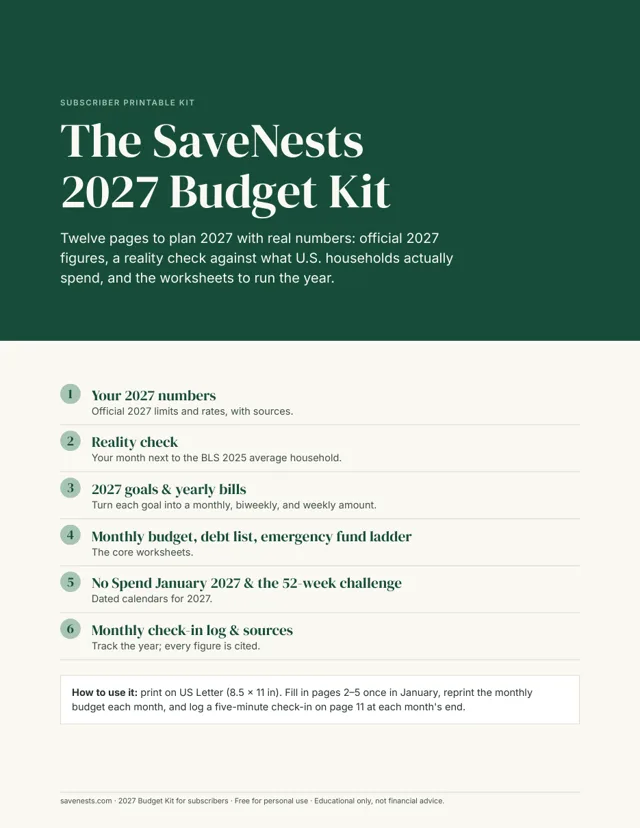
Free for subscribers
Get the 2027 Budget Kit
A 12-page printable PDF: official 2027 numbers (HSA limits, the 3.6% COLA), your month next to the BLS average household, goals and yearly bills, a monthly budget, a debt list, an emergency fund ladder, a No Spend January 2027 calendar, and dated 52-week challenge charts. Every figure is cited.