Every January, a wave of savings challenges shows up on Pinterest: grids of numbered squares, envelope charts, penny trackers. Most of them get colored in for three weeks and then quietly abandoned somewhere around Valentine's Day. That isn't because the idea is bad. It's because most people pick a challenge for how it looks on the fridge instead of how it fits their paycheck.
This guide lays out 15 money saving challenges you can start in January 2027, with the real yearly total for each one, the hardest week or month, and who it actually suits. Pick one, maybe two, and you'll have a better shot at finishing than if you try five at once.
Why a savings challenge works when "save more" doesn't
"Save more next year" is a wish. A challenge is a rule with a number and a date attached: put $14 aside this Friday, skip takeout until the 31st, move every $5 bill into a jar. That turns a vague intention into a small task you can check off.
The need is real. In the Federal Reserve's survey of household finances for 2025, published in May 2026, 63 percent of adults said they would cover a surprise $400 expense with cash or its equivalent, which means 37 percent would not. Only 55 percent said they had emergency savings that would cover three months of expenses. A year-long challenge won't build a full emergency fund on its own for most people, but finishing even a modest one gets you past that $400 line.
How to choose the right challenge
Before you print anything, answer three questions:
- How steady is your income? Charts with fixed weekly amounts suit a steady paycheck. If your hours swing, pick a challenge you can do in any order, like the 100 envelope or penny version, or one based on a percentage. Our guide to budgeting an irregular paycheck helps here.
- What's the hardest amount you could save in your tightest month? If the last weeks of a chart ask for $50 and December is already your worst month, flip the chart or choose a flat amount.
- What's the money for? A named goal (a $1,000 starter emergency fund, next year's Christmas, a car repair fund) makes it much harder to raid the jar. If you don't have a number yet, how much should I save each month walks through one.
15 challenges at a glance
| Challenge | Yearly total | Hardest stretch | Best for |
|---|---|---|---|
| 52-week challenge | $1,378 | $52 in week 52 | Steady weekly pay |
| Reverse 52-week | $1,378 | $52 in week 1 | People with tight Decembers |
| 100 envelope challenge | $5,050 | The $90s to $100 envelopes | Bigger goals, any order |
| Penny challenge (365 days) | $667.95 | $3.65 on the last day | Beginners, low income |
| 26-paycheck ladder ($10 steps) | $3,510 | $260 on the last check | Biweekly pay |
| $20 a week | $1,040 | Every week is the same | Simplicity |
| $5 a week | $260 | Every week is the same | Very tight budgets |
| $5 bill challenge | Varies | Depends on cash use | Cash spenders |
| Round-up challenge | Varies | None | Hands-off savers |
| No-spend January | Varies | Week 3 | Resetting habits |
| 30-day savings challenge | Varies | Days with plans | Short bursts |
| Takeout swap | Up to about $2,070 | Busy weeknights | Households that eat out a lot |
| 1% pay-yourself-first ladder | $3,120 on $4,000 take-home | Month 12 (12%) | Steady pay, some slack |
| Subscription audit | Varies | Week 1 | Anyone with five-plus subscriptions |
| Sinking fund challenge | Your annual bills | The first two months | People tired of surprise bills |
The number-chart challenges
1. The 52-week money challenge
Save $1 in week one, $2 in week two, and so on up to $52 in week 52. The total is $1,378. The early months are almost painless, so the habit is in place before the amounts get big. The catch is timing. The $45 to $52 weeks land in late November and December, right when holiday spending peaks. We have a full guide and free printable for the 52-week money challenge for 2027.
2. The reverse 52-week challenge
Same chart, same $1,378, but you start at $52 in January and work down to $1 in December. You save the most while your New Year motivation is high and the least when gift shopping starts. If you get a tax refund in February or March, it can also cover several of the big early weeks at once.
3. The 100 envelope challenge
Number 100 envelopes from 1 to 100. Each time you save, draw an envelope at random and put that many dollars in it. Fill all 100 and you have $5,050. Because you choose the order, you can pull a $3 envelope in a lean week and a $97 one when a paycheck stretches further. Over 52 weeks, that's an average of about $97 a week, so it's best for a large goal like a car fund or a big chunk of an emergency fund. Our 100 envelope challenge guide shows half-size and shorter versions.
4. The penny challenge
Save 1 cent on day one, 2 cents on day two, up to $3.65 on day 365. The total is $667.95. It sounds tiny, but the daily rhythm is what makes it work, and it's one of the few challenges that fits a very small budget. Shortcut: move the money weekly instead of daily. Week one is 28 cents; the last full week is about $25.
5. The 26-paycheck ladder
Made for people paid every other week. Save $10 from your first paycheck, $20 from the second, and so on, ending with $260 on paycheck 26. Total: $3,510. That last stretch is steep, so many people use $5 steps instead, which halves everything (a $1,755 total, $130 on the last check). If you're new to splitting a budget by paycheck, start with how to budget biweekly paychecks.
6 and 7. The flat $20 or $5 a week challenge
No chart, no escalation: the same amount every week. $20 a week is $1,040 a year; $5 a week is $260. Flat challenges are boring, and boring is good. Set up an automatic transfer for the day after payday and the challenge runs itself. If $5 is all the room you have, that's a real start, and our guide to saving money on a low income has more ideas that don't depend on a big paycheck.
The habit challenges
8. The $5 bill challenge
Every $5 bill you get as change goes into a jar, no exceptions. How much you'll save depends entirely on how often you pay cash, which is why it pairs well with cash stuffing. Count the jar at the end of each month and move it to savings so you're not keeping a growing pile of cash at home.
9. The round-up challenge
Round every purchase up to the next dollar and move the difference to savings, either through your bank's round-up feature or by adding it up yourself once a week. A $4.35 coffee sends 65 cents to savings. Small, but effortless, and a good second challenge next to a chart.
10. No-spend January
For 31 days, you buy only what's on your essentials list: rent, bills, groceries, gas, medicine. Everything else waits. It's a natural fit after December, and the money you don't spend goes straight to savings or a card balance. Week three is usually the hardest, once the novelty has worn off. Our no-spend January 2027 guide has the rules and a printable calendar. If a month feels too short, a low-buy year stretches the same idea over 12 months with softer rules.
11. The 30-day savings challenge
A daily task for 30 days, like packing lunch, skipping one purchase, selling one unused thing, or canceling one charge, with whatever you saved moved to a savings account the same day. It's a good warm-up before a longer challenge. See the 30-day savings challenge for a full day-by-day list.
12. The takeout swap
Eating out is one of the easiest places to find money. The Bureau of Labor Statistics' Consumer Expenditure Survey found the average household spent $4,142 on food away from home in 2025, about $345 a month. And restaurant prices are still climbing: the food away from home index rose 0.5 percent in October 2026 alone. The challenge: swap half of your usual takeout and restaurant meals for home-cooked ones and move the difference to savings each week. At the national average, cutting it in half frees up about $172 a month, or roughly $2,070 over a year. Your number will be different, so check your last three statements first.
Challenges that build a system
13. The 1% pay-yourself-first ladder
Save 1 percent of your take-home pay in January, 2 percent in February, and keep adding a point each month until you reach 12 percent in December. On $4,000 a month in take-home pay, that starts at $40 and ends at $480, for a total of $3,120. The real point is finding the savings rate you can hold. If month seven feels tight, stop climbing and keep that rate for the rest of the year.
14. The subscription audit challenge
In the first week of January, list every recurring charge from your bank and card statements: streaming, apps, memberships, cloud storage, delivery passes. Cancel the ones you didn't use in December and pause any you're unsure about. Then move the monthly cost of everything you canceled to savings for the rest of the year. Three $12 subscriptions add up to $36 a month, or $432 by December.
15. The sinking fund challenge
This one is less a game and more a cure for surprise bills. List every irregular bill you paid in 2026 (car registration, insurance premiums, back-to-school, gifts, the vet), divide each annual cost by 12, and fund those amounts every month in 2027. Our guide to sinking funds has 20 categories and a free tracker, and the budget categories list helps you catch the bills you'd forget.
Scaling a challenge down
Any of these challenges can be cut in half, cut to a quarter, or stretched out. A half-size 52-week chart (50 cents up to $26) totals $689. The 100 envelope challenge with only envelopes 1 through 50 totals $1,275. The penny challenge already fits most budgets. What matters is finishing a smaller version, not quitting a big one in March.
Where to keep challenge money
Get the money out of your checking account as soon as you save it. If it's sitting next to your spending money, it will get spent. A separate savings account at an FDIC-insured bank (or an NCUA-insured credit union) works well, and deposits are insured to at least $250,000 per depositor at each insured bank.
Check the rate, too. The FDIC's national average savings rate was 0.39 percent as of November 16, 2026, and money market accounts averaged 0.64 percent. Many online banks and credit unions pay more than that, so it's worth comparing before you open an account. Cash envelopes are fine for small amounts while you count them, but move large sums into an insured account.
How to actually finish
- Automate it. Set the transfer for the day after payday so the money moves before you can spend it.
- Pick one main challenge. Add a low-effort second one like round-ups if you want, but not three charts at once.
- Put the chart somewhere you see every day: the fridge, the bathroom mirror, your phone's lock screen.
- Plan for the hard weeks now. Circle the big amounts on your chart and mark which paychecks will cover them.
- Catch up without guilt. Missed two weeks? Combine them into the next paycheck or pick small envelopes. A missed week isn't a failed challenge.
- Use windfalls. A tax refund, a bonus, or birthday money can knock out several weeks at once. If you file electronically, IRS Form 8888 lets you split a refund across more than one account, so part of it can go straight to savings.
- Give the money a job. When the challenge ends, move the total to its goal right away: the emergency fund, the card balance, or next year's sinking funds.
Getting started this week
- Choose one challenge from the table above.
- Write down the goal it pays for and the yearly total.
- Open or name a separate savings account for it.
- Set up the first automatic transfer for the first payday in January.
- Print a tracker, like the free 52-week savings challenge printable, or pick another from our budget printables.
If you'd like to see how long a goal will take at different weekly amounts, the savings goal calculator runs in your browser. To close out 2026 first, use the year-end financial checklist.
Questions readers ask
What is the best money saving challenge for beginners?
The penny challenge or a flat $5 or $20 a week challenge. Both start small and stay predictable. The penny challenge saves $667.95 over 365 days, $5 a week saves $260 a year, and $20 a week saves $1,040. Once one of those feels automatic, try a bigger chart like the 52-week challenge.
How much do you save with the 52-week challenge?
$1,378. You save $1 in week one, $2 in week two, and so on up to $52 in week 52. The reverse version saves the same total but starts with $52 in January, so the biggest weeks don't land during the holidays.
How much is the 100 envelope challenge?
Filling all 100 envelopes saves $5,050. Over a year, that's an average of about $97 a week. A half version using envelopes 1 through 50 saves $1,275.
What is the $5 bill challenge?
Every time you get a $5 bill as change, you put it in a jar instead of spending it. The total depends on how often you pay with cash. Move the jar to an insured savings account once a month.
Should I do a savings challenge if I have credit card debt?
Keep a small cash buffer, then put most extra money toward the card. The Federal Reserve reported an average 22.36 percent rate on credit card accounts charged interest in the third quarter of 2026, far higher than the 0.39 percent national average savings rate from the FDIC. You can still use a challenge chart to track payments instead of savings.
Where should I keep money from a savings challenge?
In a separate savings account at an FDIC-insured bank or an NCUA-insured credit union, not in checking and not as a big pile of cash at home. Compare rates first, since many banks pay well above the 0.39 percent national average.
Sources
- Board of Governors of the Federal Reserve System, Economic Well-Being of U.S. Households in 2025 (SHED report, May 2026)63% would cover a $400 emergency expense with cash or its equivalent; 55% had three months of expenses in emergency savings.
- U.S. Bureau of Labor Statistics, Consumer Expenditures 2025 (October 29, 2026)Average household spending on food away from home: $4,142 in 2025.
- U.S. Bureau of Labor Statistics, Consumer Price Index, October 2026 (November 10, 2026)Food away from home index +0.5% in October 2026 (seasonally adjusted).
- FDIC, National Rates and Rate Caps (November 16, 2026)National average rates: savings 0.39%, money market 0.64%.
- FDIC, Deposit InsuranceDeposits are insured to at least $250,000 at each FDIC-insured bank.
- Federal Reserve, G.19 Consumer Credit (November 6, 2026)Commercial bank interest rate on credit card accounts assessed interest: 22.36% (2026 Q3).
- Internal Revenue Service, About Form 8888, Allocation of RefundForm 8888 lets you direct deposit a refund, or part of it, to one or more accounts.
Mohamed Ouhammouche
Mohamed Ouhammouche founded and runs SaveNests, a budgeting site that helps beginners build simple budgets. This guide was reviewed by the SaveNests Editorial Desk under the editorial and fact-checking policies.
Free for subscribers
Get the 2027 Budget Kit
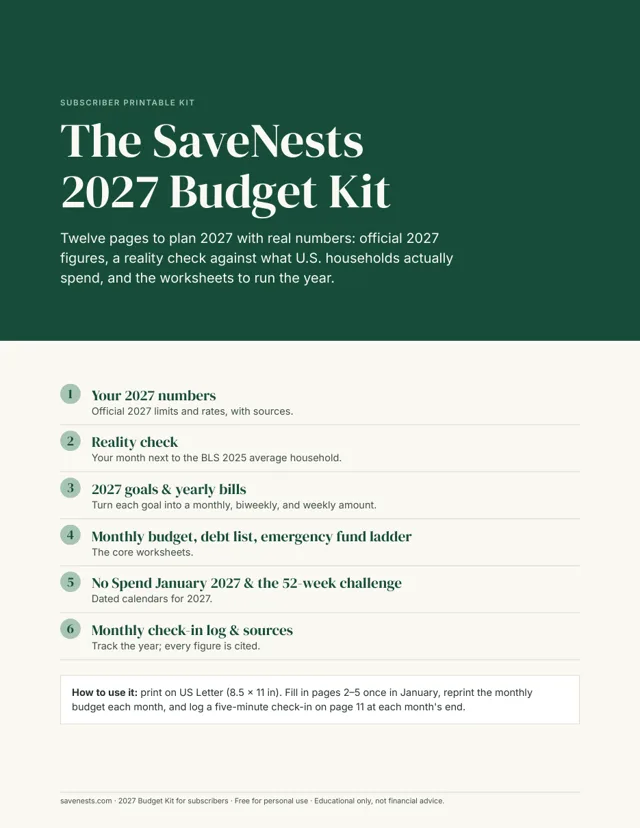
A 12-page printable PDF: official 2027 numbers (HSA limits, the 3.6% COLA), your month next to the BLS average household, goals and yearly bills, a monthly budget, a debt list, an emergency fund ladder, a No Spend January 2027 calendar, and dated 52-week challenge charts. Every figure is cited.