The idea is simple: save $1 in week 1, $2 in week 2, and keep going until you save $52 in week 52. Add it up and you have $1,378 by the end of the year. It works because the early weeks are easy and the habit is built before the amounts get large.
Three ways to do the 52-week challenge
| Version | Week 1 | Week 52 | December (weeks 49–52) | Best for |
|---|---|---|---|---|
| Classic | $1 | $52 | $202 | Starting small and building the habit |
| Reverse | $52 | $1 | $10 | Keeping December free for holidays |
| Flat | $26.50 | $26.50 | $106 | Steady paychecks and automatic transfers |
The classic version's weakness is the ending. Weeks 49 to 52 ask for $202 right in the holiday season, when Deloitte's 2026 survey found shoppers expected to spend an average of $1,654. The reverse version front-loads the work into January, when many people are already resetting with a No Spend January. The flat version, $26.50 every week, is the easiest to automate.
Quarterly totals for 2027
| Quarter | Classic | Reverse | Flat $26.50 |
|---|---|---|---|
| Q1 (weeks 1–13) | $91 | $598 | $344.50 |
| Q2 (weeks 14–26) | $260 | $429 | $344.50 |
| Q3 (weeks 27–39) | $429 | $260 | $344.50 |
| Q4 (weeks 40–52) | $598 | $91 | $344.50 |
| Total | $1,378 | $1,378 | $1,378 |
If $598 in a quarter is too much for you, pick the version where the hard quarter lands in the season you earn most, or halve every amount for a $689 year. A smaller challenge you finish beats a bigger one you quit in March. If a weekly chart isn't your style, the 100 envelope challenge is another way to save a fixed total, with a 2027 pace.
Where to keep the money
Keep it separate from checking so it doesn't get spent. The FDIC's October 2026 national averages were 0.38 percent for savings accounts, 0.63 percent for money market accounts, and 1.76 percent for a 12-month CD. Many online high-yield savings accounts pay well above the national average, so compare rates and confirm the bank is FDIC-insured. For a weekly challenge, a savings account you can add to any time fits better than a CD.
What is the money for? $1,378 is a strong start on an emergency fund. In the Fed's 2025 SHED report, 55 percent of adults said they had enough rainy-day savings to cover three months of expenses. The savings goal calculator shows how long a bigger target takes.
How to make it stick
- Set an automatic weekly transfer on payday, then update the amount once a month if you're on classic or reverse.
- Shade each week on a printed chart. Seeing the progress keeps people going.
- Missed a week? Double up next week or move the amount to the end. Don't restart.
- Pair it with your monthly plan in the 2027 budget planner so the transfer is a line item, not an afterthought.
- Want something shorter first? Try a 30-day savings challenge and come back to the full year.
- Not sure the 52-week chart fits your pay? Compare it with 14 other money saving challenges, from the penny challenge to a biweekly paycheck ladder.
Questions readers ask
How much do you save in the 52-week money challenge?
$1,378. The sum of 1 through 52 is 1,378, and the flat version of $26.50 a week gives the same total.
What is the reverse 52-week challenge?
You start at $52 in week 1 and count down to $1 in week 52. December needs only $10 in total instead of $202.
When should I start the 52-week challenge for 2027?
The first week of January 2027 is the cleanest start, but you can begin any week and run 52 weeks from there.
Where should I keep my 52-week challenge savings?
In a separate FDIC-insured savings account. National averages were 0.38% for savings in October 2026, and many online accounts pay more.
Sources
- Deloitte, 2026 Deloitte Holiday Retail SurveyAverage expected holiday spending $1,654, up 4% from 2025.
- FDIC, National Rates and Rate Caps – October 2026 (published October 19, 2026)National averages: savings 0.38%, money market 0.63%, 12-month CD 1.76%.
- Board of Governors of the Federal Reserve System, Economic Well-Being of U.S. Households in 2025 (SHED, May 2026)55% had rainy-day savings to cover three months of expenses.
Mohamed Ouhammouche
Mohamed Ouhammouche founded and runs SaveNests, a budgeting site that helps beginners build simple budgets. This guide was reviewed by the SaveNests Editorial Desk under the editorial and fact-checking policies.
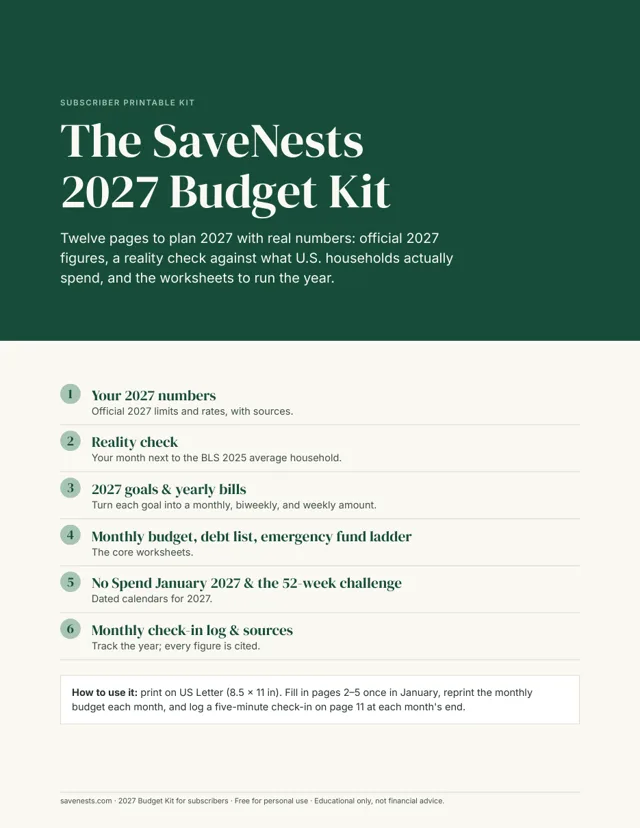
Free for subscribers
Get the 2027 Budget Kit
A 12-page printable PDF: official 2027 numbers (HSA limits, the 3.6% COLA), your month next to the BLS average household, goals and yearly bills, a monthly budget, a debt list, an emergency fund ladder, a No Spend January 2027 calendar, and dated 52-week challenge charts. Every figure is cited.