Savings challenges are all over Pinterest for a good reason: they turn "I should save more" into a checklist you can color in. The problem is that a lot of them are designed by people who already have spare cash. The popular escalating versions start easy and then ask for $25, $40, or $50 in a single day near the end, right when real life tends to show up.
I'd rather give you a challenge you'll actually finish. Below are three flat 30-day versions, the classic 52-week money challenge (plus two easier ways to run it), and one rule that matters more than any chart: what to do on the day you can't put money in.
Why so many savings challenges fail
Most challenges fail for one of three reasons:
- They escalate. A 30-day challenge that goes $1, $2, $3, and so on up to $30 adds up to $465, but the last week alone asks for $189. That’s a lot to find in seven days.
- They have no skip rule. Miss one day and the chart feels broken, so people quit.
- The money has no destination. If the saved cash sits in checking, it quietly gets spent.
A good challenge has a flat or front-loaded amount, a clear rule for missed days, and a named account where the money goes.
The 30-day savings challenge: three flat versions
Pick the amount that fits the tightest week of your month, not your best one.
| Daily amount | Weekly equivalent | Total after 30 days |
|---|---|---|
| $2 | $14 | $60 |
| $5 | $35 | $150 |
| $10 | $70 | $300 |
The math is plain multiplication: $5 × 30 days = $150. If $5 a day sounds like a lot, try $2. Sixty dollars is a real result, and finishing a small challenge is how you build the habit for a bigger one.
Daily transfers or one weekly transfer?
You don't have to move money every single day. Many banks have transfer limits or make daily transfers tedious. I'd cross off each day on paper and move the week's total ($35 for the $5 version) once a week, the day after payday if you can. The chart keeps you honest; the weekly transfer keeps it practical.
Where the daily amount can come from
- Skip one purchase you'd normally make: a drink, a snack, a delivery fee.
- Pack lunch on workdays and move what you would have spent.
- Pause one subscription for the month and save the charge.
- Sell one thing you don't use and front-load several days at once.
- Make a no-spend day once a week and move that day's usual spending.
The 52-week money challenge
The 52-week money challenge is the most popular savings challenge on Pinterest. You save $1 in week one, $2 in week two, and so on, up to $52 in week 52.
That's a satisfying number. But the original version has the same problem as escalating 30-day challenges: the hardest weeks come last. Weeks 49 through 52 ask for $49, $50, $51, and $52, which is $202 in December, right in the middle of the holiday season. In Deloitte's 2026 holiday survey of 4,000 consumers, shoppers expected to spend an average of $1,654 on the season, up 4 percent from last year, so December is already crowded before a savings chart asks for its biggest deposits. Here are two fixes. (For a full 2027 plan with quarterly totals, see the 52-week money challenge 2027. The 100 envelope challenge is a different format with its own 2027 plan.)
The reverse 52-week challenge
Start at $52 in week one and count down to $1. Same $1,378 total, but you do the heavy lifting in January when motivation is high, and December only asks for a few dollars a week. If you start in January, this is the version I'd pick.
The biweekly version
If you're paid every two weeks, combine weeks into 26 deposits. Each paycheck you save two weeks' worth: $3 (weeks 1 and 2), then $7 (weeks 3 and 4), and so on up to $103 (weeks 51 and 52). The total is still $1,378. It lines up with your pay schedule, so there are fewer transfers to remember.
| Version | First deposit | Last deposit | Total |
|---|---|---|---|
| Classic weekly | $1 | $52 | $1,378 |
| Reverse weekly | $52 | $1 | $1,378 |
| Biweekly (26 deposits) | $3 | $103 | $1,378 |
| Flat $26.50 weekly | $26.50 | $26.50 | $1,378 |
The last row is worth noticing. Saving a flat $26.50 every week gets you to the same $1,378, with no hard weeks at all. Not as fun to color in, but very hard to fail.
The skip rule
This is the part most charts leave out, and it's the reason most people quit.
If you miss a day or a week, don't try to double up the next time. Mark it, skip it, and add it to the end. A 30-day challenge with two skipped days becomes a 32-day challenge. A 52-week challenge with a missed week becomes 53 weeks. You still finish, and you still hit the full total.
What you shouldn't do is pull money back out of savings to cover a short week. A skipped deposit is still part of the plan. A deposit you reverse teaches you that the savings account is just a second checking account.
Where the money goes
Before you start, decide where the money lives and what it's for. That's what keeps it from evaporating.
- Use a separate savings account from your checking, ideally one that's insured by the FDIC (bank) or NCUA (credit union).
- Give it a name. "Emergency fund" or "Car repair fund" works better than "savings."
- If you don't have any emergency savings yet, I'd point the challenge there first. The Federal Reserve's latest household survey, covering 2025 and published in May 2026, found that 63 percent of adults would cover a $400 emergency expense entirely with cash or its equivalent. That share hasn't moved in four years, and it means 37 percent would not. Even the $150 version of the 30-day challenge is a big step toward that $400 line. How to Build a $1,000 Emergency Fund shows what to do next.
- If your emergency fund is covered, point the challenge at a sinking fund for a bill you know is coming.
It's also worth checking what that account pays. The FDIC's national average savings rate was 0.38 percent in October 2026, and 0.63 percent for money market accounts. Over the same stretch, consumer prices rose 3.7 percent in the 12 months to September 2026, according to the Bureau of Labor Statistics. Money sitting at the average rate is losing ground to prices, so it pays to compare. Many banks and credit unions pay well above the average, and moving challenge money to one of them takes a few minutes. Just keep it insured and easy to reach.
How to make a printable tracker
You don't need to buy a fancy printable. Here's a simple layout that takes five minutes:
- Draw a grid of 30 boxes (or 52 for the weekly challenge) on a sheet of paper.
- Write the amount in each box. For flat versions, every box is the same.
- Write the destination account and the end date at the top.
- Leave a "skipped" row at the bottom for days you miss, so they go at the end instead of disappearing.
- Tape it somewhere you'll see it daily, like the fridge or the bathroom mirror.
For more free worksheets, see the budget printables section. If you want to see how long a bigger goal will take at your challenge pace, try the savings goal calculator.
After the challenge
When you finish, do two things. First, keep the transfer going at the same amount. If $35 a week worked for a month, it can probably keep working, and the challenge was just the warm-up. Second, look at your budget and give that amount a permanent line. The tight-month budget guide shows how to fit a savings line in even when things are tight.
Which savings challenge should you pick?
Here's how I'd choose, depending on where you're starting:
- No savings at all and a tight budget: the $2-a-day, 30-day challenge. Sixty dollars is a real start, and you'll learn whether a daily habit or a weekly transfer suits you.
- Some breathing room each month: the $5 or $10 version, or a flat $26.50 a week for the full year.
- Paid every two weeks: the biweekly 52-week version, so deposits line up with paychecks.
- Starting in January with plenty of motivation: the reverse 52-week challenge.
- Starting in the fall: a 30-day challenge now, then the reverse 52-week challenge in January. Running the classic version from September would put the biggest deposits in the summer, which is fine if that's a lighter month for you.
You can also stack them: finish a 30-day challenge, then roll straight into a 52-week one at the same weekly pace. The goal is a habit that runs without willpower. The challenge is just the way in.
A holiday-season version: save for the trip home
If you're starting a challenge in late October or November, give it the most obvious job on the calendar: getting where you're going for the holidays. Travel is the part of the season that has gotten noticeably more expensive. Airline fares rose 22.4 percent and gasoline 34.2 percent over the 12 months to September 2026, according to the BLS.
- Driving: a 600-mile round trip in a car that gets 25 miles per gallon takes about $102 in gas at late-October 2026 prices. The $5-a-day version ($150) covers that with room for tolls and snacks.
- Flying: the average domestic round-trip fare was $549 in the second quarter of 2026, before bag fees. The $10-a-day version ($300) covers more than half of one ticket. For a family, pair it with a bigger weekly transfer.
- Christmas timing: a 30-day challenge started on November 1 finishes on November 30, which leaves time to book or top up before the December rush.
Our guide to holiday travel on a budget has a full trip template, the cheaper days to fly this year, and how to work out a weekly savings number for the whole trip, not just the ticket. If the trip is one part of a bigger season, fold it into your Christmas budget so travel and gifts draw from the same plan.
No Spend November vs a savings challenge
If you are reading this in mid-October, you may also be weighing a No Spend November challenge. They solve different problems. A 30-day or 52-week savings challenge moves a set amount into savings on a schedule. No Spend November pauses discretionary spending so that money never leaves checking in the first place.
A clean pairing for the rest of the year: run No Spend November to cut the leaks, point what you do not spend at a named goal, then start a flat $5-a-day savings challenge in December or a reverse 52-week challenge in January. The no-spend guide includes rules, an allowed list, and Thanksgiving and Black Friday decision rules so the freeze survives the holiday calendar.
Free printables: 52-week chart and no-spend calendar
If you'd like the challenge on your fridge, download the free 52-Week Savings Challenge Chart for 2027 (PDF). Every week is dated from January 1, with the deposit and running total already filled in, so you only check boxes. For a spending freeze instead of a deposit schedule, use the No-Spend Challenge Calendar (PDF) with the full No Spend November rules. Both printables are on the budget printables page, along with a full 2027 budget planner. If you're setting up the whole year, start with how to budget for 2027.
Questions readers ask
How much will I save with the 30-day savings challenge?
At $2 a day, $60. At $5 a day, $150. At $10 a day, $300. An escalating version from $1 to $30 totals $465.
How much is the 52-week money challenge total?
$1,378. That's the sum of $1 through $52. The reverse and biweekly versions reach the same total.
What if I miss a week of the 52-week challenge?
Skip it and add a week at the end. Don't double up or pull money back out of savings.
Which savings challenge is best for beginners?
A flat 30-day challenge at $2 or $5 a day. It's short enough to finish and builds the habit before you try a full year.
Should I keep challenge money in cash?
A separate, insured savings account is safer and easier to track than cash at home.
Is a no-spend challenge the same as a 30-day savings challenge?
No. A savings challenge moves a set amount into savings on a schedule. A no-spend challenge pauses discretionary spending. You can run No Spend November first, then a flat savings challenge with the money you did not spend.
Why is the classic 52-week challenge hard in December?
The largest weekly deposits land at the end of the year, often on top of holiday spending. Use the reverse version, a flat weekly amount, or finish a short 30-day challenge before January.
Can I use a 30-day savings challenge to pay for holiday travel?
Yes, and it's a good fit if you start by early November. The $5-a-day version saves $150, about enough for the gas on a 600-mile round trip at late-October 2026 prices. The $10-a-day version saves $300, more than half of the $549 average domestic round-trip fare in the second quarter of 2026.
Where should I keep my savings challenge money?
In a separate savings account insured by the FDIC or NCUA, ideally one that pays more than the average. The FDIC's national average savings rate was 0.38 percent in October 2026, while prices rose 3.7 percent over the year to September 2026, so it's worth shopping for a better rate.
Sources
- Board of Governors of the Federal Reserve System, Economic Well-Being of U.S. Households in 2025 (May 2026)63 percent of adults would cover a hypothetical $400 emergency expense exclusively with cash or its equivalent, unchanged from the previous three years and down from 68 percent in 2021; 37 percent would not.
- Consumer Financial Protection Bureau, An essential guide to building an emergency fundRecommends a specific savings goal and automatic, regular saving.
- FDIC, Deposit insuranceHow FDIC insurance protects bank deposits.
- Deloitte, 2026 Deloitte Holiday Retail SurveySurvey of 4,000 consumers, Aug. 26–Sept. 10, 2026: average expected holiday spending $1,654, up 4% from $1,595 in 2025.
- FDIC, National Rates and Rate Caps (October 2026)National average rates as of October 19, 2026: savings 0.38%, money market 0.63%.
- U.S. Bureau of Labor Statistics, Consumer Price Index, September 2026, Table 2 (released October 14, 2026)12 months to September 2026, not seasonally adjusted: all items +3.7%; airline fares +22.4%; gasoline (all types) +34.2%.
- Bureau of Transportation Statistics, Second Quarter 2026 Average Air Fare (September 29, 2026)Average domestic round-trip fare $549 in Q2 2026, excluding optional fees.
- U.S. Energy Information Administration, Gasoline and Diesel Fuel Update (October 27, 2026)U.S. regular gasoline $4.269 per gallon for the week of October 26, 2026.
Mohamed Ouhammouche
Mohamed Ouhammouche founded and runs SaveNests, a budgeting site that helps beginners build simple budgets. This guide was reviewed by the SaveNests Editorial Desk under the editorial and fact-checking policies.
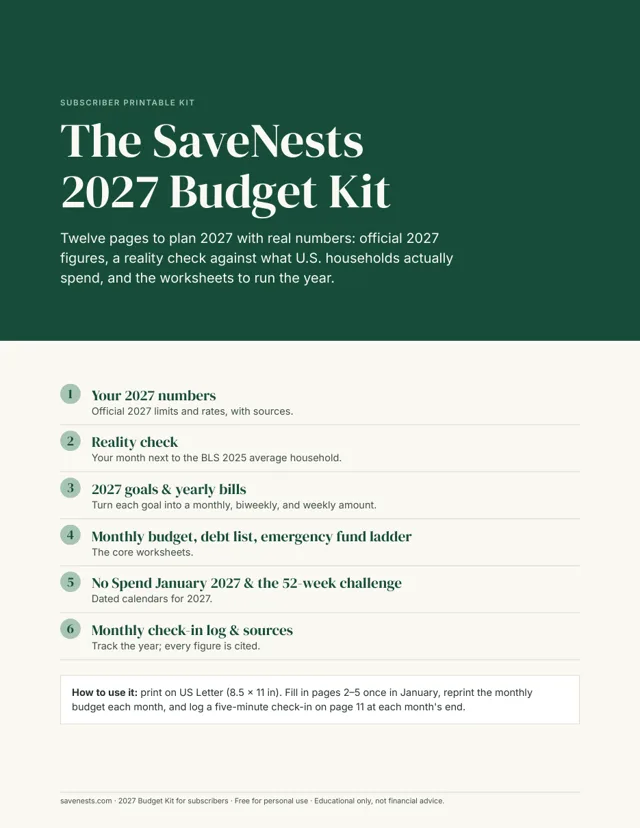
Free for subscribers
Get the 2027 Budget Kit
A 12-page printable PDF: official 2027 numbers (HSA limits, the 3.6% COLA), your month next to the BLS average household, goals and yearly bills, a monthly budget, a debt list, an emergency fund ladder, a No Spend January 2027 calendar, and dated 52-week challenge charts. Every figure is cited.