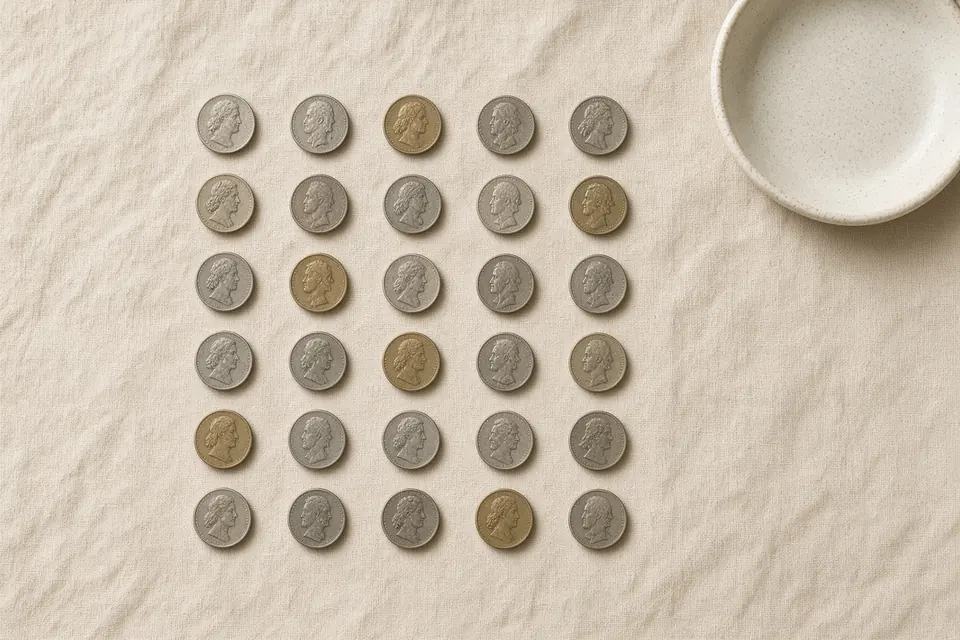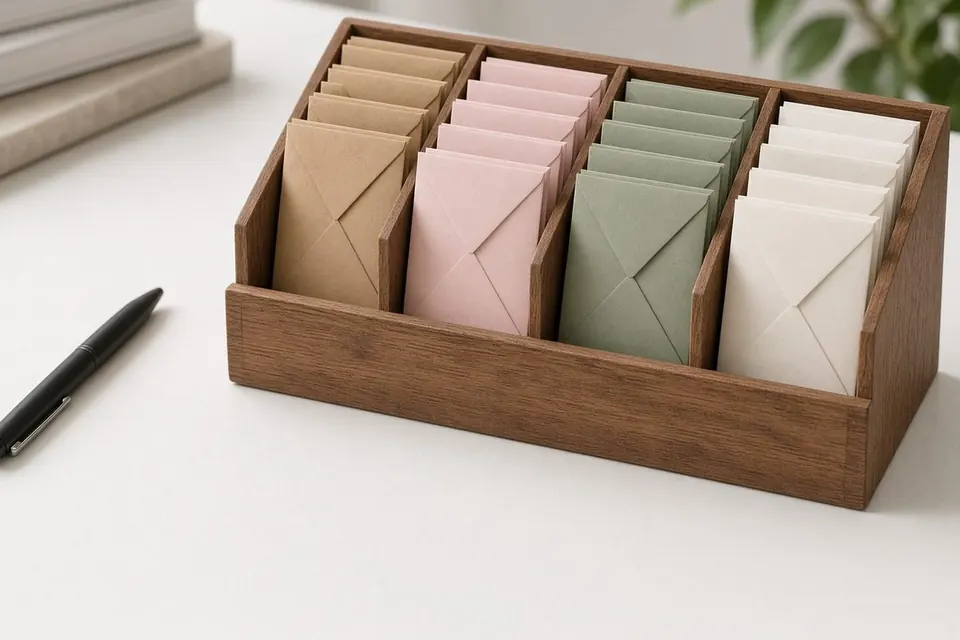
The 100 envelope challenge looks simple on Pinterest: a box or binder of 100 envelopes numbered 1 to 100, and every so often you pick one and put that many dollars inside. Envelope 37 means $37. Envelope 4 means $4. When every envelope is full, you have saved $5,050.
That total surprises a lot of people, and it's the part the pretty videos tend to skip. $5,050 is real money. Spread across a year it's about $421 a month, which is more than many households can set aside without changing something else. So this guide does the math first, then shows how to run the challenge on a real paycheck, which smaller or bigger versions to pick, where the money should live while you fill it, and what to do with it when you're done.
What is the 100 envelope challenge?
It's a savings challenge built on 100 numbered envelopes. Each envelope's number is the dollar amount that goes in it. You choose envelopes in random order, usually by drawing one out of a box or rolling a number, so some days you owe $3 and other days you owe $88. Each filled envelope gets crossed off a tracker until all 100 are done.
The random draw is the hook. It turns saving into a small game, and the low numbers give you easy wins on tight weeks. The downside is that the same randomness can hand you $96 the day before rent is due, which is why the plan below doesn't rely on luck alone.
How much money is the 100 envelope challenge?
Adding 1 through 100 gives 100 × 101 ÷ 2 = 5,050. So the classic challenge saves $5,050. The average envelope is $50.50. That's also why there are so many spin-offs: people want the same game at a size that fits their budget.
| Version | Envelopes | Amounts | Total saved |
|---|---|---|---|
| Mini (cents) | 100 | $0.10 to $10.00 in 10-cent steps | $505 |
| Half challenge | 50 | $1 to $50 | $1,275 |
| Classic | 100 | $1 to $100 | $5,050 |
| Double ("$10,000 challenge") | 100 | $2 to $200 in $2 steps | $10,100 |
The "$10,000 envelope challenge" you'll see in search results is usually just the classic one with every amount doubled. It comes out to $10,100, about $842 a month over a year. For most households that's a goal for a raise or a second job, not a starting point.
How long does the 100 envelope challenge take?
As long as you want it to. The original version fills one envelope a day and finishes in 100 days. Started on Friday, January 1, 2027, that schedule ends on Saturday, April 10, 2027. It also means saving an average of about $354 a week for three months straight, which is why I don't recommend it to most people.
| Pace | Envelopes per period | Average saved | Finish (starting Jan 1, 2027) |
|---|---|---|---|
| Daily | 1 a day | About $50.50 a day, $354 a week | April 10, 2027 |
| Twice a week | 2 a week | About $101 a week | Mid-December 2027 |
| Every biweekly payday | About 4 per payday (26 paydays) | About $194 per payday | Late December 2027 |
| Monthly | 8 or 9 a month | About $421 a month | December 2027 |
Twice a week or per payday is the pace that holds up best for people with ordinary paychecks. It ties the challenge to the day money actually arrives, and it still finishes in time for Christmas 2027. If you're paid every two weeks, How to Budget Biweekly Paychecks shows how to line up bills with each check before you add a savings challenge on top.
Is $5,050 realistic for you?
Before you buy envelopes, check the monthly number against your budget. About $421 a month is the classic pace over a year. If your take-home pay minus bills, groceries, gas, and debt minimums doesn't leave that much, the full challenge will fall apart by spring, and that's a math problem, not a willpower problem.
You'd also be in good company if the bigger version doesn't fit yet. In the Federal Reserve's survey of household finances for 2025, 63 percent of adults said they would cover a surprise $400 expense with cash or its equivalent, which means 37 percent would not. Fifty-five percent said they had three months of expenses set aside in an emergency or rainy day fund.
If money is tight right now, How to Save Money on a Low Income is a better first stop than any challenge. Saving $10 a week on purpose still beats starting a $5,050 game and quitting in March.
How to do the 100 envelope challenge, step by step
- Pick your version and pace from the tables above, based on your monthly leftover, not on the version that looks best online.
- Number 100 envelopes, or skip the envelopes and print or draw a 10-by-10 grid of the numbers 1 to 100. The grid works just as well and costs nothing.
- Decide when you draw: payday is easiest. Put the draws on your calendar so they don't depend on remembering.
- On each draw day, pick your envelopes and fill them, or transfer the same total to savings and cross the numbers off.
- Deposit any cash at least once a week. More on why below.
- Check your progress once a month. Count crossed-off numbers and add them up, or use the savings goal calculator to see if you're on pace for your finish date.
Rules that keep the challenge going
Most people who quit the 100 envelope challenge quit for the same reason: a run of big numbers lands in a short week. These rules take the edge off without turning it into a different challenge.
Pair a big number with a small one
On each draw day, pull one envelope from the top half (51 to 100) and one from the bottom half (1 to 50). Pairs like 92 and 9, or 64 and 37, keep each draw closer to the $101 average and stop you from getting stuck with $180 in one week.
Allow a swap on tight weeks
If you draw a number you can't fill this week, put it back and pick a lower one. You still have to fill the big one later. Writing "swapped" next to the number keeps you honest.
Use a skip rule instead of quitting
Life happens: a car repair, a medical bill, a short paycheck. Allow yourself to skip a draw day with no guilt, and add the skipped envelopes to the next payday that has room, or push your finish date back. A challenge that finishes in February 2028 still saved $5,050.
Save the small numbers for December
Some people hold back envelopes 1 through 10 (just $55 together) for November and December, when gifts and travel squeeze the budget. You still finish the challenge, and the holiday months only ask for a few dollars.
Where to keep the money while you save
The envelopes are the game. They shouldn't be the bank. A box with a few thousand dollars in it is easy to borrow from, and it has no protection if it's lost, stolen, or damaged in a fire or flood. Money in a checking, savings, money market, or CD account at an FDIC-insured bank is insured to at least $250,000, according to the FDIC. At federally insured credit unions, the NCUA's Share Insurance Fund provides up to $250,000 of coverage.
A simple setup that keeps the fun part: fill the envelope, snap a photo or cross the number off, then deposit the cash or transfer the same amount to a separate savings account once a week. Some people skip cash completely and just move the envelope amount by app on draw day.
Pick the account on purpose. The FDIC's national average savings rate was 0.39 percent as of November 16, 2026, and the national average 12-month CD rate was 1.81 percent. At 0.39 percent, even the full $5,050 sitting for a whole year would earn only about $20. Many online banks and credit unions pay more than the national average, so it's worth comparing rates and checking that the account is FDIC- or NCUA-insured before you start.
What to do with $5,050 when you finish
Decide this before you fill the first envelope. A named goal is what keeps you going in month seven. Here's the order I'd consider:
- High-interest card debt. Credit card accounts that were charged interest averaged a 22.36 percent rate in the third quarter of 2026, according to the Federal Reserve. If you carry a balance, sending envelope money to the card can make more sense than keeping it in a savings account earning well under 1 percent. Some people pay the card as they go instead of waiting for the end. How to Pay Off Credit Card Debt walks through the order.
- A starter emergency fund. In the Fed's 2025 survey, 59 percent of adults had at least one major unexpected expense in the prior 12 months, and the most common was a major vehicle repair or replacement (30 percent). The first $1,000 of the challenge can become that cushion. See How to Build a $1,000 Emergency Fund.
- Sinking funds for bills you know are coming, like car insurance, back-to-school, or Christmas 2027. Sinking funds explains how to split the money by goal.
- A bigger savings target. If $5,050 is a first step toward a larger goal, How to Save $5,000 has other ways to get there that don't depend on envelopes.
100 envelope challenge vs. 52-week challenge vs. cash stuffing
These three get mixed up because they all show up in the same binders. They do different jobs.
| 100 envelope challenge | 52-week money challenge | Cash stuffing | |
|---|---|---|---|
| Goal | Save a fixed total | Save a fixed total | Control everyday spending |
| Total | $5,050 (classic) | $1,378 (classic) | No total; money gets spent |
| How amounts are set | Random draw, $1 to $100 | Week number, $1 to $52 | Your budget per category |
| Best for | A big goal with a game | A smaller, steady goal | Overspending on groceries, gas, eating out |
If $5,050 is too much, the 52-week money challenge for 2027 saves $1,378 with a predictable schedule. If your problem is spending rather than saving, cash stuffing for beginners is the better tool, and you can run both: envelope leftovers at the end of each month can fill a few challenge envelopes. Pairing it with a low buy year is another way to free up the monthly amount.
Common 100 envelope challenge mistakes
- Choosing the version that looks best online instead of the one your budget can fund.
- Keeping thousands of dollars in a box at home for months.
- Filling envelopes with money that was meant for a bill, then paying the bill with a card.
- Daily draws on a biweekly paycheck. Match draws to the days money arrives.
- Quitting after one missed week. Skip, catch up later, or move the finish date.
- No goal for the money, so it quietly gets spent once the box is full.
100 envelope challenge checklist
- Work out your monthly leftover after bills and everyday spending.
- Pick a version: $505, $1,275, $5,050, or $10,100.
- Pick a pace and a finish date, and put the draw days on your calendar.
- Open or choose an insured savings account for the money.
- Write down what the money is for.
- Draw on payday, pairing a big number with a small one.
- Deposit or transfer at least weekly.
- Check progress monthly and use the skip rule instead of quitting.
Questions readers ask
How much money is the 100 envelope challenge?
The classic 100 envelope challenge saves $5,050, because the numbers 1 through 100 add up to 5,050. The average envelope is $50.50. A 50-envelope version saves $1,275, and the doubled version, often called the $10,000 envelope challenge, saves $10,100.
How long does the 100 envelope challenge take?
One envelope a day finishes in 100 days, but that averages about $354 a week. Two envelopes a week finishes in about 50 weeks at roughly $101 a week. Drawing about four envelopes each biweekly payday finishes in about a year at roughly $194 per payday.
Is the 100 envelope challenge realistic?
It is if your budget has about $421 a month left after bills and everyday spending, which is the classic challenge spread over a year. If it doesn't, the 50-envelope version ($1,275) or a cents version ($505) gives you the same game at a size you can finish.
Where should I keep the 100 envelope challenge money?
Deposit the cash at least weekly into a separate savings account at an FDIC-insured bank or NCUA-insured credit union. Cash at home isn't insured if it's lost or stolen. Compare rates, since the FDIC's national average savings rate was only 0.39 percent in November 2026.
What is the $10,000 envelope challenge?
It's the 100 envelope challenge with every amount doubled, so envelopes run from $2 to $200 in $2 steps. The total is $10,100, or about $842 a month over a year, so it suits households with a lot of room in the budget.
Can I do the 100 envelope challenge without envelopes?
Yes. Print or draw a 10-by-10 grid of the numbers 1 to 100, pick numbers on payday, and transfer that amount to savings by app. Cross each number off as you go. It saves the same amount without cash at home.
Sources
- Board of Governors of the Federal Reserve System, Economic Well-Being of U.S. Households in 2025 (SHED report, May 2026)63 percent would cover a $400 emergency expense with cash or its equivalent; 55 percent had three months of expenses in an emergency or rainy day fund; 59 percent had a major unexpected expense in the prior 12 months, most commonly a major vehicle repair or replacement (30 percent).
- FDIC, National Rates and Rate Caps (as of November 16, 2026)National average savings rate 0.39%; 12-month CD 1.81%.
- FDIC, Deposit InsuranceDeposits are automatically insured to at least $250,000 at each FDIC-insured bank; covers checking, savings, money market deposit accounts, and CDs.
- Federal Reserve, G.19 Consumer Credit (November 6, 2026)Commercial bank interest rate on credit card accounts assessed interest: 22.36% (2026 Q3).
- NCUA, Share Insurance CoverageThe Share Insurance Fund provides up to $250,000 of federal share insurance at all federal credit unions and the overwhelming majority of state-chartered credit unions.
Mohamed Ouhammouche
Mohamed Ouhammouche founded and runs SaveNests, a budgeting site that helps beginners build simple budgets. This guide was reviewed by the SaveNests Editorial Desk under the editorial and fact-checking policies.
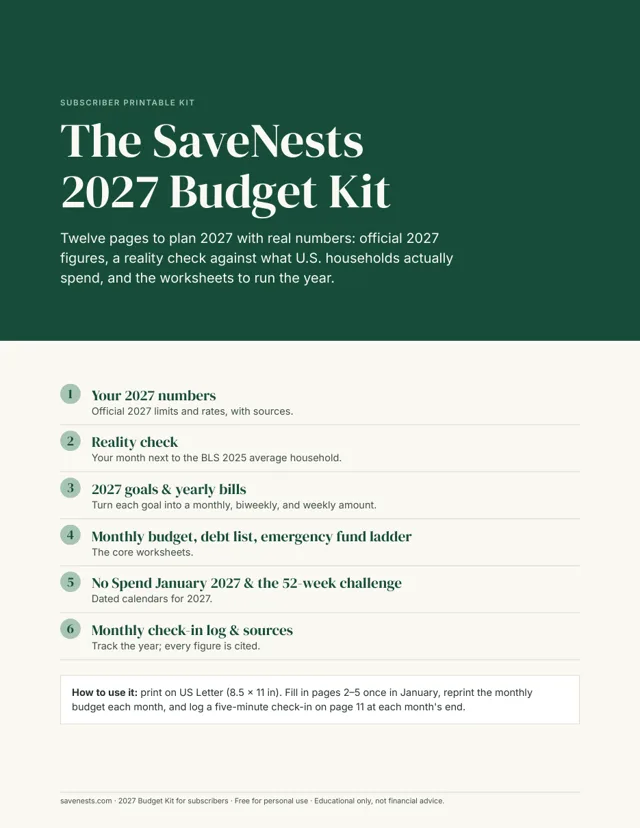
Free for subscribers
Get the 2027 Budget Kit
A 12-page printable PDF: official 2027 numbers (HSA limits, the 3.6% COLA), your month next to the BLS average household, goals and yearly bills, a monthly budget, a debt list, an emergency fund ladder, a No Spend January 2027 calendar, and dated 52-week challenge charts. Every figure is cited.