Credit card debt rarely arrives as one big decision. It's a car repair in March, a slow month in July, a few gifts in December, and a minimum payment that seems to handle it. Then one day the statement says the balance will take years to clear, and the interest line is bigger than some of your bills.
If that's where you are, here's a plan in the order that matters, with worked examples you can check yourself and an honest look at balance transfers, consolidation loans, and debt relief offers.
What credit card debt costs right now
The Federal Reserve's consumer credit report released October 7, 2026, put the average interest rate at 22.36 percent in August 2026 for credit card accounts that were charged interest. Across all accounts, including people who pay in full, the average stated rate was 21.19 percent. At about 22 percent, every $1,000 you carry costs roughly $19 a month in interest.
Plenty of people are paying it. The New York Fed counted $1.263 trillion in US card balances at the end of June 2026, up $54 billion in a year. In the Fed's survey of household finances for 2025, 45 percent of cardholders carried a balance at least once in the prior year, and the average card balance among respondents matched to credit records was $7,279, up $748 from 2023.
The interest rate is why this debt deserves its own plan. Every extra dollar you send to a 22 percent balance stops costing you money right away.
Why the minimum payment keeps you stuck
Your statement has a box labeled "Minimum Payment Warning." Issuers must show how long the current balance would take to pay off with minimum payments and no new charges, and, in most cases, the monthly payment that would clear it in three years. It's the most useful number on the page.
The trap is that minimum payments shrink as the balance shrinks. Issuers set their own formulas, but many use something like the month's interest plus 1 percent of the balance. As you pay down, the required payment drops, so you never build speed.
That example holds the most important idea in this guide: the biggest win isn't a clever trick. It's choosing a fixed payment and refusing to let it fall.
Step 1: Stop the balance from growing
You can't bail out a boat that's still taking on water. Stop new charges on the cards you're paying down. You don't have to close accounts; just change what they're used for:
- Take the card out of your phone wallet and remove it from shopping sites where it's saved.
- Move recurring charges, like streaming and subscriptions, to a debit card, or cancel the ones you don't use.
- Set a weekly spending amount for groceries and everyday costs and pay it from checking.
- If you use one card for a rewards or credit-history reason, keep it for a single fixed bill you pay in full each month.
If overspending is what keeps refilling the balance, read how to stop overspending without feeling restricted before you go further. A payoff plan only works if the month underneath it balances.
Step 2: Keep a small cash buffer
It feels backwards to save while you owe 22 percent, but a buffer stops the next flat tire from going back on the card. In the Fed's 2025 survey, 63 percent of adults said they'd cover a surprise $400 expense with cash or its equivalent. That leaves 37 percent who wouldn't, and 15 percent said they'd put it on a credit card and pay it off over time.
You don't need a full emergency fund first. Even a few hundred dollars in a separate savings account breaks the cycle of every surprise becoming new debt. Our guide to building a $1,000 emergency fund shows how to get there in small steps. Once you have a buffer, send everything else to the cards.
Step 3: List every card on one page
Pull up each statement and write down four things for every card.
| Card | Balance | Interest rate (APR) | Minimum payment | Due date |
|---|---|---|---|---|
| Card A | $ | % | $ | |
| Card B | $ | % | $ | |
| Store card | $ | % | $ | |
| Total | $ | $ |
Note any promotional rate and its end date, because a deferred-interest store card can charge all the back interest if the balance isn't gone by then. Then turn on autopay for at least the minimum on each card. A missed payment brings a late fee, and falling more than 60 days behind lets the issuer raise your rate on existing balances.
Step 4: Pick a monthly number you can keep
Add up the minimums, then decide on a total monthly payment above that amount that you can make every month, including the expensive ones. That total is your debt payment. It stays the same even as the minimums fall, which is where the speed comes from.
To find the money, budget from your actual take-home pay and the bills you can't skip. Zero-based budgeting gives every dollar a job, with the debt payment among the first. Plan ahead for a tax refund, a third paycheck in a biweekly month, or a raise, and assign them before they arrive.
If the minimums alone don't fit, skip to the section on when you can't make the payments.
Step 5: Aim the extra at one card
With more than one card, pay the minimum on all of them and send every extra dollar to one target. When that card is paid off, roll its whole payment onto the next. There are two ways to choose the target:
- Avalanche: target the highest interest rate first. It usually costs the least in total interest.
- Snowball: target the smallest balance first. You close accounts sooner, and those early wins keep many people going.
Either beats spreading extra money evenly. If your cards charge similar rates, the cost difference is often small, so pick the one you'll stick with. Our debt avalanche vs snowball guide runs the same debts through both methods, and the free debt payoff calculator shows your own payoff date and total interest for each.
Step 6: Lower the interest rate if you can
A lower rate sends more of each payment to the balance. Three common ways to get one:
Call your card issuer
This is free. The CFPB notes that some creditors may be willing to lower minimum payments, waive certain fees, reduce your interest rate, or move your due date to line up with payday. Ask directly: "I'm working on paying this balance off. Can you lower my rate, or do you have a hardship program?" If they say yes, get the terms in writing and ask whether the change affects your account, such as freezing the card.
Balance transfer card
A 0 percent or low-rate balance transfer can pause interest while you pay down principal. The CFPB lists the catches: the promotional rate lasts a limited time, you'll probably pay a transfer fee charged as a percentage of the amount or a flat amount, whichever is more, and if you use the new card for purchases, you lose the grace period on those purchases. Being more than 60 days late can also let the issuer raise the rate on all balances, including the transferred one.
Debt consolidation loan
A personal loan turns several card balances into one fixed payment with an end date. The Fed's August 2026 data put the average 24-month personal loan rate at commercial banks at 11.90 percent, compared with 22.36 percent on cards that charge interest. On $5,000 paid off over two years, that's about $235 a month and $643 in interest, versus about $260 a month and $1,247 in interest at the card rate.
The CFPB's cautions: a lower payment may just mean a longer term that costs more overall, some low rates are teaser rates, and a loan doesn't help if the cards fill back up, which is why Step 1 comes first. Using a home equity loan for card debt is risky because you could lose your home.
If you can't make the minimum payments
If the minimums don't fit even after trimming the budget, call before you miss a payment, not after. Then talk to a nonprofit credit counselor. According to the CFPB, these organizations can help you build a budget, review your credit report, and set up a debt management plan, which typically lowers your monthly payments and interest charges. You make one payment to the agency, and it pays your creditors. The National Foundation for Credit Counseling is one place to start. Get any fees in writing, and confirm that your creditors have accepted a plan before you send money.
Be very careful with debt settlement or "debt relief" companies. The CFPB warns that they often charge expensive fees, typically tell you to stop paying your cards (bringing late fees, penalty interest, and possible lawsuits), and can leave you deeper in debt. Avoid any company that charges before it settles a debt, guarantees results, or touts a "new government program" for card debt. A bankruptcy attorney is another legitimate option, and some offer a free first consultation.
If money is tight everywhere, how to save money on a low income covers help with bills and benefits.
Paying off cards during the holidays
November and December are when payoff plans usually stall. You don't need to skip the season, but pay for it with cash you've set aside. Set a firm number for gifts and food, shop from a list, and ask of any sale: would I buy this at this price without the countdown timer? Our Black Friday budget guide shows how to set that cap. If a holiday purchase lands on a card anyway, add it to your payoff list that week.
Keep the plan going
Payoff plans usually fail quietly in month four or five, when nothing feels different yet. A few habits help:
- Write the payoff date from your calculator somewhere you'll see it, and update it when you pay extra.
- When a card hits zero, roll its full payment to the next one the same month, before it disappears into spending.
- If you have a bad month, pay the minimums, then get back to the plan. One miss isn't the end of it.
Credit card payoff checklist
- Stop putting new charges on the cards you're paying off.
- Build a small cash buffer in a separate account.
- List every card's balance, rate, minimum, and due date, and set autopay for the minimums.
- Choose a fixed monthly payment above the minimums and don't let it shrink.
- Send the extra to one card at a time, by highest rate or smallest balance.
- Call each issuer and ask for a lower rate or a hardship program.
- Compare a balance transfer or consolidation loan only if you can clear it on schedule.
- If the minimums don't fit, talk to a nonprofit credit counselor before you miss a payment.
Questions readers ask
What is the fastest way to pay off credit card debt?
Stop adding new charges, pay a fixed amount every month that's well above the minimum, and send every extra dollar to one card at a time. Paying off the highest-rate card first (the avalanche method) usually costs the least interest. A lower rate from your issuer, a balance transfer you can clear before the promo ends, or a cheaper consolidation loan can speed things up further.
How long does it take to pay off credit card debt with minimum payments?
Often many years. In our $5,000 example at 22.36 percent, a minimum of interest plus 1 percent takes more than 19 years, while a fixed $200 a month takes 34 months. The Minimum Payment Warning box on your statement shows the estimate for your balance.
Should I pay off credit card debt or save money first?
Do both, in order. Build a small cash buffer first so surprises don't go back on the card, then send everything else to the debt. Card accounts that paid interest averaged 22.36 percent in August 2026, while the FDIC's national average savings rate was 0.38 percent in October 2026, so beyond a starter cushion, paying down the card is the better return.
Is a balance transfer a good idea?
It can be if the transfer fee is lower than the interest you'd pay and you can clear the balance before the promotional rate ends. Divide the balance plus the fee by the number of promo months to find your monthly payment. Don't use the card for new purchases, and never pay late, because being more than 60 days late can raise the rate on the whole balance.
How do I pay off credit card debt on a low income?
Start with the free steps: call your issuers and ask for a lower rate or a hardship program, cut the balance's growth by moving everyday spending to debit or cash, and pick a fixed payment you can keep even if it's small. If the minimums don't fit, a nonprofit credit counselor can review your budget and may set up a debt management plan that lowers interest and payments.
Are debt settlement companies worth it?
Usually not as a first step. The CFPB warns they often charge expensive fees, tell you to stop paying your bills, and can leave you deeper in debt with damaged credit and possible lawsuits. Forgiven debt can also be taxable. A nonprofit credit counselor or a bankruptcy attorney is a safer first call.
Sources
- Board of Governors of the Federal Reserve System, Consumer Credit G.19 (released October 7, 2026)August 2026, commercial banks: credit card plans 22.36% on accounts assessed interest and 21.19% on all accounts; 24-month personal loan 11.90%.
- Federal Reserve Bank of New York, Quarterly Report on Household Debt and Credit, Q2 2026 (August 11, 2026)Credit card balances $1.263 trillion at the end of June 2026, up $21 billion in the quarter and $54 billion from Q2 2025; flow into serious delinquency for card balances 6.97%.
- Board of Governors of the Federal Reserve System, Economic Well-Being of U.S. Households in 2025 (May 2026)82% of adults had a credit card; 45% of cardholders carried a balance at least once in the prior 12 months; average card balance of respondents linked to credit records $7,279 in 2025, up $748 from 2023, and $9,265 (up $2,530) for those finding it difficult to get by; 63% would cover a $400 expense with cash or its equivalent; 15% would put it on a credit card and pay over time.
- Consumer Financial Protection Bureau, A box on my credit card bill says that I will pay off the balance in three years if I pay a certain amount. What does that mean?Issuers must show how long minimum-only payments would take and the monthly payment to clear the current balance in 36 months.
- Consumer Financial Protection Bureau, Regulation Z § 1026.7(b)(12), Repayment disclosuresRequired "Minimum Payment Warning" on periodic statements.
- Consumer Financial Protection Bureau, What do I need to know about consolidating my credit card debt? (reviewed September 2, 2026)Creditors may lower payments, waive fees, cut rates, or move due dates; balance transfer fees and lost grace period; 60+ days late can raise rates on all balances; consolidation loan and home equity loan risks.
- Consumer Financial Protection Bureau, What is credit counseling?Nonprofit counselors and debt management plans; confirm creditors accept a plan before sending payments.
- Consumer Financial Protection Bureau, What is a debt relief program and how do I know if I should use one?Debt settlement risks, red flags, and possible tax consequences of forgiven debt.
- FDIC, National Rates and Rate Caps (October 2026)National average savings rate 0.38%.
Mohamed Ouhammouche
Mohamed Ouhammouche founded and runs SaveNests, a budgeting site that helps beginners build simple budgets. This guide was reviewed by the SaveNests Editorial Desk under the editorial and fact-checking policies.
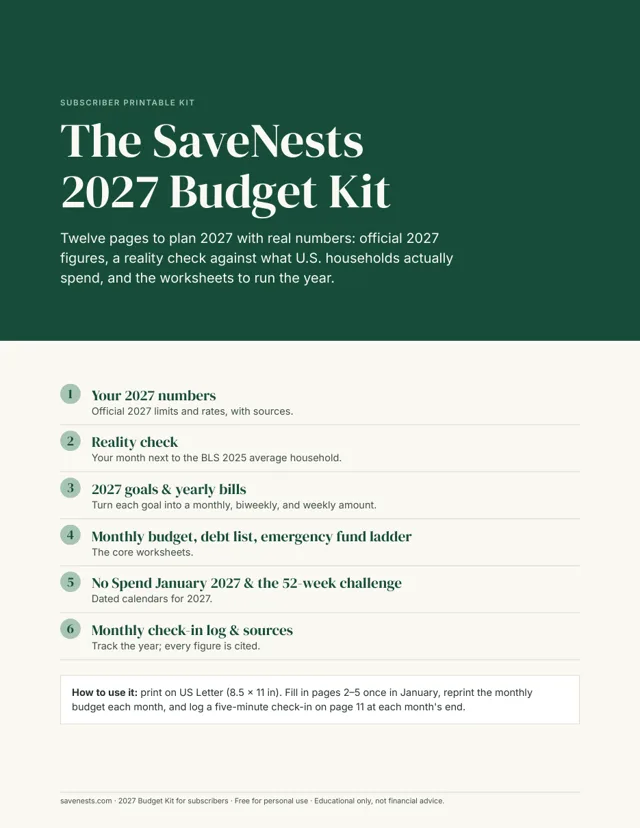
Free for subscribers
Get the 2027 Budget Kit
A 12-page printable PDF: official 2027 numbers (HSA limits, the 3.6% COLA), your month next to the BLS average household, goals and yearly bills, a monthly budget, a debt list, an emergency fund ladder, a No Spend January 2027 calendar, and dated 52-week challenge charts. Every figure is cited.