January is the natural month for a spending freeze. The holiday bills land, the year is new, and most of us want a reset. A no-spend month means you pay your essentials and stop the optional spending for 31 days. It's not a diet for your bank account forever, it's a short test that shows you where the money goes when you're not paying attention.
Why January 2027 is a good month for it
In Deloitte's 2026 holiday survey of 4,000 US consumers, shoppers expected to spend an average of $1,654 on the season, up 4 percent from 2025. If that lands on a credit card, the Federal Reserve's G.19 release puts the average rate on card accounts assessed interest at 22.36 percent (August 2026). On a $1,654 balance that's about $31 of interest in the first month alone ($1,654 x 22.36% / 12). A month without optional spending is a fast way to free cash for that balance.
The calendar helps too. January 1, 2027 is a Friday, so the month has five Fridays, five Saturdays, and five Sundays. Weekends are where most no-spend months break, so plan those fifteen days first. Martin Luther King Jr. Day falls on Monday, January 18, which gives many people a three-day weekend in the middle of the month.
No Spend January rules (write yours down)
- Pay every essential on time: rent or mortgage, utilities, insurance, minimum debt payments, phone, and childcare.
- Buy groceries from a list, and only from the list. Food is essential; snacks and impulse add-ons are not.
- Keep transportation to work and appointments. Gas is essential even though the BLS reported gasoline prices up 34.2 percent over the year to September 2026. Cutting a needed drive doesn't help.
- No restaurants, takeout, or coffee runs. Food away from home was up 3.5 percent over the same period, so this is one of the easiest places to see savings.
- No new clothes, gadgets, home decor, or apps. Make a 'February list' instead of buying.
- Pick one exception in advance (a birthday dinner, a work lunch) and set its dollar limit. An exception you planned is not a failure.
- Cancel or pause one subscription you didn't use in December.
The No Spend January 2027 calendar
| Week | Dates | Focus |
|---|---|---|
| 1 | Fri Jan 1 – Sun Jan 3 | Write your rules, list essentials, pause one subscription |
| 2 | Mon Jan 4 – Sun Jan 10 | Plan meals and do one grocery trip from a list |
| 3 | Mon Jan 11 – Sun Jan 17 | Plan a free weekend before the long MLK holiday |
| 4 | Mon Jan 18 – Sun Jan 24 | MLK Day on the 18th: library, park, home cooking |
| 5 | Mon Jan 25 – Sun Jan 31 | Tally the savings and decide where they go |
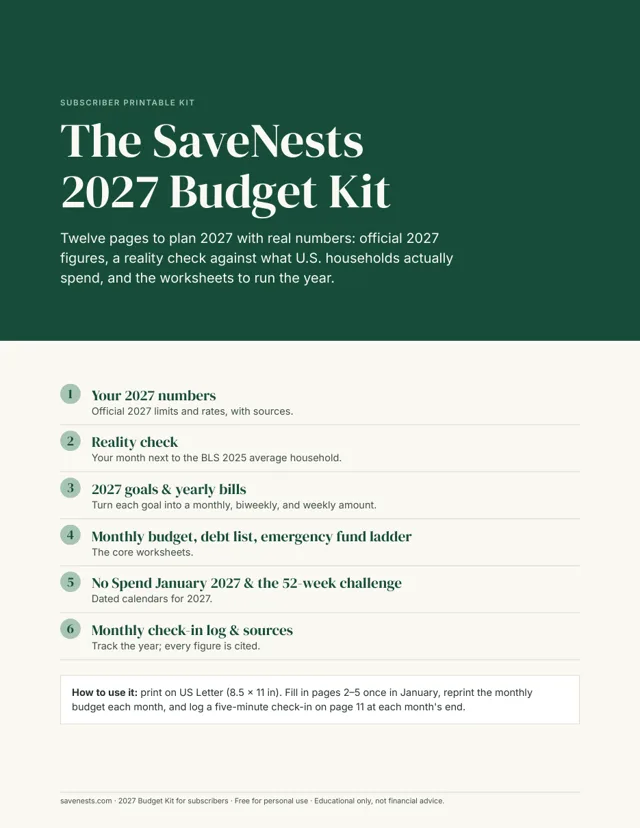
Shade each day you stayed on plan. If you want a printed version, the 2027 Budget Kit includes a full-page No Spend January 2027 calendar, and the free no-spend challenge calendar works for any month.
What to cut and what to keep
For a sense of scale, the BLS Consumer Expenditures release for 2025 shows the average household spent $81,905 for the year, including $10,633 on food, about $886 a month. Food at home is essential; the restaurant share is where a no-spend month bites. Housing ($27,790) and transportation ($13,492) are mostly fixed in the short term, so don't expect a 31-day challenge to move them.
- Keep: housing, utilities, insurance, minimum debt payments, groceries from a list, gas and transit to work, medicine.
- Cut: takeout, restaurants, coffee out, shopping 'just to look', new streaming trials, and in-app purchases.
- Swap: library books and movies, potlucks instead of restaurants, free museum days, and walking dates.
Where the money should go on February 1
Decide this before January starts, or the savings will drift back into spending. Use this order:
- Pay down any holiday credit card balance, since card interest above 22 percent costs more than any savings account pays.
- Build a starter emergency fund. In the Fed's 2025 SHED report, 63 percent of adults said they would cover a $400 emergency with cash or its equivalent. Getting to that first $400 to $1,000 is a solid January win. The emergency fund calculator gives you a full target.
- Start the 52-week money challenge for 2027 with part of the savings, so the habit continues after the month ends.
After January: keep what worked
Don't try to stay at zero forever. Look at your February list, buy what still matters, and keep one or two habits that were easy, such as cooking on weeknights. Then set a real monthly plan with how to budget for 2027. If you want a lighter rule for the rest of the year, not another freeze, Low Buy Year 2027 sets spending rules that last past January. If you liked the format, run it again in the fall with the No Spend November challenge.
Questions readers ask
What are the basic rules of No Spend January?
Pay essentials like housing, utilities, groceries, transport, and minimum debt payments, and stop optional spending such as restaurants, shopping, and new subscriptions for the month. Write your rules and one planned exception before January 1.
What day does January 2027 start on?
Friday. January 2027 has five full weekends (Friday to Sunday), and Martin Luther King Jr. Day is Monday, January 18.
Can I buy groceries during a no-spend month?
Yes. Groceries are an essential. Shop from a written list and skip the extras.
What should I do with the money I save?
Pay down high-interest debt first, then build a starter emergency fund, then automate a savings habit like the 52-week challenge.
Sources
- Deloitte, 2026 Deloitte Holiday Retail SurveyAverage expected holiday spending $1,654, up 4% from $1,595 in 2025.
- Federal Reserve, Consumer Credit G.19 (released October 7, 2026)August 2026 credit card plans: 22.36% on accounts assessed interest.
- U.S. Bureau of Labor Statistics, Consumer Price Index – September 2026 (released October 14, 2026)Gasoline +34.2% and food away from home +3.5% over 12 months.
- U.S. Bureau of Labor Statistics, Consumer Expenditures – 2025 (released October 29, 2026)Average annual expenditures $81,905; food $10,633; housing $27,790; transportation $13,492.
- Board of Governors of the Federal Reserve System, Economic Well-Being of U.S. Households in 2025 (SHED, May 2026)63% would cover a $400 expense with cash or its equivalent.
Mohamed Ouhammouche
Mohamed Ouhammouche founded and runs SaveNests, a budgeting site that helps beginners build simple budgets. This guide was reviewed by the SaveNests Editorial Desk under the editorial and fact-checking policies.
Free for subscribers
Get the 2027 Budget Kit
A 12-page printable PDF: official 2027 numbers (HSA limits, the 3.6% COLA), your month next to the BLS average household, goals and yearly bills, a monthly budget, a debt list, an emergency fund ladder, a No Spend January 2027 calendar, and dated 52-week challenge charts. Every figure is cited.