"How much should I spend on Christmas gifts?" has no single right answer, and anyone who gives you a dollar figure without knowing your paycheck is guessing. What does have an answer is how to find your number: start from the cash you'll have before the holidays, set aside the non-gift costs, and divide what's left by person, with the closest people getting the biggest share.
For context, Gallup's October 2026 poll found Americans expected to spend an average of $1,011 on holiday gifts this year, about the same as in 2025 and 2024. Twenty-seven percent planned to spend under $500, 18 percent between $500 and $999, and 36 percent $1,000 or more; 24 percent said they would spend less than last year and 18 percent more. Last year's pattern is a useful warning: Gallup's estimate fell from $1,007 in October 2025 to $778 in November as people revised their plans, and in that November poll households earning under $50,000 expected to spend $384, middle-income households $842, and those earning $100,000 or more $1,230. The National Retail Federation's 2025 survey put planned gift spending at $627.93 per person out of $890.49 in total holiday spending. Those are averages and intentions, not targets, and they say nothing about whether anyone could afford them.
This guide gives you a per-person framework, a sample gift budget table, low-cost and homemade gift ideas, and simple scripts for talking about gift limits with family. If you haven't set a total holiday budget yet, How to Budget for Christmas Without Going Into Debt walks through that first step.
Step 1: Find your total gift budget
Your gift budget is what's left of your holiday budget after everything that isn't a present. Work it out in this order:
- Count the paychecks you have left before mid-December and decide what each can spare after rent, utilities, groceries, transportation, minimum debt payments, and your regular savings.
- Add anything already saved in a holiday sinking fund or Christmas account.
- Subtract non-gift costs: holiday meals (including Thanksgiving), travel, decorations, wrapping, cards, postage, and events.
- What remains is your gift total. Write it down before you shop.
In NRF's 2025 numbers, about 30 percent of planned holiday spending went to things other than gifts, such as food, decorations, and cards. Budgets that list only presents tend to run out in December, when those costs show up.
Prices matter for the per-person math too. Over the 12 months ending September 2026, the Bureau of Labor Statistics measured overall consumer prices up 3.7 percent, but toys were up 6.6 percent, candy 7.7 percent, coffee 7.1 percent, and postage 12.7 percent, while recreational books slipped 0.7 percent. A cap that matched last year buys a little less this year, especially for mailed gifts, so it is worth checking your caps against current prices rather than last year's receipts.
Step 2: A per-person gift budget framework
Once you have a total, split it by circles of closeness. One approach that's easy to adjust is to give each circle a share of the total, then divide that share by the number of people in it:
| Circle | Who | Share of gift total | How to use it |
|---|---|---|---|
| 1. Household | Partner, your kids | About 50% | Fund this first; equal caps for siblings |
| 2. Close family | Parents, siblings, a best friend | About 25% | One gift each, or one shared gift |
| 3. Extended family | Nieces, nephews, cousins, in-laws | About 15% | Name draw or a family price cap |
| 4. Thank-yous | Teachers, coaches, sitters, coworkers | About 10% | Small, consistent amounts; cards count |
These shares aren't a rule. A single person with no kids might put most of the money into close family. A family with three young children might put 70 percent into the household circle and cut the extended family to a name draw. What matters is deciding the split before you shop, so the first few gifts don't swallow the money meant for everyone else.
How much to spend on Christmas gifts per child
There's no official per-child figure. Decide two things for each child: a dollar cap and a gift count. Kids tend to notice fairness between siblings more than totals, so keep caps equal or have a simple reason ready if they differ (an older child's one bigger gift, for example). A gift count limit also helps; many families use the "something you want, something you need, something to wear, something to read" rule. Christmas on a Budget for Kids walks through that four-gift plan in more detail.
How much to spend per adult, parents, and friends
For adults, one considered gift usually lands better than several small ones. If you're spending on both parents, a shared gift goes further. For adult siblings and friends, a price cap agreed in advance (say, $20 or $30) keeps things even. For coworkers, follow your workplace's exchange limit and don't feel you have to go above it; if you're the one organizing, the Secret Santa budget guide covers office caps, tax and shipping, and gift card rules.
Sample gift budget table
Here's the framework applied to a $500 gift total. It's an illustration of the method, not a recommendation of what to spend.
| Person | Circle | Cap | Plan |
|---|---|---|---|
| Partner | Household | $80 | One gift |
| Child, age 10 | Household | $85 | Want, need, wear, read, stocking included |
| Child, age 6 | Household | $85 | Same structure, same cap |
| Mom and Dad | Close family | $60 | One shared gift |
| Sister | Close family | $35 | Agreed $35 cap |
| Best friend | Close family | $30 | Experience gift (shared lunch) |
| Nieces and nephews (4) | Extended | $45 | Family name draw: one $25 gift, plus $5 books for the other three |
| In-laws | Extended | $30 | Homemade food gift, framed photo |
| Two teachers, one coach | Thank-yous | $30 | $10 each: card plus a small gift or gift card |
| Cushion | — | $20 | For the one you forgot |
| Total | $500 |
Track each purchase against the person's cap the same day. When a cap is hit, that person is done, even if you see something perfect later. If you shop during the sales, our Black Friday budget guide shows how to buy from this list without overspending.
Cheap and homemade gift ideas
Low-cost gifts work best when they look intentional. A few categories that tend to land well:
Homemade gifts
- Baked goods or a food gift: cookies, spiced nuts, granola, or a jar of soup mix with a handwritten recipe card. Buy ingredients in bulk for several people at once.
- A family recipe book: type up five or ten favorites and print them, or copy them by hand into an inexpensive notebook.
- Framed photos or a printed photo calendar. Photo printing sales are common in late fall.
- A playlist, a letter, or a recorded message for a grandparent.
- Crafts you already have the supplies for: knitted items, drawings from kids, painted ornaments.
Time and skill gifts
- Coupons for babysitting, a cooked dinner, yard work, or a ride to the airport.
- A repair or project you can do: fixing a bike, hanging shelves, setting up a phone.
- An afternoon together: a hike, a museum free day, a movie night at home.
Small store-bought gifts
- Books: NRF's Thanksgiving weekend survey found books and other media were the third most popular gift category in 2025, bought by 28 percent of shoppers.
- Something consumable the person actually uses: good coffee, a favorite snack, a nice hand cream.
- Secondhand or refurbished items in good condition, checked carefully before you pay.
- Gift cards for a place they already go. They top wish lists again: in NRF's 2026 holiday survey, 47 percent of people said they'd like to receive gift cards, ahead of clothing (44 percent) and books and other media (25 percent). Under federal rules summarized by the CFPB, gift card funds must be good for at least five years and inactivity fees can't start in the first 12 months.
If money is very tight, a card with a sincere note is a real gift. People remember being thought of more often than they remember price tags.
How to talk about gift limits with family
Most gift overspending isn't about the gifts. It's about not wanting to be the person who brings it up. Early, specific, and kind usually works best.
When to bring it up
Raise it before Thanksgiving if you can, or at the latest the first week of December, before anyone has bought gifts. A group text or a family call is fine. Bringing it up after someone has already bought you something expensive makes it harder for everyone.
What to suggest
- A price cap for adults: "What if we keep adult gifts to $25 this year?"
- A name draw (Secret Santa) for adults or cousins, so each person buys one gift instead of eight. Secret Santa Budget: How Much to Spend + Rules has a cap-picking method and rules you can paste into the family chat.
- Kids only: adults skip gifts to each other and focus on the children.
- An experience instead of presents: a shared meal, a game night, a day trip.
- A homemade-only or secondhand-only rule for one branch of the family.
Simple scripts
- "We're keeping our holiday budget tight this year. Would you be up for a name draw so we can each get one nice gift?"
- "I love giving you something, but I'd rather spend the day together than spend a lot. Can we set a $20 limit?"
- "We're focusing on the kids this year, so we're skipping adult gifts. Please don't feel you need to get us anything."
You don't owe anyone a detailed explanation of your finances. "It's not in the budget this year" is a complete sentence. If someone still gives you a bigger gift, a warm thank-you is enough; you don't need to match it.
How to pay for gifts without new debt
Fund the gift total on a schedule. Move the per-paycheck amount into a separate savings bucket on payday, or use cash envelopes for the gift line (Cash Stuffing for Beginners shows the setup). A No Spend November can free up extra cash for December.
If you use a credit card, pay the full statement balance. The Federal Reserve's November 6, 2026 consumer credit release still shows an average 22.36 percent rate (August 2026, the latest quarterly reading) on card accounts that were charged interest. If you already carry a balance, How to Pay Off Credit Card Debt lays out a plan before you add December to it. Buy now, pay later plans can look interest-free, but the Consumer Financial Protection Bureau notes most charge late fees, and autopay from an empty account can trigger overdraft fees. Count every installment against your gift budget.
After the holidays: set next year's number
In January, add up what gifts actually cost, including the extras you forgot. Divide by 11 or 12 and start a monthly transfer into a sinking fund for next year. A $600 gift total is $50 a month from January. The savings goal calculator does the math for any amount and date.
Gift budget checklist
- Set your total holiday budget from the paychecks you have left.
- Subtract food, travel, decorations, wrapping, and cards to get your gift total.
- Split the total by circle: household, close family, extended family, thank-yous.
- Give every person a cap and, for kids, a gift count.
- Bring up price caps or a name draw with family before Thanksgiving.
- Mix in homemade, time, and secondhand gifts where they fit.
- Track each purchase against the person's cap the same day.
- Pay in cash or pay any card in full; count BNPL installments.
- In January, total the real cost and start next year's fund.
Questions readers ask
How much should I spend on Christmas gifts?
Whatever you can pay in cash from the paychecks left before the holidays after bills, savings, and non-gift holiday costs. NRF's 2025 survey found people planned to spend $627.93 on gifts on average, but that's a national average, not a target.
How much should I spend on Christmas gifts per person?
Split your gift total by circles of closeness: roughly half for your household, a quarter for close family, and the rest for extended family and thank-yous, then divide each share by the number of people. Adjust the shares to fit your family.
How much should I spend on Christmas gifts per child?
There's no official amount. Set a dollar cap and a gift count for each child, keep siblings' caps equal or explain the difference, and fund the kids' line before adult gifts if money is tight.
What is the average amount spent on Christmas gifts?
Gallup's October 2026 poll put expected holiday gift spending at an average of $1,011, similar to 2025 and 2024. In 2025, Gallup's estimate fell to $778 by November, ranging from $384 for households under $50,000 to $1,230 for households earning $100,000 or more. NRF's 2025 survey put planned gift spending at $627.93 per person.
How do I tell my family I can't afford Christmas gifts this year?
Bring it up early, before Thanksgiving if you can, and suggest an alternative such as a price cap, a name draw, kids-only gifts, or a shared experience. You don't need to explain your finances in detail.
What are good cheap Christmas gifts?
Homemade food gifts, framed photos, a recipe book, time or skill coupons, books, consumables the person uses, and secondhand items in good condition. A sincere card is also a real gift.
How much should I spend on a Secret Santa or gift exchange?
Spend up to the cap the group agrees on before names are drawn, and set that cap at a level the person with the tightest budget can afford. Include tax and shipping in the cap, and count the exchange as one name on your own gift list.
Are Christmas gifts more expensive this year?
Some categories are. In BLS data for the 12 months ending September 2026, overall prices rose 3.7 percent, while toys rose 6.6 percent, candy 7.7 percent, coffee 7.1 percent, and postage 12.7 percent. Recreational books fell 0.7 percent.
Do gift cards expire?
Under federal rules summarized by the CFPB, gift card funds must be good for at least five years, and inactivity fees can't be charged in the first 12 months. Some states give more protection.
Sources
- Gallup, Holiday Shopping Plans Point to Average Retail Year (November 6, 2026)October 1–19, 2026: average expected gift spending $1,011; 27% under $500, 18% $500–$999, 36% $1,000+; 24% spending less, 18% more.
- National Retail Federation, Affordability Shapes Winter Holiday Shopping, According to NRF Holiday Survey (October 20, 2026)Most-wanted gifts: gift cards 47%, clothing 44%, books and other media 25%, personal care or beauty 24%.
- U.S. Bureau of Labor Statistics, CPI Table 2, detailed expenditure categories (September 2026)12-month changes: all items +3.7%; toys +6.6%; candy and chewing gum +7.7%; coffee +7.1%; postage +12.7%; recreational books -0.7%.
- National Retail Federation, Consumers to Spend Second-Highest Amount on Record, According to NRF Holiday Survey (October 16, 2025)$890.49 per person planned, including $627.93 on gifts and $262.56 on food, decorations, cards, and other seasonal items.
- National Retail Federation, Thanksgiving Holiday Weekend Draws a Record 203 Million Shoppers (December 2, 2025)Top gifts bought Thanksgiving weekend 2025: clothing and accessories (51 percent), toys (32 percent), books and other media (28 percent), gift cards (26 percent).
- Gallup, U.S. Holiday Shoppers Plan to Spend Briskly (October 28, 2025)Average expected holiday gift spending of $1,007 in October 2025.
- Gallup, Economic Confidence Slips; Holiday Spending Plans Plummet (December 4, 2025)November 2025 estimate of $778; $384 for households under $50,000, $842 middle income, $1,230 for $100,000 or more.
- LendingTree, Holiday Debt Hits $1,223 as Tariffs Push 45% of Americans to Cut Back on Gifts (December 22, 2025)37 percent took on holiday debt averaging $1,223.
- Federal Reserve, Consumer Credit G.19 (release of November 6, 2026)Average interest rate on credit card accounts assessed interest: 22.36 percent (August 2026).
- Consumer Financial Protection Bureau, Do Buy Now, Pay Later (BNPL) loans have fees?Most BNPL loans charge late fees; autopay can trigger overdraft or NSF fees.
- Consumer Financial Protection Bureau, If my prepaid card expires, do I lose my money?Gift card funds must be good for at least five years under federal law; inactivity fees only after 12 months.
Mohamed Ouhammouche
Mohamed Ouhammouche founded and runs SaveNests, a budgeting site that helps beginners build simple budgets. This guide was reviewed by the SaveNests Editorial Desk under the editorial and fact-checking policies.
Free for subscribers
Get the 2027 Budget Kit
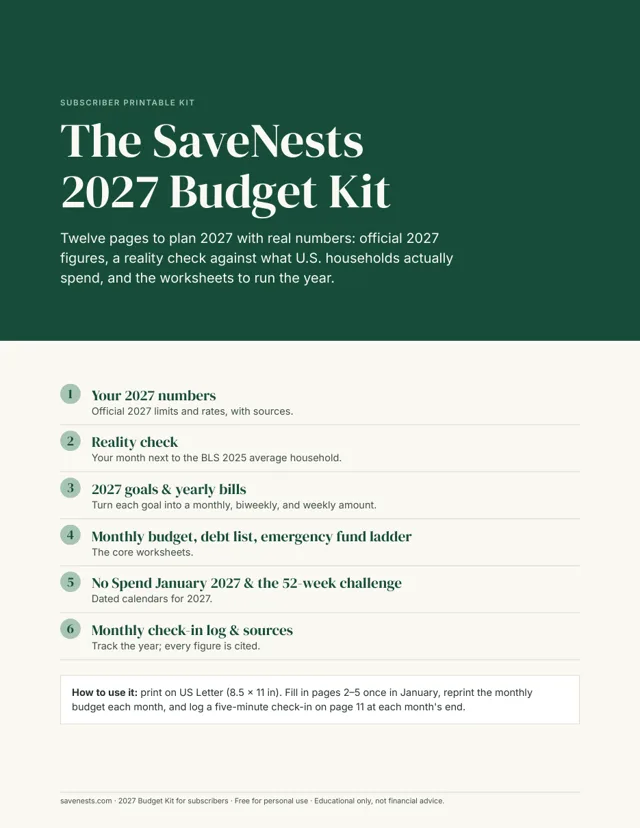
A 12-page printable PDF: official 2027 numbers (HSA limits, the 3.6% COLA), your month next to the BLS average household, goals and yearly bills, a monthly budget, a debt list, an emergency fund ladder, a No Spend January 2027 calendar, and dated 52-week challenge charts. Every figure is cited.