
If you're building a 2027 budget, you want official numbers, not forecasts. Benefits firms often publish estimates weeks before the IRS does, and a contribution plan built on a forecast can be off by hundreds of dollars. The IRS has now published the 2027 retirement limits and the 2027 tax inflation adjustments, so the figures below are the official ones.
So this page sticks to one rule. Every figure below comes from the agency that sets it or measures it: the IRS, the Social Security Administration, the Bureau of Labor Statistics, the Federal Reserve, and the FDIC. Each one is linked in the sources at the bottom. I last checked them on November 16, 2026.
2027 numbers at a glance
| Number | 2027 | 2026 | Status |
|---|---|---|---|
| 401(k) employee contribution limit | $25,500 | $24,500 | Official (IR-2026-136 / Notice 2026-66) |
| 401(k) catch-up, age 50+ | $8,500 ($11,750 at ages 60 to 63) | $8,000 ($11,250 at ages 60 to 63) | Official (IR-2026-136 / Notice 2026-66) |
| IRA contribution limit | $7,500 (+$1,100 at 50+) | $7,500 (+$1,100 at 50+) | Official (unchanged; IR-2026-136 / Notice 2026-66) |
| Standard deduction, single | $16,600 | $16,100 | Official (IR-2026-133 / Rev. Proc. 2026-35) |
| Standard deduction, married filing jointly | $33,200 | $32,200 | Official (IR-2026-133 / Rev. Proc. 2026-35) |
| Standard deduction, head of household | $24,925 | $24,150 | Official (IR-2026-133 / Rev. Proc. 2026-35) |
| HSA limit, self-only coverage | $4,500 | $4,400 | Official (Rev. Proc. 2026-24) |
| HSA limit, family coverage | $9,000 | $8,750 | Official (Rev. Proc. 2026-24) |
| Social Security COLA | 3.6% | 2.8% | Official (SSA, October 14, 2026) |
| Social Security taxable wage base | $192,300 | Official (SSA notice, October 26, 2026) | |
| Maximum federal SSI payment, individual | $1,029 a month | Official (SSA notice) |
401(k) limit 2027: $25,500
The official 2027 401(k) employee contribution limit is $25,500, up from $24,500 in 2026. The IRS announced it on November 12, 2026 in IR-2026-136, with the technical details in Notice 2026-66. The same limit applies to 403(b) plans, governmental 457 plans, and the federal Thrift Savings Plan. If you're 50 or older you can add an $8,500 catch-up, for a total of $34,000. Under SECURE 2.0, people aged 60, 61, 62, or 63 get a higher catch-up of $11,750 instead of $8,500, for a total of $37,250.
What you can do now: decide on a percentage of pay rather than a dollar target. Most beginners are nowhere near the cap, so the limit matters less than getting the full employer match, if your plan has one. If you are aiming for the maximum, $25,500 spread across 26 biweekly paychecks is about $981 per check, or $2,125 a month.
2027 IRA limit
The official 2027 IRA contribution limit is $7,500, unchanged from 2026, and the catch-up for people 50 and older remains $1,100. The IRS confirmed both in IR-2026-136 and Notice 2026-66. Spread over a year, $7,500 is $625 a month or about $144 a week. You can still make 2026 IRA contributions until the April 15, 2027 filing deadline, which our year-end financial checklist walks through.
2027 HSA limits (official)
Health savings account limits come out earlier than the rest, and the 2027 numbers are final. In Revenue Procedure 2026-24, the IRS set the 2027 HSA contribution limit at $4,500 for self-only coverage and $9,000 for family coverage, up from $4,400 and $8,750 in 2026. People 55 and older can add $1,000. To be HSA-eligible in 2027, your health plan's deductible must be at least $1,750 for self-only coverage or $3,500 for a family, and its out-of-pocket maximum can't exceed $8,700 or $17,400.
In budget terms, maxing a self-only HSA in 2027 means $375 a month. If your employer contributes, its money counts toward the same limit, so subtract it before you set your own payroll amount.
2027 standard deduction
The official 2027 standard deduction is $16,600 for single filers and married people filing separately, $33,200 for married couples filing jointly, and $24,925 for heads of household. The IRS set those amounts in Revenue Procedure 2026-35 and announced them in IR-2026-133 on November 5, 2026. They apply to tax year 2027, the return you'll file in 2028. For tax year 2026, the return you'll file in early 2027, the standard deduction remains $16,100, $32,200, and $24,150.
2027 tax brackets
The IRS also published the 2027 tax rate tables in Revenue Procedure 2026-35 (announced in IR-2026-133). These apply to tax year 2027, the return you'll file in 2028. The rates themselves did not change. The income ranges that fall into each rate rose with inflation. The amounts below are taxable income, which is after the standard deduction (or itemized deductions).
| Rate | Single | Married filing jointly | Head of household |
|---|---|---|---|
| 10% | $0 to $12,800 | $0 to $25,600 | $0 to $18,250 |
| 12% | $12,801 to $52,025 | $25,601 to $104,050 | $18,251 to $69,650 |
| 22% | $52,026 to $109,125 | $104,051 to $218,250 | $69,651 to $109,100 |
| 24% | $109,126 to $208,325 | $218,251 to $416,650 | $109,101 to $208,300 |
| 32% | $208,326 to $264,550 | $416,651 to $529,100 | $208,301 to $264,550 |
| 35% | $264,551 to $661,375 | $529,101 to $793,650 | $264,551 to $661,350 |
| 37% | Over $661,375 | Over $793,650 | Over $661,350 |
A beginner reading: these brackets apply to taxable income, not to your gross pay. After a $16,600 standard deduction, a single filer with $50,000 in wages has $33,400 of taxable income, which falls in the 12 percent bracket. Only the income above each threshold is taxed at the higher rate, not the whole amount. This is general information, not tax advice for your return.
Social Security COLA 2027: 3.6 percent
The Social Security Administration announced on October 14, 2026 that benefits will rise 3.6 percent for 2027. That's up from 2.8 percent for 2026. SSA says the average retirement benefit will go up by about $75 a month. About 72 million Social Security beneficiaries get the increase starting with January 2027 payments, and about 7.3 million people receiving SSI get it starting December 31, 2026. The maximum federal SSI payment for 2027 is $1,029 a month for an individual and $1,544 for an eligible couple.
If you're still working, the more relevant 2027 figure is the taxable wage base: Social Security tax applies to earnings up to $192,300 in 2027. You also need $1,970 in earnings to get credit for one quarter of coverage, so four credits take $7,880 in covered earnings.
Inflation right now: 3.7 percent
The latest Consumer Price Index, released by BLS on October 14, 2026, shows prices up 3.7 percent over the 12 months to September 2026, faster than the 3.4 percent rate through August. Energy did most of the damage. Prices excluding food and energy rose 2.6 percent. The next CPI release is scheduled for November 10, 2026.
- Gasoline (all types)+34.2%
- Energy+20.4%
- Electricity+4.4%
- All items+3.7%
- Food away from home+3.5%
- Shelter+3.2%
- Food at home+1.8%
Source: BLS Consumer Price Index, September 2026 (CPI-U, not seasonally adjusted).
For a 2027 budget, the practical point is that a line you set a year ago is probably low, especially gas. Don't inflate every line by 3.7 percent. Replace each one with what you actually paid over the last two or three months.
What U.S. households spent in 2025
The Bureau of Labor Statistics released its 2025 Consumer Expenditure data on October 29, 2026. The average consumer unit (roughly, a household) spent $81,905 in 2025, up 4.3 percent from 2024, on average pre-tax income of $110,847. That's about $6,825 a month in spending. Housing alone took 33.9 percent.
| Category | Per year | Per month | Share of spending |
|---|---|---|---|
| Housing | $27,790 | $2,316 | 33.9% |
| Transportation | $13,492 | $1,124 | 16.5% |
| Food | $10,633 | $886 | 13.0% |
| Personal insurance and pensions | $10,175 | $848 | 12.4% |
| Healthcare | $6,470 | $539 | 7.9% |
| Entertainment | $4,084 | $340 | 5.0% |
| Cash contributions | $2,237 | $186 | 2.7% |
| Apparel and services | $2,010 | $168 | 2.5% |
| All spending | $81,905 | $6,825 | 100% |
- Housing33.9%
- Transportation16.5%
- Food13.0%
- Personal insurance and pensions12.4%
- Healthcare7.9%
- Entertainment5.0%
Source: BLS Consumer Expenditures 2025, Table 2.
A few details are worth knowing. Shelter spending rose 8.0 percent and spending on rented dwellings 10.8 percent, both statistically significant increases. Spending on meats, poultry, fish, and eggs rose 11.7 percent. And averages hide a wide range: households in the lowest income fifth spent $37,935 on average, while the highest fifth spent $159,512. Use these as a reality check, not a target. If your housing is well above a third of your spending, you're not unusual, but it's the first line to look at in a monthly budget.
What savings accounts pay now
On October 28, 2026, the Federal Reserve held the federal funds rate at a target range of 3.75 to 4 percent. Two of the twelve voters wanted a quarter-point increase. Banks don't pass that rate straight to savers, though. The FDIC's national average rates, published October 19, 2026, show how far behind the typical account is.
- Federal funds target (top of range)4.00%
- 12-month CD1.76%
- Money market0.63%
- Savings0.38%
- Interest checking0.07%
Sources: FDIC National Rates, October 19, 2026; Federal Reserve FOMC statement, October 28, 2026 (top of 3.75%–4% range shown).
At the national average savings rate of 0.38 percent, $1,000 earns about $3.80 in a year. At the average 12-month CD rate of 1.76 percent, it earns about $17.60. With prices rising 3.7 percent, money in an average savings account is losing buying power. That doesn't mean skip the emergency fund. It means it's worth checking what your bank pays and comparing it with other FDIC-insured or NCUA-insured accounts before you park your 2027 savings. Our guide to how much to save each month covers setting that up once.
How to use these numbers in your 2027 budget
- Rebuild your spending lines from recent bills, not last year's budget. Inflation is 3.7 percent overall but much higher for gas.
- Set retirement contributions as a percentage now, or as a dollar amount using the official 2027 limits: $25,500 for a 401(k) and $7,500 for an IRA.
- If you have an HSA-eligible plan, update payroll to the 2027 limit of $4,500 (self-only) or $9,000 (family), minus any employer money.
- If you get Social Security, expect your January 2027 payment to be about 3.6 percent higher and watch for your COLA notice.
- Check your savings rate. If you're earning near the 0.38 percent national average, shop around.
- Put it all in a plan: our step-by-step guide to how to budget for 2027 takes these numbers and turns them into a month-by-month budget.
Questions readers ask
What is the 401(k) limit for 2027?
The official 2027 401(k) employee contribution limit is $25,500, up from $24,500 in 2026, announced by the IRS on November 12, 2026 (IR-2026-136 and Notice 2026-66). The catch-up is $8,500 at age 50 or older, or $11,750 at ages 60, 61, 62, or 63. The same employee limit applies to 403(b) plans, governmental 457 plans, and the federal Thrift Savings Plan.
What is the 2027 IRA contribution limit?
The official 2027 IRA contribution limit is $7,500, unchanged from 2026, and the catch-up for people 50 and older remains $1,100 (IR-2026-136 and Notice 2026-66). You can still make 2026 IRA contributions until April 15, 2027.
What are the 2027 HSA contribution limits?
$4,500 for self-only coverage and $9,000 for family coverage, set in IRS Revenue Procedure 2026-24. People 55 and older can contribute an extra $1,000.
How much is the Social Security COLA for 2027?
3.6 percent, announced by the Social Security Administration on October 14, 2026. SSA says the average retirement benefit rises about $75 a month, starting with January 2027 payments. SSI increases start December 31, 2026.
What is the 2027 standard deduction?
For tax year 2027, the official standard deduction is $16,600 for single filers and married people filing separately, $33,200 for married couples filing jointly, and $24,925 for heads of household (IR-2026-133 and Revenue Procedure 2026-35). Those amounts apply to the return you'll file in 2028. For tax year 2026, the return you'll file in early 2027, the standard deduction is $16,100, $32,200, and $24,150.
How much does the average American household spend per month?
According to BLS Consumer Expenditure data released October 29, 2026, the average consumer unit spent $81,905 in 2025, or about $6,825 a month. Housing was the biggest share at 33.9 percent.
Sources
- IRS, IR-2026-136: 401(k) limit increases to $25,500 for 2027, IRA limit remains $7,500 (November 12, 2026)2027: 401(k)/403(b)/457/TSP elective deferral $25,500; catch-up $8,500; ages 60–63 catch-up $11,750; IRA $7,500; IRA catch-up $1,100.
- IRS, Notice 2026-66: 2027 amounts relating to retirement plans and IRAs (November 12, 2026)Technical cost-of-living adjustments for 2027 retirement plan and IRA limits.
- IRS, IR-2026-133: Tax inflation adjustments for tax year 2027 (November 5, 2026)2027 standard deduction: $16,600 single / married filing separately; $33,200 married filing jointly; $24,925 head of household. Also announces the 2027 tax rate tables.
- IRS, Revenue Procedure 2026-35 (2027 inflation-adjusted tax items)Section 3.01 tax rate tables and section 3.15 standard deduction amounts for taxable years beginning in 2027.
- IRS, IR-2025-111: 401(k) limit increases to $24,500 for 2026, IRA limit increases to $7,500 (November 13, 2025)2026 comparison figures: 401(k) $24,500; catch-up $8,000; ages 60–63 catch-up $11,250; IRA $7,500; IRA catch-up $1,100.
- IRS, IR-2025-103: Tax inflation adjustments for tax year 2026 (October 9, 2025)2026 standard deduction comparison: $16,100 single; $32,200 married filing jointly; $24,150 head of household.
- IRS, Revenue Procedure 2026-24 (2027 HSA inflation adjusted amounts)2027 HSA limits $4,500 self-only, $9,000 family; HDHP minimum deductible $1,750/$3,500; out-of-pocket max $8,700/$17,400.
- EY Tax News, IRS releases Health Savings Account limits for 20272026 comparison ($4,400/$8,750) and the $1,000 additional contribution for people 55 and older.
- Social Security Administration, Social Security Announces 3.6 Percent Benefit Increase for 2027 (October 14, 2026)3.6% COLA; average retirement benefit up about $75 a month; ~72 million beneficiaries from January 2027; ~7.3 million SSI recipients from December 31, 2026.
- Federal Register, Cost-of-Living Increase and Other Determinations for 2027 (SSA, October 26, 2026)Taxable wage base $192,300; quarter of coverage $1,970; max federal SSI $1,029 individual, $1,544 couple.
- ABC News, Social Security cost-of-living adjustment will rise 3.6% in 2027Prior year's (2026) COLA was 2.8%.
- U.S. Bureau of Labor Statistics, Consumer Price Index – September 2026 (released October 14, 2026)All items +3.7% (12 months, NSA), up from 3.4% in August; core +2.6%; energy +20.4%; gasoline +34.2%; electricity +4.4%; shelter +3.2%; food at home +1.8%; food away from home +3.5%. Next release November 10, 2026.
- U.S. Bureau of Labor Statistics, Consumer Expenditures – 2025 (released October 29, 2026)Average annual expenditures $81,905 (+4.3%); income before taxes $110,847; housing $27,790 (33.9%); transportation $13,492 (16.5%); food $10,633 (13.0%); shelter +8.0%; rented dwellings +10.8%; lowest quintile $37,935, highest $159,512.
- Board of Governors of the Federal Reserve System, FOMC statement (October 28, 2026)Federal funds target range maintained at 3-3/4 to 4 percent; 10–2 vote.
- FDIC, National Rates and Rate Caps – October 2026 (October 19, 2026)National averages: savings 0.38%; interest checking 0.07%; money market 0.63%; 12-month CD 1.76%.
Mohamed Ouhammouche
Mohamed Ouhammouche founded and runs SaveNests, a budgeting site that helps beginners build simple budgets. This guide was reviewed by the SaveNests Editorial Desk under the editorial and fact-checking policies.
Free for subscribers
Get the 2027 Budget Kit
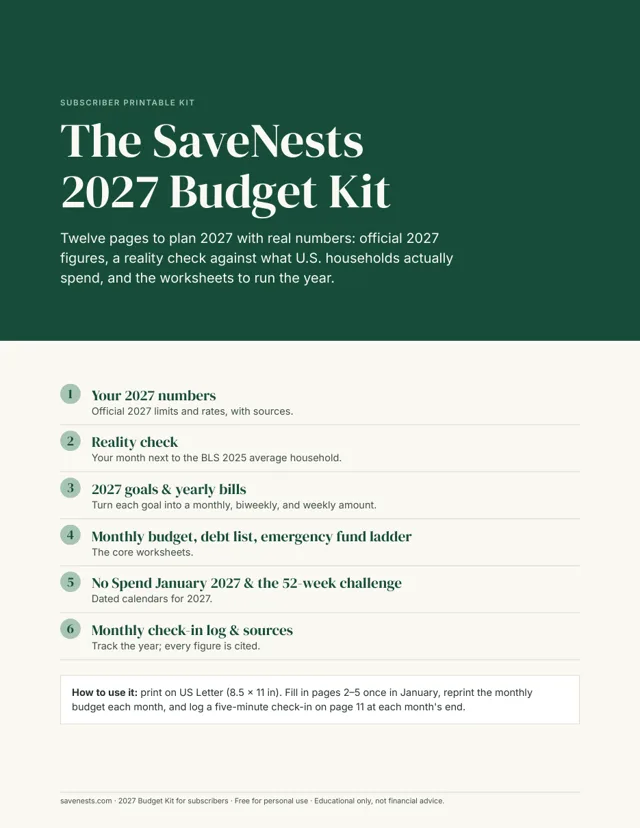
A 12-page printable PDF: official 2027 numbers (HSA limits, the 3.6% COLA), your month next to the BLS average household, goals and yearly bills, a monthly budget, a debt list, an emergency fund ladder, a No Spend January 2027 calendar, and dated 52-week challenge charts. Every figure is cited.