If you have three budgeting apps, two half-filled templates, and still feel surprised by the power bill, the problem is not your personality. It is the missing sequence. A monthly budget checklist tells you what to check, in what order, on payday—so the money is assigned before the week starts spending it for you.
This guide is that sequence. It pairs with the free monthly budget checklist printable on this site (blank lines, no fake sample numbers). The numbers below come from Federal Reserve, CFPB, and BLS sources. If the month already cannot cover rent and groceries, start with How to Create a Budget When Money Is Tight first, then come back here for the recurring payday pass.
The short answer
On payday (or the night before), run six checks: write the take-home pay that will actually arrive, list every bill due before the next payday with its due date, set food and transport dollars, set aside money for irregular bills you can see coming, give every leftover dollar a named job, then spend ten minutes comparing last period's plan to what really left the account. Repeat weekly for a shorter check-in. Print the list if paper helps you finish it.
- Income: take-home deposits you can count on for this pay cycle.
- Bills due before next payday: amount, due date, and which account pays.
- Food and transport: a realistic number from recent weeks, not an aspirational zero.
- Irregular set-asides: car registration, insurance, holidays—monthly slices of known bills.
- Leftover jobs: buffer, debt extra, sinking fund, or a small fun line—named, not "misc."
- Look back: what overran, what underspent, one adjustment for next cycle.
Why a checklist beats a blank sheet
Blank budgets invite optimism. Checklists force due dates. In the Federal Reserve's Survey of Household Economics and Decisionmaking (SHED) for 2025 (released May 2026), 16 percent of adults did not pay all their bills in full in the prior month, and 28 percent either missed a bill or had difficulty paying. Among people who struggled with bills, 42 percent paid at least one bill late and 48 percent cut other spending to cope. A payday checklist will not raise your income. It does make late fees and "I forgot that was due" less common.
The same survey found 59 percent of adults had at least one major unexpected expense in the prior year—most often a vehicle repair (30 percent), a house or appliance repair (22 percent), or a medical surprise (21 percent). Those shocks are why the checklist also includes a small buffer line and irregular set-asides, not just rent and streaming. Sixty-three percent of adults said they could cover a $400 emergency with cash or its equivalent; that still leaves 37 percent who could not. The checklist is how you start building that margin on purpose.
- Did not pay all bills in full (prior month)16%
- Struggled with bills (missed or difficult)28%
- Could cover $400 with cash or equivalent63%
- Had a major unexpected expense (past year)59%
Board of Governors of the Federal Reserve System, Economic Well-Being of U.S. Households in 2025 (May 2026).
Step 1: Income that will actually arrive
Write take-home pay—the deposit after taxes and paycheck deductions—not the salary on a job offer. If you are paid biweekly, plan this paycheck, not a fictional "monthly" average that smooths away the short weeks. For the full two-check routine and the 2027 three-paycheck months, see How to Budget Biweekly Paychecks. If income is uneven, use a conservative number you have actually received recently, then treat extras as a bonus with a job. Tips, overtime, and side gigs count only when they are already in the account or contractually due this cycle.
- List each expected deposit and the date it hits.
- Ignore money that might arrive. Plan the money that will.
- If two people share bills, write both take-home amounts on the same page so the bills have one total to draw from.
Step 2: Bills due before the next payday
Open your bank and card apps and pull the next 14 to 16 days of due dates—not the whole year. Rent or mortgage, utilities, phone, insurance premiums, minimum debt payments, childcare, and any subscription that renews before you are paid again. Write the due date next to each amount. A bill due three days after payday is a different problem from one due the day before.
The CFPB's Bill Calendar (part of the Your Money, Your Goals toolkit) is built for this: list bills, mark payment dates, and see which weeks are heavy. Our free bill organizer is a simpler blank table (bill, due date, amount, account). Either works. The point is visibility before the autopay surprise.
- Match messy merchant names on the statement to the real service.
- Include annual or quarterly bills only if a payment falls in this cycle—or if you are funding the monthly set-aside (next step).
- If a due date sits on the wrong side of payday, ask the biller whether you can move it. Many utilities and lenders will shift a due date once.
Step 3: Food and transport
These two lines break more beginner budgets than "entertainment" does, because people write a heroic grocery number and a gas number from a calm week. Look at the last two to four weeks of real spending. Round to a number you can live with, not a number that only works if nobody gets hungry or needs to get to work.
Context, not a target: grocery (food-at-home) prices were up 1.8 percent over the 12 months through September 2026 (BLS), while food away from home was up 3.5 percent. If takeout is the leak, give it a small named line instead of pretending it is zero.
- Groceries + household staples: one number for the pay cycle.
- Eating out / delivery: a capped line, even if it is small.
- Gas, transit, parking: based on the weeks you actually work and commute.
Step 4: Irregular bills you can see coming
Car registration, an insurance premium due twice a year, back-to-school, birthdays, and the holidays are not surprises. They are known bills on a slow schedule. Divide each yearly (or quarterly) cost by the months until it is due, and treat that slice as a line on this paycheck. That is a sinking fund.
In November and December, the holiday fund is usually the biggest irregular line. Size Thanksgiving food with a per-person number (Thanksgiving on a Budget uses the AFBF classic dinner as a benchmark), and size gifts and December extras from the paychecks you have left (How to Budget for Christmas). Put those monthly slices on the checklist so December does not wipe out January.
Step 5: Give leftover dollars a job
Subtract bills, food, transport, and irregular set-asides from take-home. Whatever remains needs a name before the week invents one. Common jobs: starter buffer, extra debt payment, next sinking fund, or a small fun line so the plan is sustainable. "Misc" is how leftovers disappear.
If the subtraction goes negative, you do not need a prettier app. You need a tighter order of operations—needs and due dates first—covered in the tight-money guide linked above, or the cash-flow repair path in How to Stop Living Paycheck to Paycheck. The checklist still helps: it shows exactly which lines do not fit.
- First leftover job for most beginners: a $500–$1,000 cash buffer in separate insured savings.
- Next: extra toward high-interest balances once the buffer can catch a small shock.
- Keep a tiny fun line if it prevents a bigger blow-up mid-month.
Step 6: A ten-minute look back
Before you lock next cycle's numbers, compare plan versus actual for the period that just ended. Which line overran? Which underspent? Change one number, not twelve. The look-back is where a checklist becomes a budget instead of a wish list.
- Open the last pay cycle's checklist or calculator totals.
- Mark overruns and the reason in a few words ("birthday dinner," "two fill-ups," "late fee").
- Carry forward one adjustment: raise food $20, cut delivery, move a due date, or raise the buffer transfer.
- Confirm savings and debt extras actually left the account.
Worked illustration (labeled)
The dollars below are an illustration for teaching the checklist order—not a claim about a real household or a promise of results. Swap in your take-home and bills.
| Checklist line | Amount |
|---|---|
| Take-home deposit (this paycheck) | $1,600 |
| Rent share / housing due this cycle | $700 |
| Utilities + phone + insurance minimums | $180 |
| Debt minimums | $120 |
| Groceries + household | $220 |
| Transport (gas/transit) | $70 |
| Eating out cap | $40 |
| Irregular set-aside (registration + holiday slice) | $60 |
| Buffer transfer | $50 |
| Leftover named (fun + misc buffer) | $160 |
| Total assigned | $1,600 |
Notice the order: housing and due bills before food, food before fun, irregular set-aside before "whatever is left." If rent were higher, the fun and buffer lines would shrink first—not the electric bill.
Weekly check-ins that keep the month honest
A full checklist on payday is enough for many people. If flexible categories tend to run hot, add a 10-minute weekly pass: update unrecorded spending, peek at bills due in the next seven days, and move money between flexible lines if groceries are fine but transport is short. You are steering, not restarting the whole plan.
Some households add cash stuffing for a few spending categories after the checklist; others prefer zero-based budgeting. The checklist works with both.
Printables and tools on this site
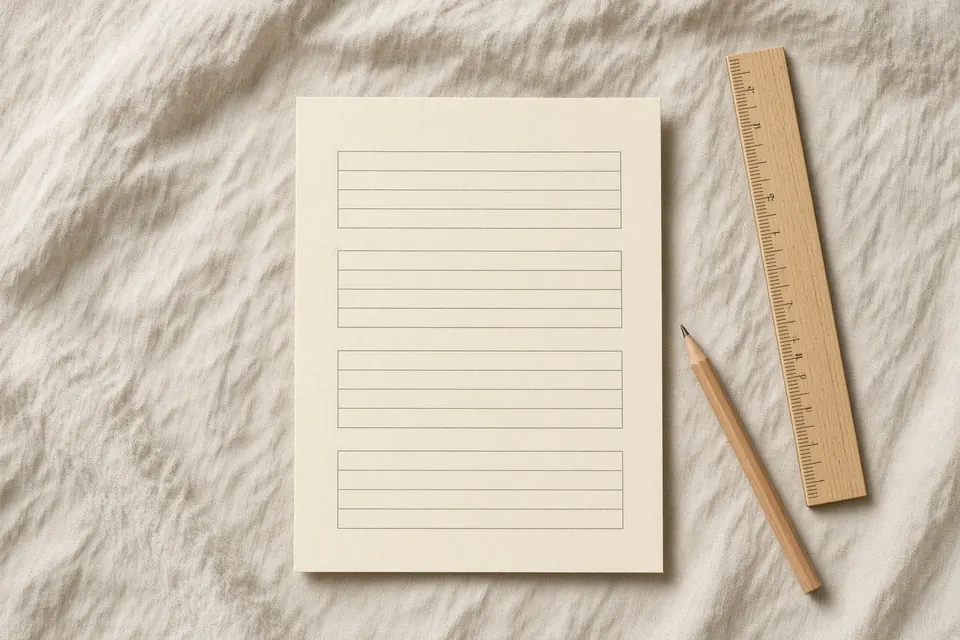
- Free monthly budget checklist: the seven-step payday list with blank lines.
- Bill organizer: bill, due date, amount, paying account.
- One-page budget printable: when you want a full sheet, not only a checklist.
- Monthly budget calculator: same math on screen; nothing you type is stored.
- More sheets in budget printables and beginner guides under budgeting.
Payday checklist (copy this)
- Write each take-home deposit and date.
- List bills due before next payday with amounts and due dates.
- Set food and transport from recent real weeks.
- Add irregular set-asides (known future bills ÷ months left).
- Subtract. Name every leftover dollar.
- Move the buffer / sinking-fund transfers the same day.
- Ten-minute look back from last cycle; change one number.
Do this on payday for two months before you decide you are "bad at budgeting." Most people who stick with the sequence find the anxiety drops even before the balances look impressive—because the due dates stopped being surprises.
Questions readers ask
What is a monthly budget checklist?
A monthly budget checklist is a short, ordered list of payday tasks: confirm take-home income, list bills due before the next pay, set food and transport, fund irregular set-asides, assign leftover dollars, and review the last cycle. It is a sequence, not a full spreadsheet.
How long should a beginner budget checklist take?
Plan 20 to 30 minutes on payday the first month, then about 15 minutes once the bill list is saved. Add a 10-minute weekly check-in if flexible categories often overrun.
Should I budget from gross pay or take-home pay?
Use take-home pay—the amount that actually lands in your account after taxes and paycheck deductions. Percentage rules like 50/30/20 are meant for after-tax income.
What if my bills are more than my paycheck?
The checklist still helps because it shows the gap in writing. Fund needs and due bills first, pause non-essentials, and use a tight-money order of operations. A checklist cannot create income, but it stops you from funding wants while utilities go unpaid.
How do irregular bills fit on a monthly checklist?
Turn them into sinking funds: divide the known bill by the months until it is due, and set aside that slice each payday. Car registration, insurance premiums, and holiday spending are common examples.
Do I need an app for a monthly budget checklist?
No. Paper or a simple notes app is enough. A free printable checklist and bill organizer work well; a calculator is optional for the arithmetic. Apps help only if you will open them on payday.
How often should I update my budget checklist?
Run the full pass every payday (or once a month if you are paid monthly). Do a short weekly review of flexible spending and upcoming due dates. Do a deeper look-back at month-end to adjust next month's numbers.
What is the difference between a budget checklist and a budget template?
A checklist is the order of tasks. A template or worksheet is the grid where numbers go. Use the checklist so you know what to fill in; use a one-page printable or calculator if you want every category on one sheet.
Sources
- Board of Governors of the Federal Reserve System, Economic Well-Being of U.S. Households in 2025 (SHED, May 2026)16% did not pay all bills in full; 28% struggled with bills; 42% of those who struggled paid a bill late; 59% had a major unexpected expense (vehicle 30%, house/appliance 22%, medical 21%); 63% would cover $400 with cash or equivalent.
- Federal Reserve, Economic Hardships chapter (SHED 2025)Bill-payment coping actions; unexpected expense medians often $1,000–$1,999 for vehicle, house/appliance, and medical shocks.
- Consumer Financial Protection Bureau, Bill Calendar (Your Money, Your Goals)Fillable bill calendar for listing bills, payment dates, and weekly income versus bill totals.
- Consumer Financial Protection Bureau, Spending tracker (Your Money, Your Goals)Worksheet for sorting recent spending before setting food and transport lines.
- U.S. Bureau of Labor Statistics, Consumer Price Index Summary (September 2026)Food at home +1.8% over 12 months; food away from home +3.5%; all-items CPI-U +3.7%.
Mohamed Ouhammouche
Mohamed Ouhammouche founded and runs SaveNests, a budgeting site that helps beginners build simple budgets. This guide was reviewed by the SaveNests Editorial Desk under the editorial and fact-checking policies.
Free for subscribers
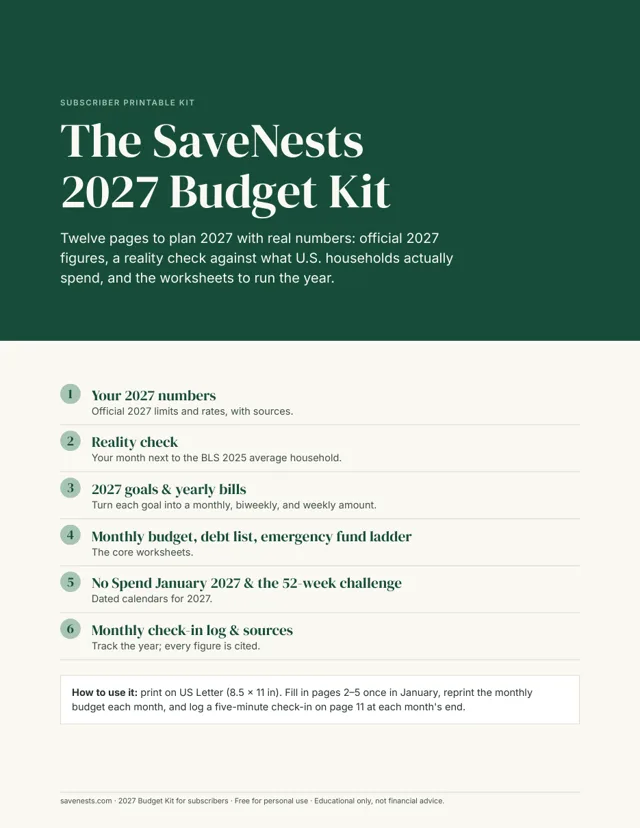
Get the 2027 Budget Kit
A 12-page printable PDF: official 2027 numbers (HSA limits, the 3.6% COLA), your month next to the BLS average household, goals and yearly bills, a monthly budget, a debt list, an emergency fund ladder, a No Spend January 2027 calendar, and dated 52-week challenge charts. Every figure is cited.